Items: 38
The likelihood of hot, dry, windy autumn weather that can set the stage for severe fires in California and western Oregon has increased 40% due to human-caused climate change, new computer models show.
Research led by OSU shows that fires are more likely to burn their way into national forests than out of them. The findings contradict the narrative of a destructive wildfire igniting on remote public land before spreading to threaten communities.
Human-caused wildfire ignitions in Central Oregon are expected to remain steady over the next four decades and lightning-caused ignitions are expected to decline.
The Columbia River basin will see an increase in flooding over the next 50 years as a result of climate change, new modeling from Oregon State University indicates.
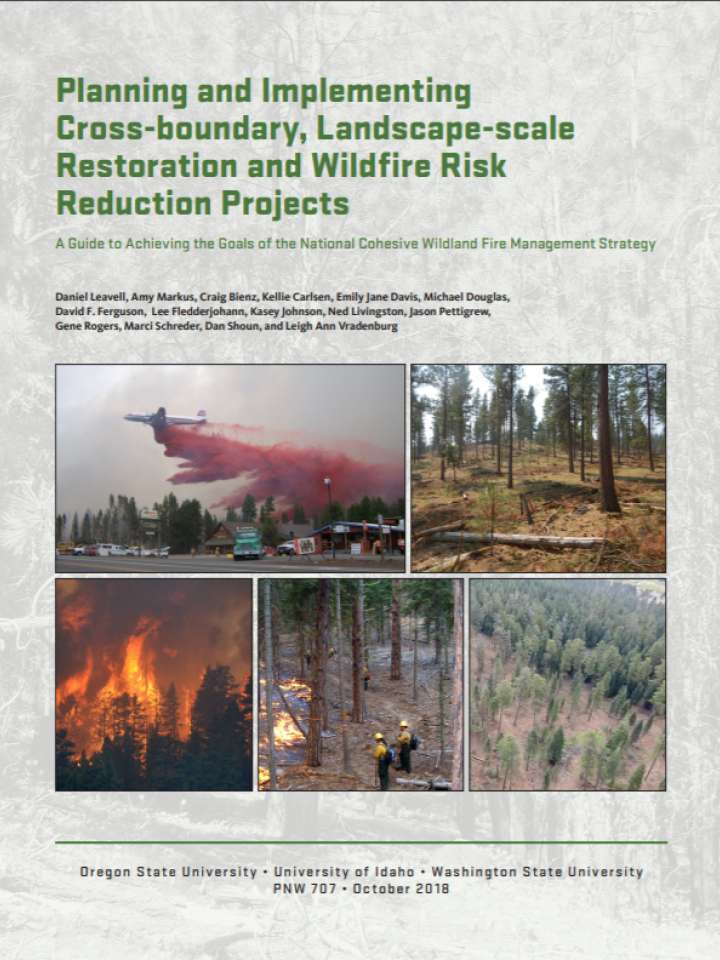
This guide describes the process of the Klamath-Lake Forest Partnership (KLFHP) has used to plan and implement cross-boundary restoration projects to achieve improved forest health conditions on large landscapes scales.
Disasters alone are not enough to motivate local communities to engage in climate change adaptation. Policy change depends on a combination of factors.
Oregon State University develops digital tool enabling land managers to adapt to wildfires through analytics guiding planning across jurisdictional boundaries.
Political affiliations, local environmental organizations and climate change media coverage molds community reactions to extreme weather events.
Voluntary Commitments
The organization has no registered commitments.
The Sendai Framework Voluntary Commitments (SFVC) online platform allows stakeholders to inform the public about their work on DRR. The SFVC online platform is a useful toolto know who is doing what and where for the implementation of the Sendai Framework, which could foster potential collaboration among stakeholders. All stakeholders (private sector, civil society organizations, academia, media, local governments, etc.) working on DRR can submit their commitments and report on their progress and deliverables.
Contact information
Fax:
+420 241760603