Mission
IFAD's mission is to enable poor rural people to overcome poverty. It is dedicated to eradicating rural poverty in developing countries. Working with rural poor people, governments, donors, non-governmental organizations and many other partners, IFAD focuses on country-specific solutions, which can involve increasing rural poor peoples' access to financial services, markets, technology, land and other natural resources.
1 IFAD's 12th replenishment period (2022-24) was committed to ensuring that at least 40% of IFAD resources are programmed as climate finance (validated as per the MDB methodologies). In 2024, IFAD managed to programme 54% of its resources as climate finance compared to 42% in 2023 taking IFAD 12 to 49%, well beyond the target.
IFAD's previous replenishment (2019-2021) programmed 35% of its programme of loans and grants as climate finance.
2 At COP 29, IFAD called for climate adaptation finance to be targeted to small-scale farmers who are the most exposed to the impacts of climate change.
IFAD also engaged in high-level discussions on methane reduction in food systems and launched a guidebook aimed to help developing countries incorporate methane reduction strategies in NDCs that was developed by IFAD under the Reducing Agricultural Methane Programme with the support of the Global Methane Hub and the U.S. State Department.
IFAD at COP 29: https://www.ifad.org/en/w/events/ifad-at-cop29
Practical Guide for Including Agricultural Methane Emission Reduction Targets in Nationally Determined Contributions: https://www.ifad.org/en/w/publications/a-practical-guide-for-including-agricultural-methane-emission-reduction-targets-in-nationally-determined-contributions
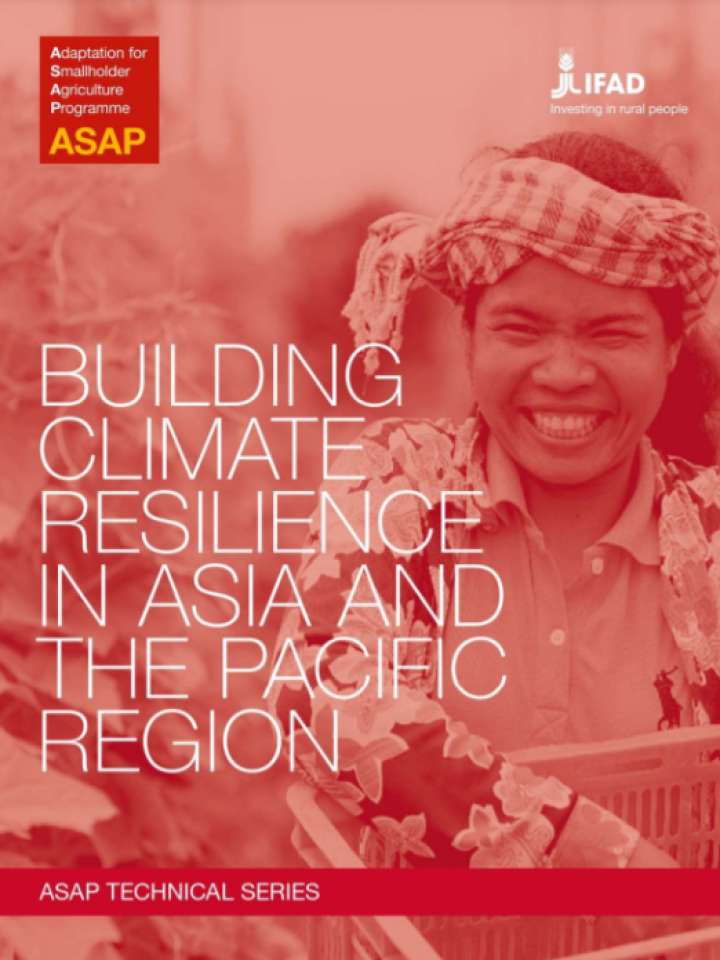
3 As at 2024, IFAD's Adaptation for Smallholder Agriculture Programme (ASAP) has shown the following results through its three phases (ASAP 1, ASAP 2 and ASAP +):
- Increased resilience for 6.9 million small-scale farmers
- Over 1 million hectares of land brought under climate-resilient practices
- USD 92.3 million in funding secured under ASAP + for a pipeline of 10 projects
4 Effective disaster risk reduction through enhanced data capabilities
IFAD and the European Space Agency (ESA) have stepped up their partnership to help vulnerable small-scale food producers increase their ability to grow food and adapt to climate change by using state-of-the-art spatial technology and data. The expanded partnership will see ESA's top-notch remote-sensing expertise and data incorporated into IFAD's agricultural programmes and project design, refining geographical targeting and monitoring natural resources, such as pastures, forests, water and soils, all of which are vital to the livelihoods of small-scale farmers and pastoralists.
Effective disaster risk reduction through enhanced data capabilities.
Climate Action Report 2024: https://www.ifad.org/en/w/publications/climate-action-report-2024
Voluntary Commitments
The Sendai Framework Voluntary Commitments (SFVC) online platform allows stakeholders to inform the public about their work on DRR. The SFVC online platform is a useful toolto know who is doing what and where for the implementation of the Sendai Framework, which could foster potential collaboration among stakeholders. All stakeholders (private sector, civil society organizations, academia, media, local governments, etc.) working on DRR can submit their commitments and report on their progress and deliverables.