Items: 45

This document describes efforts taken by the Indonesian government to restore peatland areas to reduce wildfire risk.
This report reviews the availability of data in Indonesia to report against the indicators recommended to measure the global targets of the Sendai Framework, and identify current gaps.
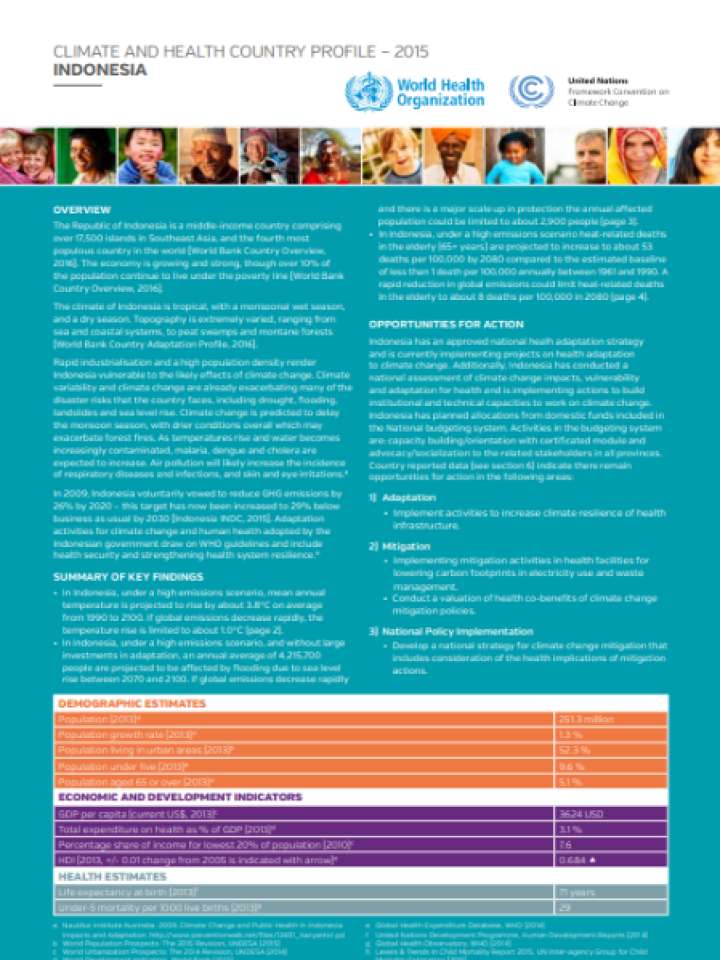
Indonesia has an approved national health adaptation strategy and is currently implementing projects on health adaptation to climate change. This report highlights the country's progress in its health adaptation programs.
The purpose of the preparation of the RAN-API is to produce a national action plan to adapt to the impacts of climate change, which is coordinated in an integrated manner with all the stakeholders involved.
This presidential regulation provides for the organization, functioning and activities of the National Disaster Management Agency of Indonesia.
The Global Thematic Consultation will build on the outcomes of the discussions at the 5th Asian Ministerial Conference on DRR in Yogyakarta, Indonesia on 22-25 October 2012 to take the discussion further on what aspects of DRR and how they should

This report describes country’s disaster risks and natural hazards, such as earthquake, tsunami, volcano, wildfire, landslide and flood, and presents governmental structures responsible for disaster management in Indonesia.
'Strengthening community resilience and reducing disaster risks are critical elements in promoting sustainable development. They must be part of the international development agenda beyond 2015, post-Hyogo Framework for Action and the Millennium Development Goals,' says Budi Adiputro, secretary general of the Indonesian Red Cross...
Voluntary Commitments
The organization has no registered commitments.
The Sendai Framework Voluntary Commitments (SFVC) online platform allows stakeholders to inform the public about their work on DRR. The SFVC online platform is a useful toolto know who is doing what and where for the implementation of the Sendai Framework, which could foster potential collaboration among stakeholders. All stakeholders (private sector, civil society organizations, academia, media, local governments, etc.) working on DRR can submit their commitments and report on their progress and deliverables.