
Items: 25

The Institute of Public Policy and Development (IPPD) commissioned The Economist Intelligence Unit (EIU) to produce an in-depth study that combines city-level resilience scores with qualitative insight from experts.
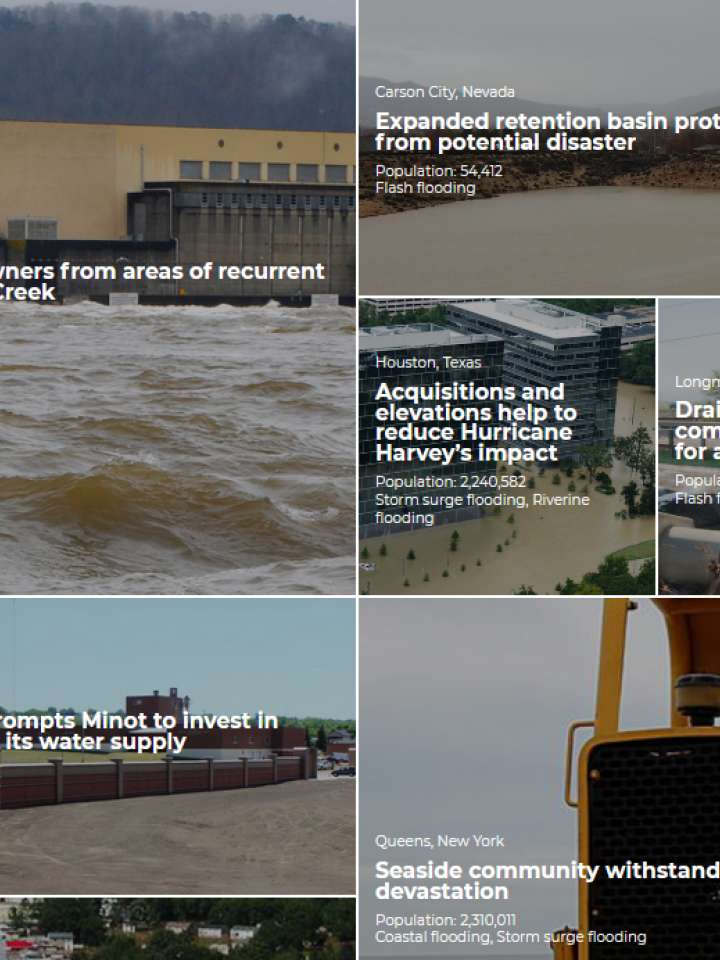
This analysis of 21 “flood loss avoidance studies” from around the country concludes that flood mitigation not only saves on the cost of repairs, but it also helps to revitalize neighbourhoods, increases public safety, and can reduce insurance pre
This report reviews the issues relating to climate-related financial disclosure and investigates the mandates of ten different international, EU and UK financial institutions to consider their roles in supporting climate-related financial risk rep

This report suggests that much of the impact of climate change on future assets will come through weaker growth and lower asset returns across the board.
Existing tsunami early warning systems cannot immediately predict whether a given earthquake will cause a tsunami and can often be too late to get people away from threatened coastlines. Current research is looking to harness data from the Global Navigation Satellite System to support the development of new tools for accurate tsunami prediction .
Population growth and globalization have accelerated the spread of infectious diseases. Quick and accurate data analytics that can pinpoint outbreaks and predict progression is key to fighting infectious diseases. New approaches include including mobile-phone tracking and data mining of search engines and social media.
From the use of satellite images and crowd-sourced mapping tools to predict and help prepare for disasters, to on-the-ground reports from drone footage, emergency responders, governments and non-government organisations (NGOs) are adopting data analytics as a critical tool to strengthen early warning systems and aid relief efforts in the aftermath of a disastrous event.
The Caribbean pioneered sovereign parametric insurance taken out by governments, not companies or households. Created in 2007, the Caribbean Catastrophe Risk Insurance Facility (CCRIF) has so far doled out $69m to places battered by storms, floods and earthquakes.
Voluntary Commitments
The organization has no registered commitments.
The Sendai Framework Voluntary Commitments (SFVC) online platform allows stakeholders to inform the public about their work on DRR. The SFVC online platform is a useful toolto know who is doing what and where for the implementation of the Sendai Framework, which could foster potential collaboration among stakeholders. All stakeholders (private sector, civil society organizations, academia, media, local governments, etc.) working on DRR can submit their commitments and report on their progress and deliverables.
Contact information
Fax:
+1-121-2963 1312