Playing with fire: Harnessing lava to build sustainable cities
When it comes to carbon emissions, there's no bigger foe than the building and construction sectors, which contribute at least a third of global greenhouse gases.
A new project suggests a novel solution, albeit one still quite theoretical: Lava.
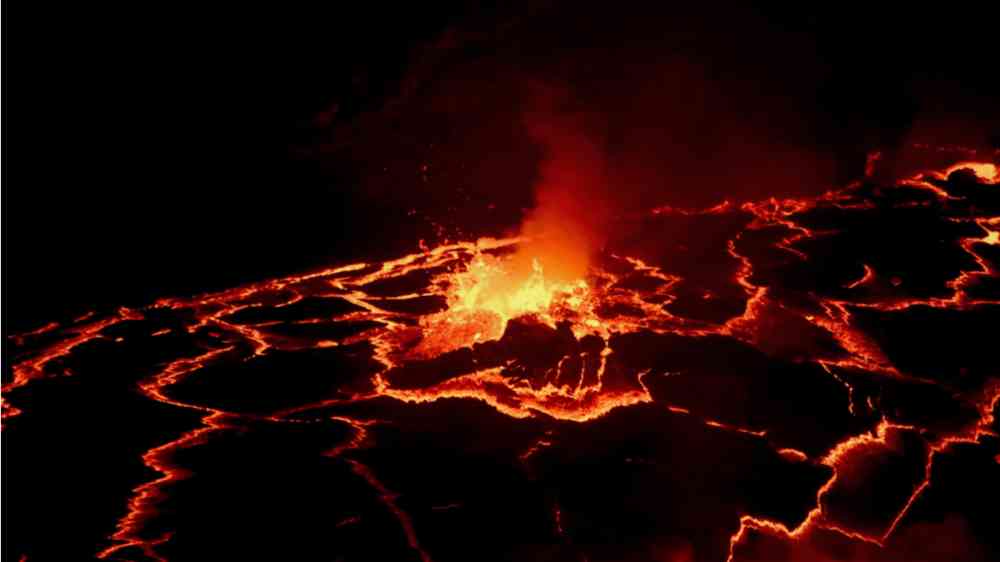
Over the past several months, the Volcanology Group at Lamont-Doherty Earth Observatory, led by Lamont research professor Einat Lev, had the opportunity to collaborate with a team of architects selected to exhibit at the Venice Biennale. (Lamont is part of Columbia University's Climate School.) The project, "Lavaforming," conceived by s.ap architects, imagines a future in which lava flows-like those regularly occurring on Iceland's Reykjanes Peninsula-can be harnessed and shaped into sustainable building materials for entire cities.
While the concept may seem futuristic, it is grounded in possibility: a rough estimate suggests that if just 10% of the lava that erupted during Iceland's 2021 Fagradalsfjall eruption were molded into structural elements, it could be used to build more than 10,000 three-story buildings-an extraordinary testament to lava's untapped potential as a construction material.
As part of this collaboration, Lamont's VICTOR team-creators of a cloud-based cyberinfrastructure for volcanology-worked closely with Lavaforming technologist Jack Armitage. The team used a suite of tools to simulate how lava might flow through and interact with the architectural forms of a hypothetical lava-molding facility. The simulations presented unique challenges, particularly due to the steep boundaries and narrow troughs envisioned in the design. Nevertheless, the team overcame these obstacles, helping to create science-informed animations that imagine an entire city built from shaped lava.
The VICTOR project offers the volcanology community a platform for performing simulations and other computations related to magmatic and volcanic processes, all within an environment that promotes open-source software and collaboration. In addition to modeling lava flows, the platform enables users to simulate a wide range of volcanic phenomena-such as the dispersal of gas and ash or the chemical evolution of magma within a volcano-and provides access to online datasets for topography, satellite imagery and other geospatial information.
Lavaforming is currently on view at the Icelandic Pavilion at the Biennale.