KADIN Indonesia introduces the business neighborhood resilience framework to strengthen disaster readiness
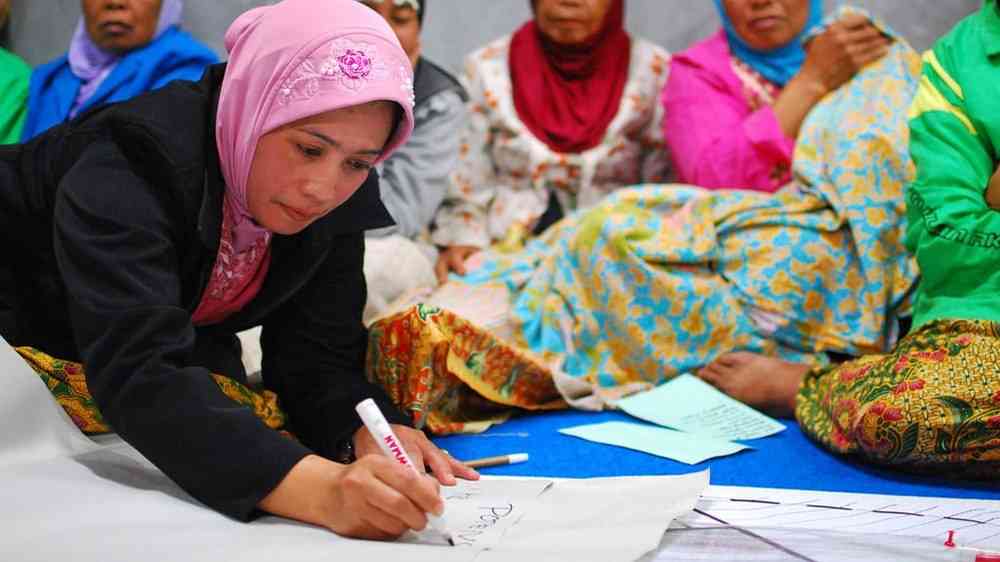
In Yogyakarta, Indonesia, women at a community meeting discuss the reconstruction of their village in the wake of the 2006 tsunami and earthquake.
Indonesia's businesses contribute nearly 60% to its GDP, particularly Micro-, Small, and Medium Enterprises (MSMEs). Yet, they remain highly vulnerable to natural disasters due to limited resources, lack of preparedness, and vulnerability to disruptions. Previous crises, such as the 2004 tsunami in Aceh and the 2018 earthquake in Lombok, highlighted the overwhelming impact on MSMEs. In these instances, many businesses struggled to recover, not because they lacked the will to rebuild, but because they didn't have the right tools, resources, or frameworks in place. For Indonesia to truly become disaster-resilient, it must address the preparedness and recovery needs of business sector. That's exactly what the Business Neighborhood Resilience Framework (BNRF) aims to do.
Spearheaded by the Indonesian Chamber of Commerce and Industry, KADIN (the CBi Member Network in the country), the BNRF is designed to strengthen business resilience across the country. Launched in October 2024, the BNRF is a practical tool to help businesses across Indonesia, especially MSMEs, prepare for and recover from the impact of disasters. Developed with input from key stakeholders such as the National Disaster Management Agency (known as BNPB), USAID-KUAT, World Vision Indonesia (WVI), Catholic Relief Services (CRS), and Miyamoto International, the framework outlines the steps businesses can take to safeguard their operations and recover more efficiently after a disaster strikes.
"Disaster resilience isn't just about government response. Businesses must be equipped to ensure they can continue operations, recover quickly, and help rebuild the economy. It's about a collective effort to strengthen every aspect of society." Suryani Motik, Vice Chairperson of KADIN's Division of Social and Disaster Management.
The BNRF focuses on four critical pillars that are designed to guide businesses through the entire cycle of disaster preparedness and recovery:
- Preparation: Helping businesses identify risks and create plans to mitigate them. This involves assessing potential threats and building strategies to reduce vulnerabilities.
- Business continuity: Ensuring essential functions remain operational during a crisis. This pillar focuses on securing core business processes and protecting key resources to maintain operations even during a disruption.
- Disaster response: Offering strategies to navigate disruptions and continue operations. This includes emergency response protocols that businesses can implement to minimize immediate damage and maintain critical services.
- Recovery: Supporting businesses in rebuilding and returning to full capacity post-disaster. The recovery pillar focuses on restoring operations, financial health, and long-term sustainability after a disaster event.
However, the road to developing such a framework has not been without its challenges. The private sector in Indonesia is diverse, with businesses of varying sizes and industries, each with its own unique needs. This has made it difficult to create a one-size-fits-all solution. To ensure the BNRF addresses these needs effectively, KADIN consulted with a broad range of businesses across multiple provinces. The feedback gathered from these consultations has been essential in shaping the final framework.
Many business owners expressed enthusiasm about the framework's potential to raise awareness and prepare them for future disasters. They particularly appreciated the focus on post-disaster recovery. However, some also noted that the draft document was difficult to understand, with technical language that could be inaccessible to small business owners. KADIN is currently revising the document to simplify the language and make it more user-friendly, ensuring that it is accessible to all businesses, regardless of size.
What makes initiatives like the BNRF so important is that they acknowledge the reality that disaster recovery cannot be achieved by the government alone. Businesses, including MSMEs, must play an active role in ensuring their own survival and contributing to the recovery of their communities. When businesses recover quickly, the entire economy benefits. The BNRF is a step in the right direction, offering businesses the tools they need to survive, recover, and ultimately help Indonesia become more resilient in the face of future disasters.
The next phase of this initiative will involve extensive outreach to KADIN's business network, the BNPB, and other disaster-focused communities throughout Indonesia. The goal is to ensure that the BNRF reaches as many businesses as possible, helping them better prepare for whatever challenges lie ahead. With the right tools, there's no reason Indonesia's businesses couldn't do more than survive but thrive, today and in the future.