Summary
Melissa was one of the most powerful landfalling hurricanes ever recorded. The IRIS model estimates that climate change increased the intensity of a hurricane of the type of “Melissa” to an exceptional Category 5 at landfall. A “Melissa” type hurricane at landfall is about four times more likely in the 2025 climate compared to a pre-industrial baseline. This event was unlikely without climate change.
Hurricane Melissa was Category 5 with a life-time minimum pressure of 892 hPa, making it one of the strongest storms ever recorded. Melissa was an exceptionally strong Category 5 hurricane at landfall in Jamaica on the 28th of October 2025. The IRIS model (Sparks and Toumi, 2024) can be used to infer the additional strengthening of a “Melissa” type storm that can be attributed to recent warming or more specifically to recent changes in potential intensity (PI). We first need to consider the change in the thermodynamic environment. There has been a recent global warming of about 0.2°C/decade putting the 2025 global mean temperature close to about 1.3°C above pre-industrial temperature_._ ERA5 reanalysis is used to calculate monthly mean PI fields between 1980 and 2024. We consider global warming to manifest itself differently with latitude. We have low confidence in attributing regional or longitude trends to global or anthropogenic warming. The regional changes are more likely to be caused by decadal variations and less likely to be sustained or representative of global warming.
To calculate the PI field in any given year we apply the corresponding monthly (October) global zonal mean trend to the 1980-2024 monthly mean PI field. In this way we can estimate the regressed anomalous PI field in any month since industrialisation and scale this by the simultaneous global mean surface temperature. This regressed value is not the actual PI now but that portion due to a linear change since 1980. The pre-industrial state is equivalent to the global mean surface temperature of the 1950s. The pre-industrial value of PI is determined by regressing ERA5 backwards in time.
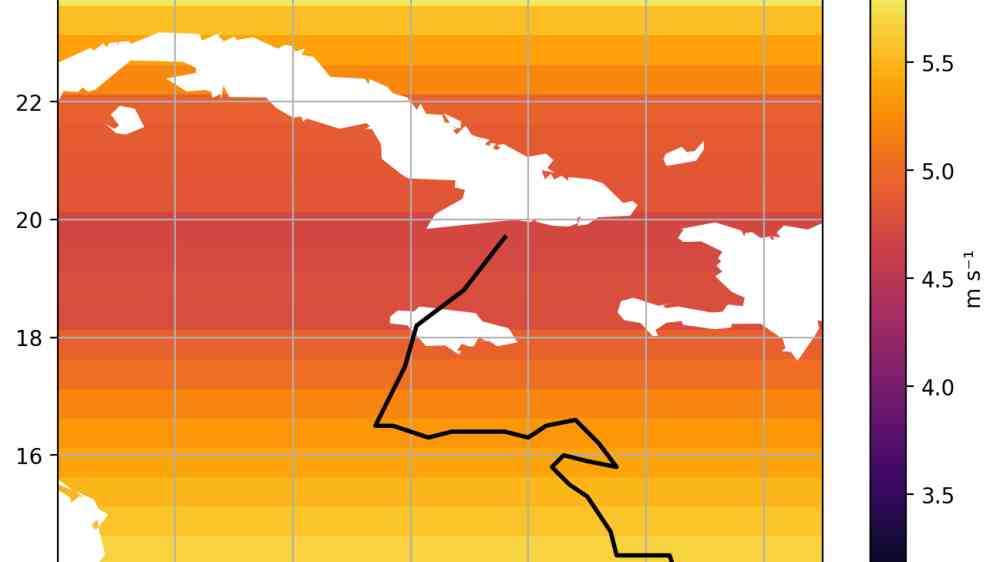
Figure 1 shows the zonal mean difference in October PI between 2025 and the pre-industrial estimate. There are large trends in the tropics which decline towards the subtropics and then increase again at larger latitudes. This meridional structure is interesting and is different to the SST trends which tend to gradually increase from the tropics to higher latitude. The difference in pattern between PI and SST is caused by the important role of moisture trends. The PI difference between 2025 and pre-industrial is about +5-6 m/s in the Caribbean.
The frequency of landfall is the next consideration. The IRIS model does not change the number of events in the Caribbean, only the initial life-time maximum intensity is modified by the PI. The tracks in IRIS are generated as deviations of the observed/historical “parent tracks”. This method does convert many historic “near misses” to then enter the region of interest.
Maximum wind speed at landfall
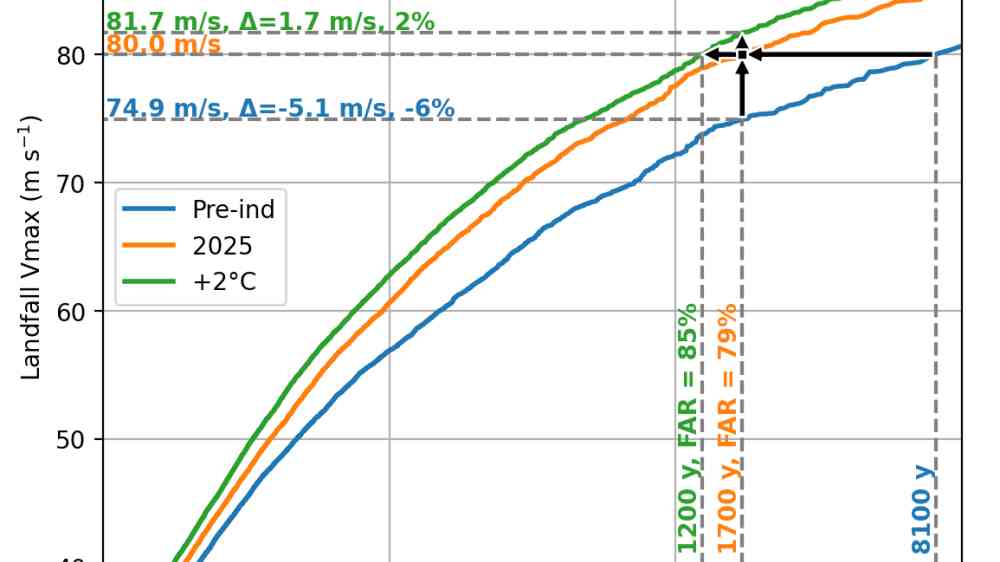
Figure 2. shows the model return period plot for hurricane landfall wind speeds in Jamaica. In the case of Melissa, a Category 5 at landfall, we estimate that this type of event was about 4 times more likely compared to pre-industrial times. The return period has decreased from 8100 yrs to 1700 yrs. For the same return period the current wind speed compared to pre-industrial events has increased by 5.3 m/s or 7%. In a +2°C degree warmer world, the landfall wind speed increases by a further +2.1 m/s compared to the current climate (+1.3°C).
In the climate change attribution literature the fractional attributable risk, FAR, is frequently used. FAR is here defined as
FAR = (Pnow - PPre-Ind) / Pnow (1)
where Pnow and PPre-Ind are the probabilities of an event of the minimum intensity for the current (now) and pre-industrial (Pre-Ind) climate respectively. The FAR for “Melissa ” type is 0.79. This means that at least 79% of the likelihood of this type of event can be attributed to climate change. It is unlikely that Melissa would have happened without climate change.
Attributing direct economic damage
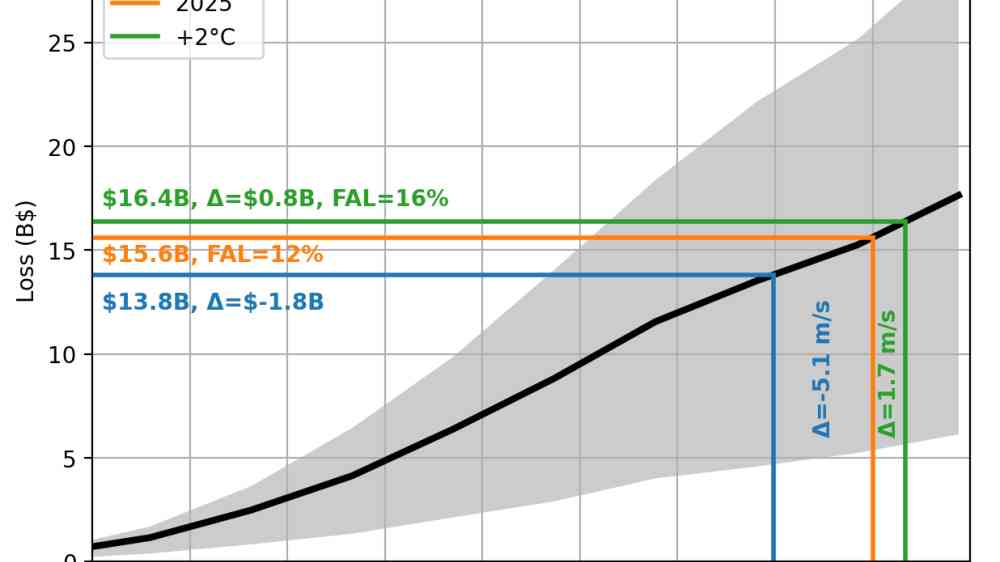
We are using IRIS to make an estimate of direct economic damage (loss) on physical assets. We have combined IRIS wind fields with a single damage function (Eberenz et al. 2021) and 10 km gridded exposure adjusted for population growth and inflation (Eberenz et al. 2020). For the damage function we apply a minimum wind threshold for damage of 25.7 m/s and a half-damage wind speed of 74.7 m/s. We create a loss against intensity curve by calculating the damage for many stochastic TCs following the track of Melissa. We then apply the landfall wind speeds for pre-industrial and current (+1.3°C) conditions and for a +2 °C world (compared to pre-industrial) to the loss curve to estimate the damages. Wind is used as a proxy for tropical cyclone hazard, the damage function and calibration indirectly account for sub-perils such as storm surges and rainfall.
Figure 3 shows the economic damages estimated with variations of intensity, size and different landfall locations centred on the track. We find the wind speed increase of this type of storm makes substantially more damage. The pre-industrial climate scenario is a counterfactual with the current exposure and vulnerability. To communicate the effect of climate change on loss we propose a new variable: the fractional attributable loss, FAL. It is defined as
FAL = (Lnow-LPre-Ind)/Lnow (2)
where L is the economic loss for the current (now) and pre-industrial climate (Pre-Ind).
For the median loss we estimate the FAL for “Melissa” is 0.12 because of the climate change driven intensification. This means 12% of the economic damage can be attributed to climate change compared to the pre-industrial baseline. We made many sensitivity studies and concluded that we can be much more confident in the estimate of the fractionable attributable loss than the absolute loss estimate. The FAL estimate is stable with a range of only 0.9-0.15 even for a factor of nearly 5 in the range (25-75%tile) of the losses (Fig 3.). The future additional loss in a +2°C degree warmer world is an additional +4% from the current damages compared to pre-industrial climate. It is important to note that the damage is already calculated as nearly complete for the area affected by Melissa so further damage under future warming is limited. These calculations are also uncertain as the Jamaica damage function we use is not tested at these extreme winds.