
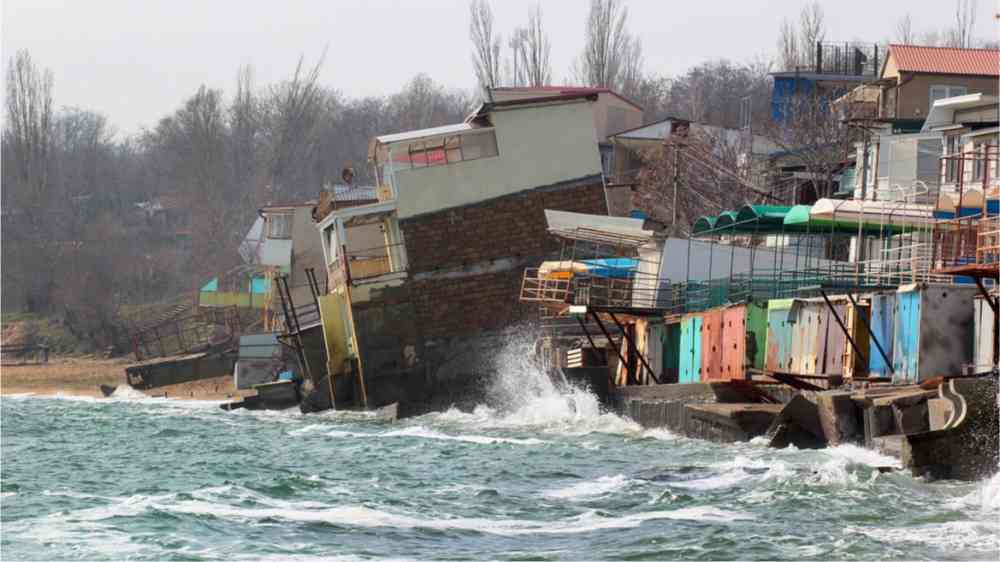
More than 2 billion people live within 50km of a coastline and are extremely vulnerable to climate hazards such as excessive rainfall and flooding.
An audio recording is available in the source article
Transcript:
According to a new study, one of the first estimates of sea level rise made by the UN’s Intergovernmental Panel on Climate Change closely matches what actually happened over the past 30 years.
Törnqvist: “What we found was that they did remarkably well.”
That’s Torbjörn Törnqvist of Tulane University.
In the nineties, the IPCC released a report with different scenarios for carbon emissions and what each would mean for global sea level rise.
Törnqvist’s study found that real-world emissions have closely tracked one of the report’s middle-of-the-road scenarios.
And global sea levels have risen about nine centimeters – very close to the eight predicted by the U.N. report.
Those early predictions were made without today’s advanced computer models, and they over- or underestimated the impacts of some drivers of sea level rise.
But Törnqvist says it shows that even 30 years ago, scientists understood the fundamentals of climate change.
Törnqvist: “I find it hard to think of any other form of evidence that is more compelling to demonstrate that this is happening, it has been happening for a long time, and we know why, and we understand it, and we can make credible projections.”
Related video: Understanding sea level rise: An expert explains
Even small increments in sea level can lead to significant coastal retreat and an increase in the frequency of coastal flooding events. In this video, Tom Mortlock, Senior Catastrophe Research Analyst at Aon and Adjunct Fellow at the UNSW Climate Change Research Centre, Sydney, delves into the critical issues of sea level rise and its far-reaching impacts on coastal regions.