1. Home
  2. Knowledge Base | PreventionWeb
  3. Themes

Health and health facilities

Capacity of health systems to anticipate, mitigate and manage situations arising from natural and man-made hazards, including biological hazards.

Across Jordan, Iraq, and Lebanon, a joint UN programme is already delivering results by strengthening migrant-inclusive health systems through a single, coordinated approach.

Latest Health & health facilities additions in the Knowledge Base

Uploaded on
Update

An analysis of surveillance data on cold-related illnesses from the past five years by the Korea Disease Control and Prevention Agency (KDCA) revealed that more than half of the cases occurred in adults aged 60 and over.

DongA Science (DAS)
Update

By 2050, climate change could contribute to 14.5 million additional deaths, $12.5 trillion in economic losses and $1.1 trillion in extra healthcare costs. Health adaptation makes the conversation about climate change real and urgent in the here and now.

World Economic Forum (WEF)
Research briefs

Exposure to wildfire smoke during the final months of pregnancy may raise the risk that a child is later diagnosed with autism, according to a new study led by Tulane University researchers.

Tulane University
Research briefs

A new analysis of air quality data from the past 70 years shows that Canada’s record wildfire smoke in 2023 is part of a broader, continent-wide trend toward smokier skies across North America.

Columbia Climate School
Border Roads Organization clear the road to Leh affected by landslide on August 29, 2012 in Manali, India. Landslides are regular phenomenon of this high altitude region.
Research briefs

The longer term mental health impacts are also deeply troubling. Akhila et al. (2025) describe how the communities were left in a constant state of fear of a repeat of the event.

Eos - AGU
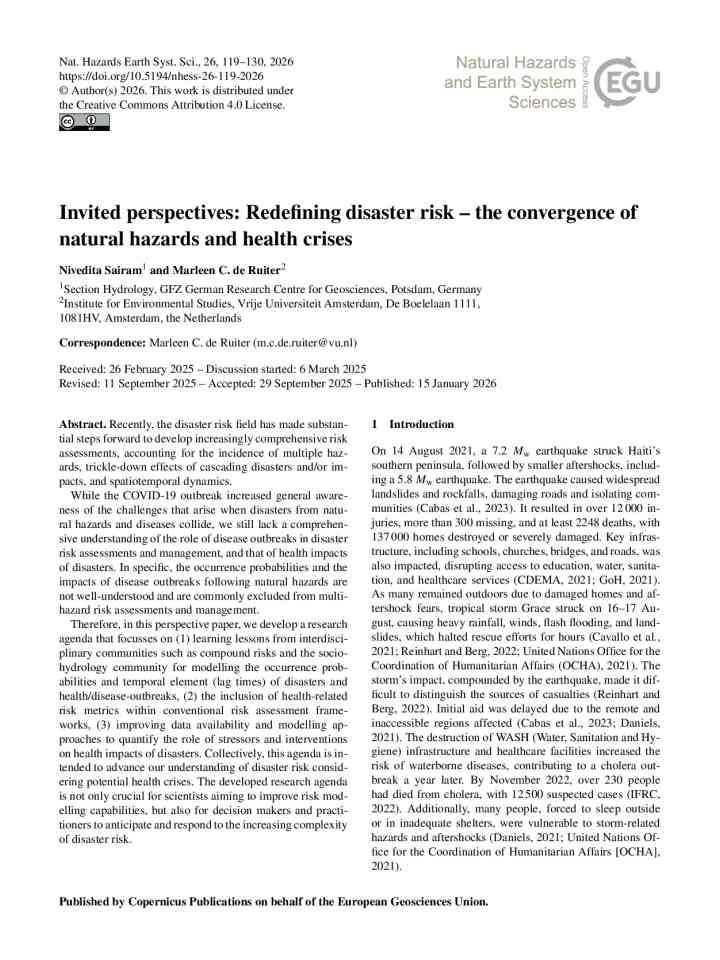
Invited perspectives: Redefining disaster risk – the convergence of natural hazards and health crises thumbnail
Documents and publications

This perspective paper develops a research agenda which is intended to advance our understanding of disaster risk considering potential health crises.

Natural Hazards and Earth System Sciences, the
Research briefs

Climate change is reducing the nutritional quality of everyday foods and disrupting supplies, increasing health risks for vulnerable communities. UC Irvine experts say supplements may help fill gaps but are no substitute for broader food‑system solutions.

University of California, Irvine
Update

The article urges reforms to track long‑term disaster impacts, strengthen healthcare systems, improve housing recovery, and build resilient communities, noting that extreme weather leaves lasting physical, mental, and social health effects.

Federation of American Scientists
Uploaded on