1. Home
  2. Knowledge Base | PreventionWeb
  3. Themes

Community-based DRR

This approach engages the local community, including the most vulnerable, in managing local disaster risk with community specific risk reduction measures while recognizing existing capacities and coping mechanisms. This includes community assessments of hazards, vulnerabilities and capacities, and their involvement in planning, implementation, monitoring and evaluation of local action for disaster risk reduction. Community-based DRR is a key disaster risk management approach.

Latest Community-based DRR additions in the Knowledge Base

Uploaded on
A Practical training manual to help communities deliver nature-based solutions for urban resilience in the Congo basin thumbnail
Documents and publications

This manual is designed to train communities and local governments, making these practices accessible, scalable, and adaptable to local contexts.

Global Center on Adaptation
Update

Citizen science blends community knowledge with digital tools to fill data gaps, improve environmental monitoring, and support better policymaking. It empowers local people, boosts inclusivity, and strengthens climate and water‑management decisions.

International Water Management Institute (IWMI)
Participatory forensic investigations of disasters (PARFORIN): including people in collective disaster risk analysis through social cartography thumbnail
Documents and publications

The Forensic Investigations of Disasters (FORIN) guide provides important approaches for research and extension purposes in order to understand and reduce disaster risks.

Centro Nacional de Monitoramento e Alerta de Desastres Naturais (CEMADEN)
Universidade Estadual Paulista "Júlio de Mesquita Filho"
Measure resilience to unlock local-level DRR solutions
Michael Szönyi Mamadou Ndong Touré Gabriel Reyes
A resilience measurement framework, adaptable to any community and proven in its effectiveness, has the potential to address some of the most common challenges.
Building disaster resilient communities through women’s leadership thumbnail
Documents and publications

This research identifies the barriers preventing women’s participation and leadership in DPR and assesses how women’s participation and leadership strengthen overall community resilience to disasters caused by natural hazards.

Oxfam International Secretariat
ijdscr202610024.pdf thumbnail
Documents and publications

The study evaluates the PHEDM model in two Uttarakhand villages, showing that community‑level training and structured risk assessment significantly improved disaster preparedness, adaptive capacity and emergency response compared with the control village.

International Journal of Disaster Studies and Climate Resilience (IJDSCR)
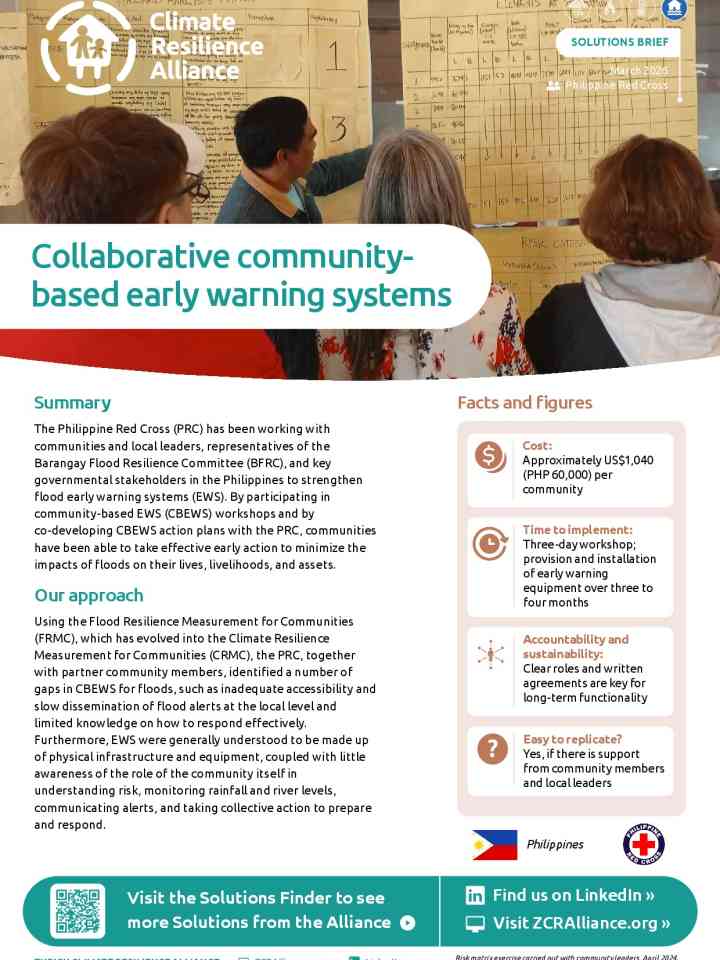
Collaborative community-based early warning systems – Solutions brief thumbnail
Documents and publications

The brief highlights how the Philippine Red Cross has partnered with communities, local leaders, members of Barangay Flood Resilience Committees, and key government stakeholders to strengthen flood early warning systems in the Philippines.

Zurich Climate Resilience Alliance
Cover
Educational materials

This education booklet was produced in the context of the RAHAT project which focuses on extreme heat vulnerability in informal housing in Jodhpur, western India, where climate change is intensifying temperature extremes.

University of Cambridge
Uploaded on