1. Home
  2. Knowledge Base | PreventionWeb
  3. Hazards

Avalanche

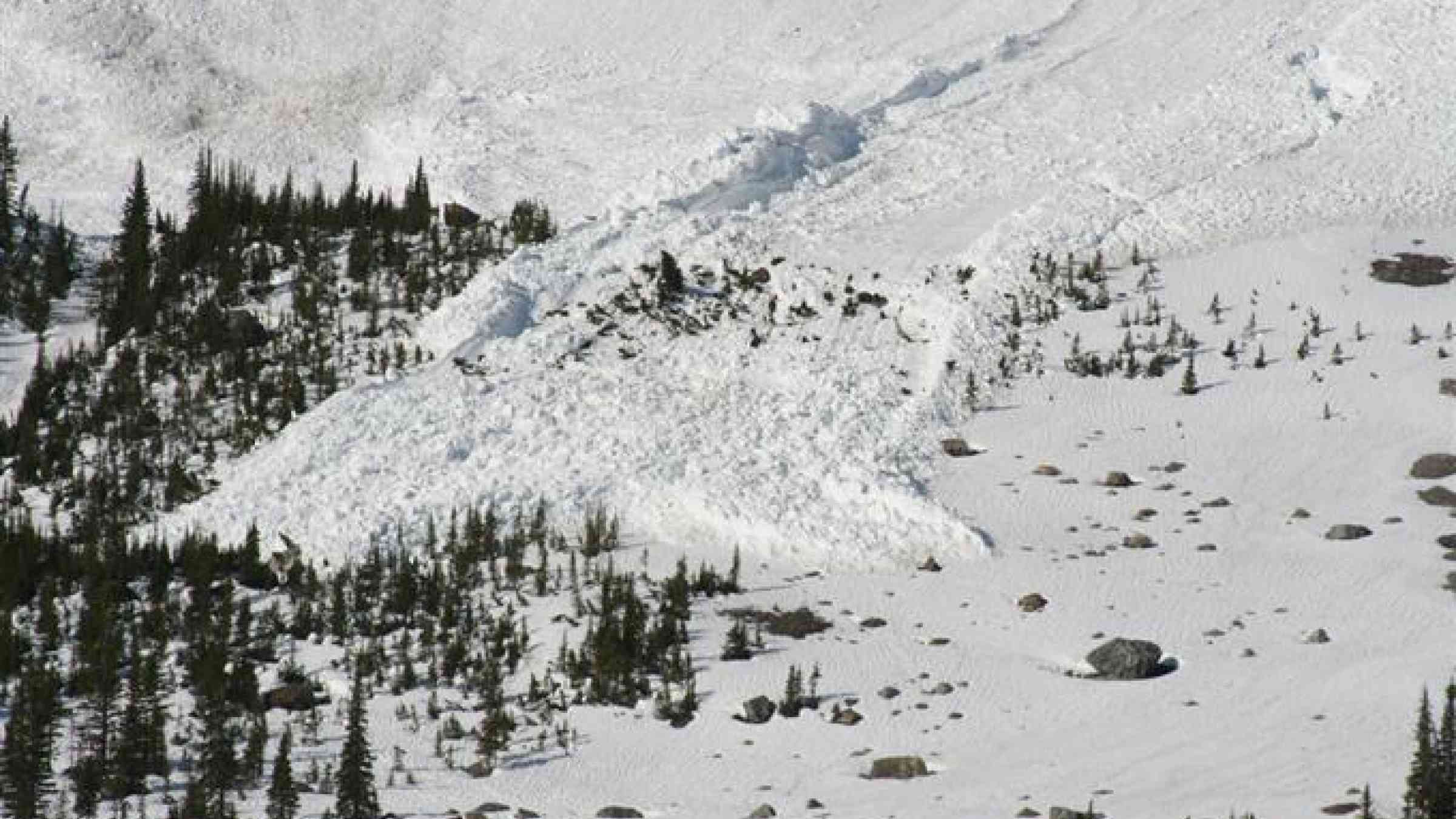
An avalanche is a mass of snow and ice falling suddenly down a mountain slope and often taking with it earth, rocks and rubble of every description (WMO, 1992).

Thousands of avalanches occur every year, killing an average of 500 people worldwide. Avalanches occur when massive slabs of snow break loose from a mountainside and shatter like broken glass as they race downhill. These moving masses can reach speeds of 130 km/hour within about five seconds. They cannot always be predicted but the weather conditions, which make them more likely, can be forecast in advance. Most accidents now occur because people ignore warnings. The majority of avalanche incidents are due to slab avalanches with skiers involved. Avalanches are bigger, travel greater distances and are triggered earlier in the year. These changes can be attributed clearly to rising temperatures, which have reached 0.2 to 0.4 degrees annually in some parts of the Himalayas.

New simulations can improve avalanche forecasting.

Avalanche protection and control measures include early warning which is key (EAWS). By way of controlled explosions, artificial avalanche triggering aims temporarily to safeguard possible starting zones (SLF). Defensive structures prevent the formation of avalanches. In order circumstances, when an avalanche is released, it can be diverted or intercepted by a dam. Other means of protection against avalanches include physical structures for buildings and snow sheds (SLF).

Avalanche risk factors

  • Quick changes in weather, snowpack and terrain.
  • Increasing human populations: winter sports lovers at ski resorts and developers building in vulnerable locations.
  • Climate change.

Vulnerable areas

  • Human settlements in avalanche-prone zones.
  • Rural mountainous villages with no early warning systems.
  • Human settlements with no forest cover.
  • Skiing populations and tourists not educated in avalanche risk.

Risk reduction measures

  • Not constructing buildings, roads, etc. in avalanche hazard areas.
  • Early warning systems at local and national levels.
  • Information on avalanches, their impacts and risks for tourism information offices.
  • Tree planting to protect against the release of avalanches.
  • Building codes and appropriate materials to reinforce resilience.
  • Raising awareness, educating and training residents and visitors on what to do before, during and after an avalanche.

Latest Avalanche additions in the Knowledge Base

Uploaded on
Photo by Flickr user freekstreet on CC BY-NC-ND 2.0
Update

Avalanches kill far more people on the Norwegian arctic island archipelago of Svalbard than polar bears ever have. Researchers are working on ways to improve avalanche prediction and protection. Understanding the forces the snow exerts before it slides away in an avalanche can help inform decisions on the construction of protective structures to prevent avalanches from happening.

Norwegian University of Science and Technology
Update

A team of researchers have developed a new model that describes how slab avalanches release. The new model opens a promising prospect for improving avalanche forecasting by combining traditional stability indices with a new index that quantifies the likelihood for cracks to propagate. In the long run, it will allow improving avalanche forecasting.

Ecole Polytechnique Fédérale de Lausanne
Update

Scientists say that climate change is another reason that snow slides are becoming more common, based on a number of research findings. A study found that recent changes in climate affected the quality of mountain snow cover which has led to more frequent and severe avalanches.

Washington Post, the
Photo by Flickr user Jonas Bengtsson CC BY-2.0
Update

Research suggests avalanche forecasts have an 80 percent accuracy rate but human activity is a huge and unpredictable factor. People travelling in the backcountry usually understand avalanche forecasts and know how to read the terrain. However, there needs to be a better understanding of how they make decisions in a group, under different settings and different pressures.

New York Times, the
Photo by Flickr user Richard Giddins CC BY 2.0
Update

Researchers at the National Snow and Ice Data Center at the University of Colorado Boulder have developed a new application for laser-scanning (lidar) systems that maps potential avalanche. The researchers have been testing the technique at Arapahoe Basin where they help snow safety teams target their explosives placements.

University of Colorado
Photo by Flickr user Kiril Rusev CC BY-NC-ND 2.0
Update

A team of Chinese and European glaciologists fear that two recent Tibetan glacier collapses may be only the beginning and that the local herders will find themselves at greater risk of avalanches. While risk analysis is not always possible, the Tibetan government was notified of the likely collapse prior to the second event and herders were evacuated.

Sixth Tone - Shanghai Media Group
Documents and publications

This study compiles and analyses approaches to the assessment of direct costs and of losses caused by the disruption of production processes. It systemizes the methods used in different hazard communities, identifying similarities and differences, so that

Helmholtz Centre for Geosciences (GFZ)
United Nations Office for Disaster Risk Reduction (UNDRR)
Adelphi
Documents and publications

This paper describes the role of Uzhydomet, the Centre of Hydrometeorological Service of the Republic of Uzbekistan, in monitoring natural disasters and communicating risk to the relevant government bodies. The monitoring is performed by using satellite

Centre of Hydrometeorological Servise at Cabinet of Ministers (Uzhydromet)
Uploaded on