1. Home
  2. Knowledge Base | PreventionWeb
  3. Hazards

Avalanche

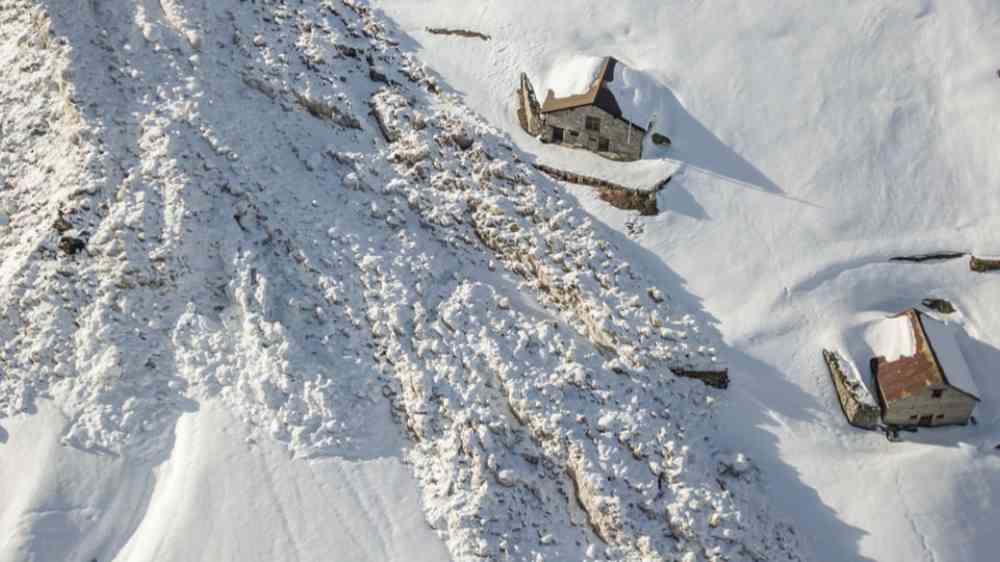
An avalanche is a mass of snow and ice falling suddenly down a mountain slope and often taking with it earth, rocks and rubble of every description (WMO, 1992).

Thousands of avalanches occur every year, killing an average of 500 people worldwide. Avalanches occur when massive slabs of snow break loose from a mountainside and shatter like broken glass as they race downhill. These moving masses can reach speeds of 130 km/hour within about five seconds. They cannot always be predicted but the weather conditions, which make them more likely, can be forecast in advance. Most accidents now occur because people ignore warnings. The majority of avalanche incidents are due to slab avalanches with skiers involved. Avalanches are bigger, travel greater distances and are triggered earlier in the year. These changes can be attributed clearly to rising temperatures, which have reached 0.2 to 0.4 degrees annually in some parts of the Himalayas.

New simulations can improve avalanche forecasting.

Avalanche protection and control measures include early warning which is key (EAWS). By way of controlled explosions, artificial avalanche triggering aims temporarily to safeguard possible starting zones (SLF). Defensive structures prevent the formation of avalanches. In order circumstances, when an avalanche is released, it can be diverted or intercepted by a dam. Other means of protection against avalanches include physical structures for buildings and snow sheds (SLF).

Avalanche risk factors

  • Quick changes in weather, snowpack and terrain.
  • Increasing human populations: winter sports lovers at ski resorts and developers building in vulnerable locations.
  • Climate change.

Vulnerable areas

  • Human settlements in avalanche-prone zones.
  • Rural mountainous villages with no early warning systems.
  • Human settlements with no forest cover.
  • Skiing populations and tourists not educated in avalanche risk.

Risk reduction measures

  • Not constructing buildings, roads, etc. in avalanche hazard areas.
  • Early warning systems at local and national levels.
  • Information on avalanches, their impacts and risks for tourism information offices.
  • Tree planting to protect against the release of avalanches.
  • Building codes and appropriate materials to reinforce resilience.
  • Raising awareness, educating and training residents and visitors on what to do before, during and after an avalanche.
Latest Avalanche additions in the Knowledge Base

Uploaded on
Children in Colombia colouring in COPE Disaster Champion books
Martha Keswick Lina Suárez
In each of the COPE books, the squad heads off on missions to disaster-prone areas to teach other kids how to be ready for disasters, how to become agents of change in their communities and deliver a clear key DRR message.
Update

After 1951, the SLF stepped up its research into avalanche protection. The findings led to a move away from walls, the usual defence mechanism until then, towards the snow bridges and snow nets that remain common today.

WSL Institute for Snow and Avalanche Research (SLF)
The impact of heat on the health of women in India: A cross-sectional study thumbnail
Documents and publications

This report highlights extreme heat as a growing public health emergency with significant and often overlooked implications for women’s health.

The M S Swaminathan Research Foundation
Avalanche from Khan Tengri Peak, Central Tian Shan, Kazakhstan - Kyrgyzstan - China
Update

Five approaches show how mountain infrastructure can be made more resilient to withstand future shocks.

United Nations University - Institute for Environment and Human Security (UNU-EHS)
Update

In a unique scientific trial, 36 volunteers were buried alive under snow to test a new device that could extend survival during avalanches.

Live-Mint/Hindustan Times, HT Media Limited
Update

The convergence of peak tourist seasons and monsoon hazards is causing dangerous ‘temporal compression’ in the Himalayas — intensifying ecological stress, amplifying disaster risks, and exposing the urgent need for climate-sensitive tourism.

Observer Research Foundation
Avalanche from Khan Tengri Peak, Central Tian Shan, Kazakhstan - Kyrgyzstan - China
Update

The collection ranges from early measurements of the snowpack to detailed reports on major avalanche events and offers an insight into both the history of snow science and the development of safety measures in alpine regions.

WSL Institute for Snow and Avalanche Research (SLF)
Research briefs

Using sensors, SLF researchers have collected data directly beneath gliding avalanches for the first time. This will allow them to better determine the timing and extent of a gliding avalanche.

WSL Institute for Snow and Avalanche Research (SLF)
Uploaded on