
How to overcome cognitive biases hindering disaster preparedness
Understanding and addressing cognitive biases in disaster risk communication

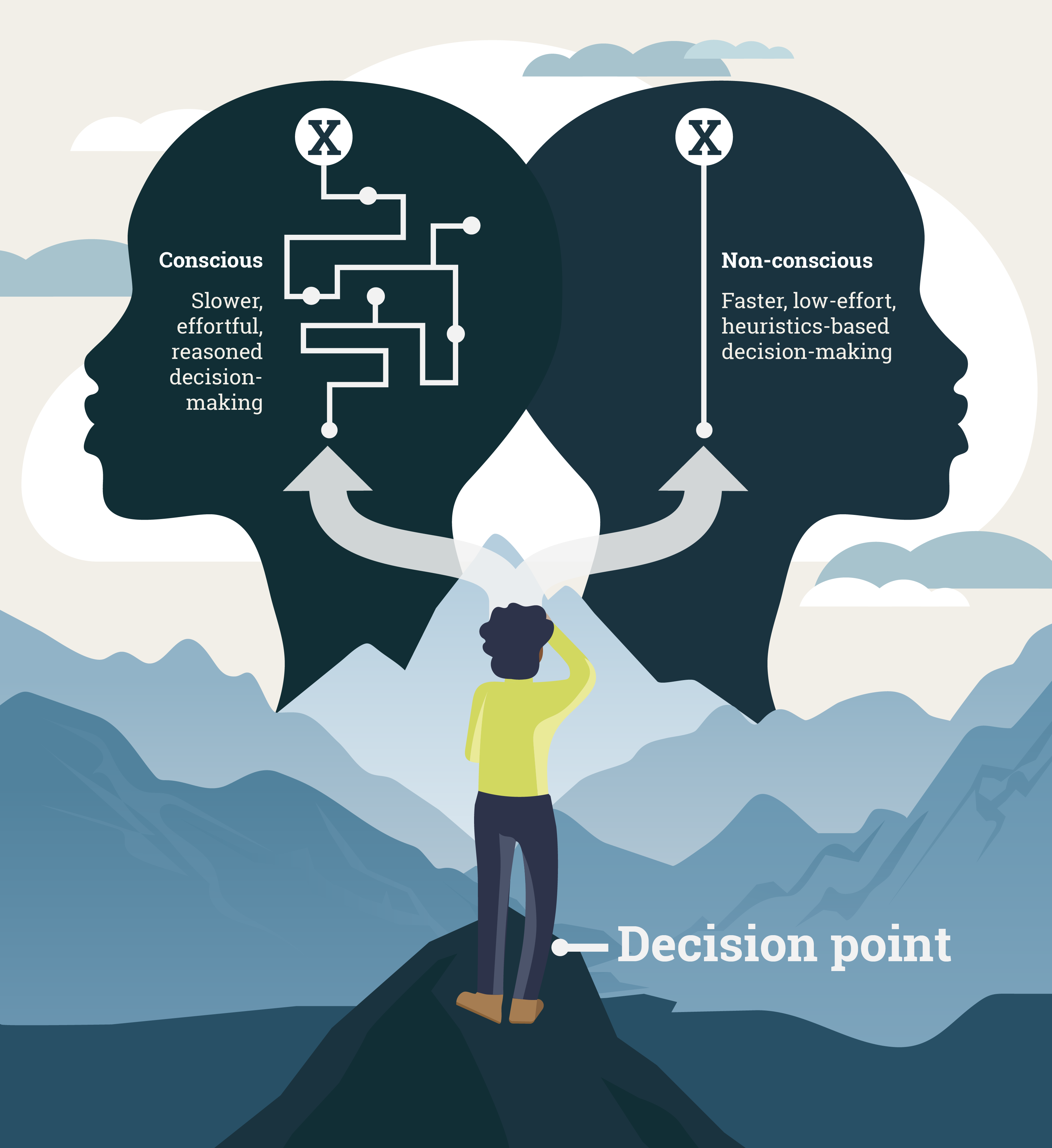
People rarely make decisions about risk through a purely rational, analytical process.Behavioural economics and cognitive science show that choices are shaped by mental shortcuts, emotions, and social cues.
GAR 2022 expands on this, highlighting how disaster risk is systematically misjudged because people rely on intuitive thinking, incomplete information, or misleading cues from their environment.
Meyer and Kunreuther identify six recurring biases that explain why preparedness decisions often fall short — even when people have information, resources, or experience.
Risk communication should therefore be designed not only to inform but also to counteract these biases and support better decisions.
Below is an expanded treatment of each bias with practical, evidence-based approaches for overcoming them.
- 1. Myopia
1. Myopia
Focusing on short-term costs and immediate inconvenience while discounting long-term protection.
Why it happens:
People tend to heavily discount future benefits (temporal discounting), especially when money, effort or comfort are involved. Risks that feel distant are deprioritized.Communication approaches:
- Make long-term benefits feel immediate. Show short-term gains of preparedness actions (comfort, cost savings, safety of loved ones).
- Use vivid, concrete scenarios, not abstract probabilities — GAR 2022 shows that relatable storytelling increases the salience of future risk.
- Highlight cumulative impact (“One small action today reduces tomorrow’s workload…”).
- Frame preparedness as routine rather than exceptional. Integrate it into daily habits.
- Offer simple, low-effort “first steps.” When the first step feels easy, people are more willing to start.
- 2. Amnesia
2. Amnesia
Forgetting lessons from previous disasters, especially as time passes and life returns to normal.
Why it happens:
Memory of risk decays quickly. Without reinforcement, people revert to routine behaviours. GAR 2022 notes that societies also undergo “collective forgetting,” especially when records are poor or when disasters fall outside lived experience.Communication approaches:
- Create regular reminders, not one-off messages (seasonal alerts, anniversary communications).
- Use community storytelling and lived experience. Survivor testimonies and intergenerational memory counteract fading recollection.
- Document local histories — maps, timelines, participatory archives — so communities retain risk narratives.
- Integrate preparedness into annual rituals, school programmes, and civic events to maintain salience.
- Show before-and-after contrasts from past events to anchor memory visually and emotionally.
- 3. Optimism bias
3. Optimism bias
Believing “it won’t happen to me” or underestimating the severity of future hazards.
Why it happens:
People tend to underestimate low-probability, high-impact events. Optimism provides emotional comfort and reduces cognitive load.Communication approaches:
- Use personalised risk framing. Replace generic statements (“your area is at risk”) with locally specific ones (“your neighbourhood flooded twice in the last 20 years”).
- Highlight common actions taken by peers. Optimism bias weakens when people see others preparing.
- Use believable ranges rather than extreme scenarios. GAR 2022 warns against alarmist framing, which may lead people to dismiss messages.
- Emphasize protective efficacy, showing that actions make a tangible difference.
- Use tools that allow people to visualise their risk, such as maps, hazard overlays, or simple calculators.
- 4. Inertia
4. Inertia
Preferring to keep things as they are, even when change is safer.
Why it happens:
Changing behaviour requires effort, attention, and sometimes financial cost. People default to “status quo bias,” especially under uncertainty.Communication approaches:
- Offer defaults that favour safety. For example: automated alerts already turned on; hazards pre-mapped on apps; starter preparedness kits.
- Reduce friction and effort. Make actions easy, short, and low cost (“Three steps, three minutes”).
- Use implementation intentions (“When I hear X alert, I will do Y”) to convert intentions into action.
- Highlight the cost of inaction, not just the cost of action — a key insight from GAR 2022.
- Create social commitments (pledges, group challenges) that build momentum for change.
- 5. Simplification
5. Simplification
Focusing on only a few facts and ignoring the full picture.
Why it happens:
Risk is complex. Under uncertainty, people rely on heuristics — mental shortcuts — and select the most available or easiest information. GAR 2022 notes that oversimplification is especially common when information is technical or overwhelming.Communication approaches:
- Present information in digestible chunks, using the “rule of 3” (three key messages).
- Use clear visual metaphors, diagrams, or simple risk scales.
- Avoid technical jargon. Translate uncertainty into everyday language.
- Use layered communication — a simple core message with optional detail for those who want more.
- Pre-test messages with target audiences to identify confusion points.
- Align instructions to real-world constraints, not idealised models (“If you cannot evacuate, do X instead…”).
- 6. Herding
6. Herding
Copying what others do — especially in uncertain situations.
Why it happens:
People look to social cues to validate their decisions. Herd behaviour can be positive (collective action) or harmful (delaying evacuation until others move).Communication approaches:
- Highlight positive social norms, even if they are emerging (“Most families on this street have signed up for alerts”).
- Show visible examples of preparedness, such as community drills or volunteer actions.
- Use trusted local role models — teachers, health workers, religious leaders — to demonstrate behaviours.
- Promote peer-to-peer encouragement, not top-down instruction.
- Counter negative herding (“Some people are staying behind, but responders strongly advise evacuation because…”).
- Create opportunities for collective action, which dramatically increases compliance and motivation.
A behavioural lens strengthens risk communication
Understanding cognitive biases does not imply people are irrational.
It acknowledges that risk decisions are made under stress, uncertainty, and with incomplete information — conditions in which intuitive thinking dominates.
Effective disaster risk communication:
- works with human psychology and emotions, not against it,
- translates complexity and uncertainty into relatable meaning,
- uses social networks and trusted messengers, and
- supports decisions that feel doable, timely, and socially validated.
When communicators intentionally design messages and systems that respond to these biases, early action becomes easier, more intuitive, and more likely to occur.