
Unifying climate and disaster risk management: Linking UNDRR and the UNFCCC through the Nairobi Work Programme to strengthen adaptation

As the world approaches the critical 1.5°C warming threshold above pre-industrial levels identified in the Paris Agreement, it is becoming increasingly clear that adaptation and preparedness are essential for managing the growing hazards and risks facing communities worldwide. Although the current geopolitical context is marked by conflict, energy insecurity and divisions among Parties, the sixty-fourth session of the Subsidiary Bodies under the United Nations Framework Convention on Climate Change (UNFCCC SB64), held in Bonn, Germany, from 8–18 June 2026, offered encouraging examples of dialogue and collaboration on climate change impacts.
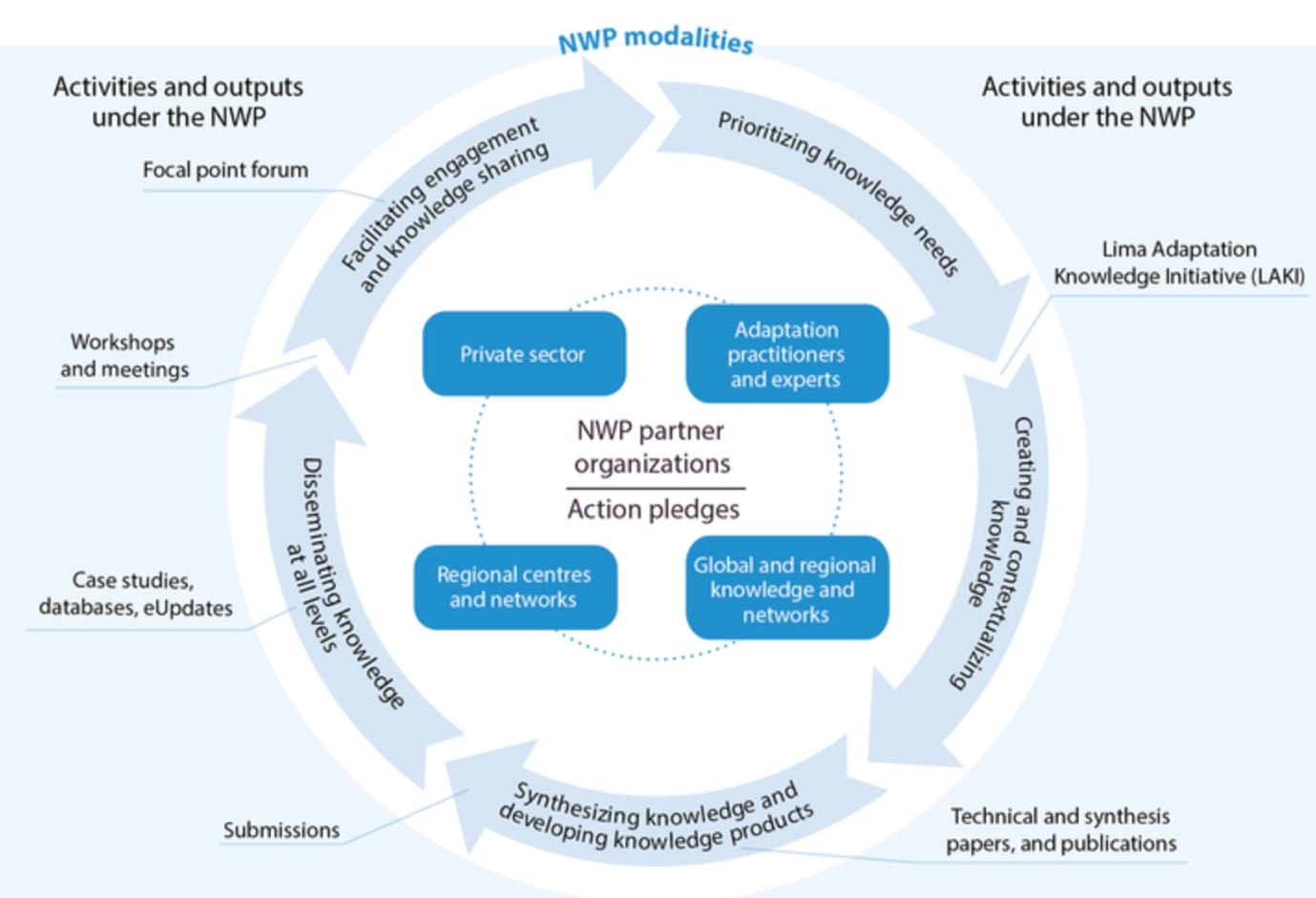
One such example is the Nairobi Work Programme (NWP), established in 2005 following recognition that adaptation needed to be integrated more effectively into climate policy. The programme supports the implementation of the Cancun Adaptation Framework by strengthening knowledge on impacts, vulnerability and adaptation (Figure 1).
Overlapping agendas across climate and disaster risk reduction
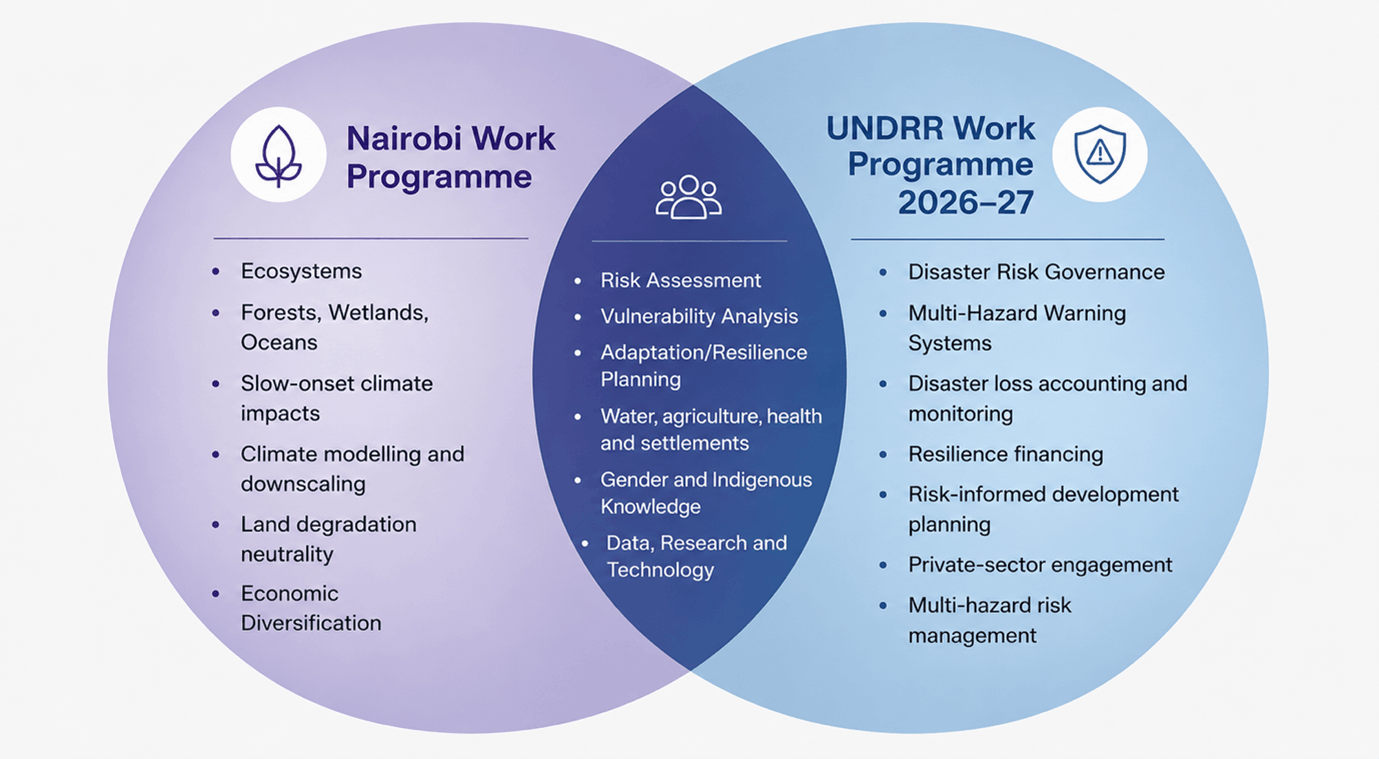
As interdisciplinary scholars working across disaster risk reduction and climate change, we observed significant similarities between the work of the Nairobi Work Programme and the United Nations Office for Disaster Risk Reduction (UNDRR) Work Programme 2026–2027 . Climate is referenced 63 times in the UNDRR programme, reflecting the growing importance of climate adaptation across disaster risk reduction efforts.
These similarities reveal how activities and priorities are often replicated across different United Nations processes. Limited exchange of knowledge, expertise and experience can hinder opportunities to strengthen National Adaptation Plans (NAPs), including the integration of early warning systems and preparedness into broader adaptation efforts.
To illustrate these common priorities, we compared the thematic areas of the two work programmes in a Venn diagram (Figure 2).
Existing mechanisms already support coordination
The substantial overlap between the two programmes presents opportunities to improve knowledge sharing, strengthen collaboration and engage more effectively with academia, the public and private sectors, and non-governmental organizations (NGOs).
Mechanisms already exist within the United Nations system to support this coordination. One example is the Sendai Stakeholder Engagement Mechanism (SEM), which helps identify areas of overlap between UNFCCC and UNDRR processes and seeks to avoid duplication. Ahead of Conference of the Parties (COP) meetings, SEM develops position papers on a range of UNFCCC processes, including the Nairobi Work Programme ( see the most recent SEM position statement ).
SEM also provides a platform through which non-State actors, researchers and practitioners can contribute to discussions and ensure that solutions draw on diverse knowledge systems and perspectives.
In addition, UNDRR published guidance in 2021 to promote alignment between climate change adaptation and disaster risk reduction. This guidance supports implementation of both the Sendai Framework for Disaster Risk Reduction 2015–2030 and the Sustainable Development Goals, while helping Parties integrate adaptation and disaster risk reduction into National Adaptation Plans.
Building on existing successes
Collaboration across work programmes and institutions is already taking place, but institutional arrangements and policy frameworks often limit deeper coordination.
During informal negotiations open to observers at SB64, Parties reaffirmed the importance of maintaining support and financing for early warning systems. These efforts could build on the success of the Early Warnings for All initiative , which demonstrates the benefits of cooperation across United Nations agencies.
Greater engagement from academia, NGOs and the public and private sectors could also help overcome persistent silos and encourage more integrated approaches to climate and disaster risk management.
Four opportunities for stronger collaboration
To improve coordination between the Nairobi Work Programme and the UNDRR Work Programme 2026–2027, we suggest four areas for action:
- Strengthen academic engagement to identify opportunities for collaboration between UNDRR and UNFCCC adaptation processes.
- Develop a shared knowledge platform for climate change adaptation and disaster risk reduction to facilitate the exchange of information and resources. Such a platform could support a more integrated approach to climate and disaster risk management.
- Align indicators and reporting systems by developing common measures for preparedness, early warning coverage and climate risk awareness.
- Create regional communities of practice bringing together Nairobi Work Programme and Sendai Framework focal points, adaptation specialists, meteorological, geological, and health institutions, and civil protection agencies to promote learning and knowledge exchange.
Making the most of existing knowledge
The foundations for stronger coordination between climate adaptation and disaster risk reduction already exist. Building on these opportunities could help integrate disaster risk reduction more systematically into adaptation processes under the UNFCCC, while supporting implementation of the Sendai Framework and the Sustainable Development Goals.
At a time when global average surface temperatures have already risen by approximately 1.37°C–1.44°C above pre-industrial levels, there is little time to duplicate efforts. Making better use of existing knowledge and mechanisms may prove just as important as developing new ones.
Prof Carina Fearnley is Professor of Warnings and Science Communication at University College London (UCL) and founder and Director of the UCL Warning Research Centre, the world's first centre dedicated to warning research. Her interdisciplinary work focuses on warning systems, risk communication, climate and disaster resilience, and the governance of complex hazards. A leading international expert on warnings, she has advised governments, international organisations, and the scientific community on improving warning effectiveness and inclusive risk communication in an increasingly uncertain world.
Rhiannon Hawkins is a PhD researcher at the University of Glasgow whose interdisciplinary research explores the impacts of climate change on community mental health, particularly in areas vulnerable to flooding and drought. Her work focuses on climate resilience, health inequalities, disability inclusion, and hazard preparedness. She devised the world’s first Mental Health Vulnerability Index (MHVI) and has advised policymakers, researchers, and communities, alongside being a Patient Advocate for the Royal College of Psychiatrists (RCPsych), on how to improve understanding of the mental health impacts of climate change and environmental hazards.