
Reducing flood risk in a changing climate: lessons from Türkiye’s integrated approach

Before-and-after views of river cleaning and rehabilitation works in the Rize province.
River rehabilitation works carried out through institutional cooperation in Türkiye constitute a concrete example of DRR–CCA integration in practice, with key strengths including strong institutional coordination, increased operational capacity, a preventive investment approach, and high cost-effectiveness.
Why climate change is reshaping disaster risk
Climate change is increasing the frequency and severity of hazards such as floods, droughts, heatwaves and wildfires. This shifting risk landscape is pushing countries to move beyond response-focused disaster management towards prevention and risk reduction.
In Türkiye, the Disaster and Emergency Management Presidency (AFAD) is leading this transition. Recognising the growing impact of climate-related risks, AFAD has strengthened its institutional approach and placed greater emphasis on preparedness and prevention.
A key step in this shift was the creation of the Department of Climate-Related Disaster Risk Reduction in January 2024. Established under the General Directorate of Earthquake and Risk Reduction, the department aims to better connect disaster risk reduction (DRR) and climate change adaptation (CCA) policies. This development represents an institutional transition from a response-oriented approach to risk-based and preventive governance.

Signing ceremony of the cooperation protocol between AFAD and DSİ aimed at reducing flash flood and flood risks.
Building a more integrated approach to risk
The new department focuses on:
- Assessing climate-related multi-hazard risks through a holistic approach
- Developing national and local risk analyses
- Integrating climate adaptation into disaster risk reduction strategies
- Promoting both structural and non-structural preventive measures
This approach aligns with global frameworks such as the Sendai Framework for Disaster Risk Reduction, which emphasises understanding risk, strengthening governance, investing in resilience and building back better.
Why integration matters in high-risk regions
As climate risks intensify, integrating DRR and CCA is essential for building resilient societies.
In Türkiye, this integration is particularly important in the Black Sea Region. The area is highly exposed to landslides and floods due to intense rainfall, steep terrain, weak soil conditions and increasing settlement pressure.
Recent efforts have focused on translating policy into practice. Field-level interventions—such as slope stabilisation, drainage improvements and excavation works—are helping reduce risks while strengthening local adaptive capacity.

Distribution of excavator across 14 provinces.
River rehabilitation as a practical solution
One of the most concrete examples of this integrated approach is river rehabilitation.
As intense rainfall events become more frequent, especially in urban areas, flood risks are increasing. To address this, AFAD and the General Directorate of State Hydraulic Works (DSİ) signed a Flood and Flash Flood Risk Reduction Protocol in April 2024.
This partnership strengthened cooperation on river rehabilitation and risk reduction. As part of the initiative:
- 111 excavators were deployed;
- Operations were launched across 14 provinces in the Black Sea Region.
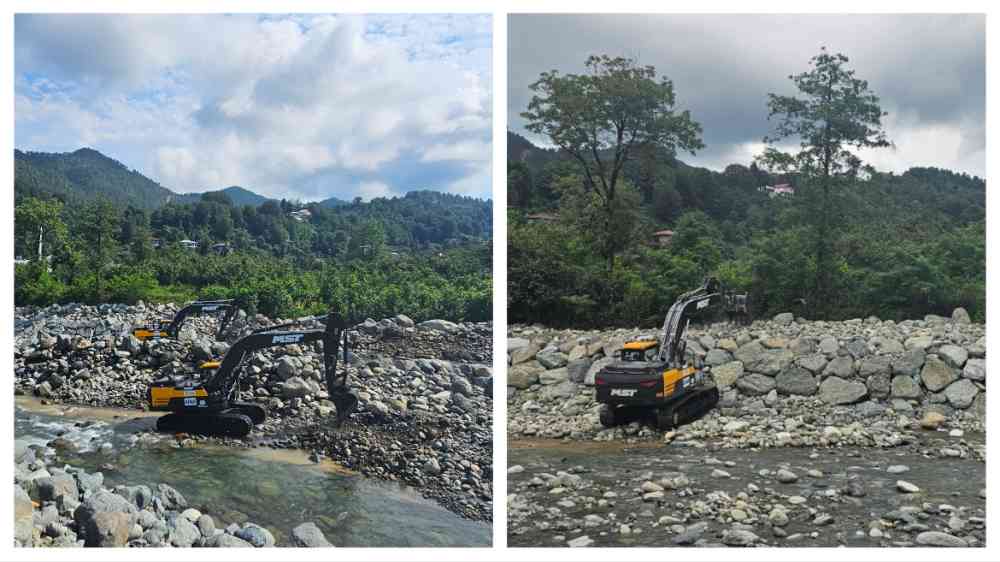
Before-and-after views of river cleaning and rehabilitation works in the Artvin province.
What the results show
Between May 2024 and March 2026, the programme delivered significant results:
- Work was completed on 326 river sections;
- Interventions covered 2,556.15 km;
- Over 25 million cubic metres of sediment were removed;
- This is equivalent to more than 2.5 million truckloads.
These interventions improved river flow capacity through sediment removal, riverbed widening and debris clearance. On a wider level, these operations strengthened preventive intervention capacity in high flood-risk areas.
From response to prevention: reducing costs and impacts
Beyond reducing physical risks, these measures have also delivered strong economic benefits. Despite continued heavy rainfall in the Black Sea Region after 2024, large-scale disasters have been limited. This suggests that preventive investments are already having an impact.
A comparative analysis from the Artvin and Rize provinces, shows that:
- Flood-related costs per unit of rainfall dropped significantly;
- Cost reductions reached 95 per cent in Artvin and 73 per cent in Rize;
- Savings amounted to millions of Euros;
These findings highlight the cost-effectiveness of combining structural measures with climate adaptation strategies.
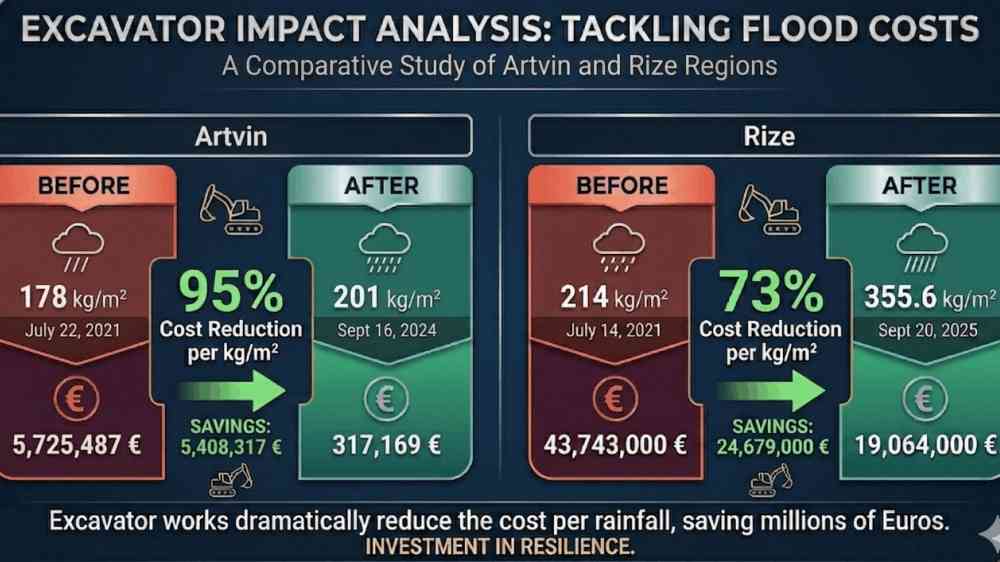
Comparative analysis of the impact of excavator-based river interventions on flood-related costs in Artvin and Rize provinces, showing significant cost reductions following implementation.
Scaling up a model for resilience
This model can be expanded to other flood-prone river basins, metropolitan areas where urban flood risk is increasing, and regions where climate projections indicate a significant escalation of risk.
The proposed strategic steps include:
- the systematic integration of climate projections into river rehabilitation planning;
- the joint planning of structural measures and nature-based solutions;
- strengthening the technical capacity of local governments;
- linking early warning systems with structural interventions, and
- incorporating cost–benefit analyses into decision-making processes.
River rehabilitation in Türkiye shows that disaster risk reduction is not only about responding to crises—it is about making smart, forward-looking investments.
By combining climate adaptation with risk reduction, and linking national policy with local action, Türkiye is building a more resilient approach to managing disaster risk.
Institutionalizing this model at the national scale and sharing it as an international good practice will strengthen Türkiye’s capacity in climate–disaster governance and establish a reference framework at the regional level.
Acknowledgements
We thank all institutions and individuals who contributed to this study. We sincerely appreciate the General Directorate of State Hydraulic Works (DSİ) for field data, technical information, and documentation on river rehabilitation. We also thank the Provincial Directorates of the Disaster and Emergency Management Presidency (AFAD) for their support with data sharing and technical assistance.
The information, documentation, and technical support provided have significantly contributed to the preparation of this study.
Davut Şahin is a civil engineer and disaster management expert with over 15 years of professional experience. He has actively participated in numerous disaster response operations and has played a key role in post-disaster recovery processes. He currently serves as the Head of the Department of Climate-Related Disaster Risk Reduction. His areas of expertise include disaster risk reduction, post-disaster recovery, climate change adaptation, and urban resilience.
Dr. Yeliz Teker is a geological engineer with over 15 years of experience at AFAD. She has been actively involved in disaster risk reduction and the adaptation of Sendai Framework to Türkiye’s context. She currently leads efforts in the Department of Climate-Related Disaster Risk Reduction, focusing on strengthening resilience.”
Ozgur Bostanci has actively participated in all stages of disaster and emergency management, including training, preparedness, exercises, response, and coordination, throughout his 16 years of professional experience. He is currently continuing his work in the Department of Climate-Related Disaster Risk Reduction, contributing to the strengthening of disaster management and climate adaptation processes.
Dogus Bulut is a geospatial engineer specializing in remote sensing and GIS. He has been working at AFAD for approximately 8 years and is currently continuing his activities in the Department of Climate-Related Disaster Risk Reduction, focusing on strengthening resilience.