
From crisis to resilience: How the village of Kemnay transformed its flood defences

In 2016, Storm Frank devastated Kembhill Park in Scotland, flooding 48 homes and exposing the fragility of traditional defences. At MegaSecur, we witnessed how a passive community transformed itself into a leader of its own governance by implementing Water-Gate technology to protect 32 high-risk homes, securing their future against climate change.
The collapse of the traditional model
For decades, Kemnay relied on an earthen embankment built in 1978. But today’s climate is not forgiving to obsolete designs. Storm Frank brought more than just water; it brought the revelation that individual defences were insufficient. The houses, built with timber and concrete bases, were technically impossible to protect using traditional sandbags. The result was heartbreaking: $1.27 million in losses and families displaced for months.
The science of self-stabilization
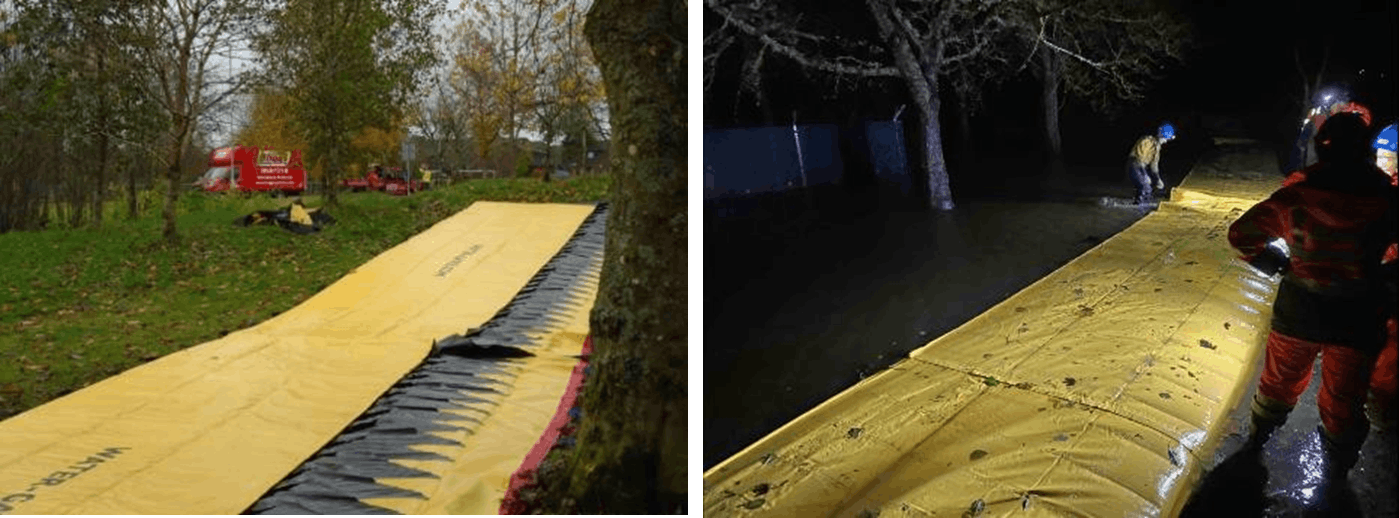
In my experience, I have learned that in an emergency, every second counts. The community, through the Kembhill Park Flood Group (KPFG), did not look for a temporary solution, but for certified engineering. They opted for barriers that deploy due to the water’s own force.
This design is innovative and adaptable in its technological leverage of a fundamental physical advantage: the vertical thrust exerted by the water on the base skirt is approximately four times greater than the horizontal thrust attempting to move the barrier. This ensures the barrier remains stable even on surfaces like asphalt or irregular terrain like gravel or grass, without the need for permanent mechanical anchors.
Unlike concrete walls that take years to plan, these modular solutions offer an immediate response. The ANSI/FM 2510 certification is not just a technical seal; it is a guarantee that the system will withstand debris impact and extreme pressure—something vital for insurers to maintain their coverage in high-risk flood zones.
Governance and professional deployment
Kemnay’s success was not only due to technology but also due to their decision to professionalize the response. Given the local population’s characteristics, rather than relying on exhausted volunteers under the rain, specialists (Briggs Marine) were hired to guarantee installation in less than 4 hours. This includes the experts' travel, moving equipment to planned sites, and full deployment.
This model was tested with resounding success in 2023 during Storm Babet. While 170 km/h winds lashed the region, the barriers stood firm. Most inspiring was seeing how "inclusive governance" allowed neighbours—far from panicking—to actively support the operators, reinforcing the social fabric in the midst of a crisis.
This solution is particularly relevant for Latin America. In our region, many communities suffer from recurrent flooding and, lacking budgets for massive engineering projects, often fall into a state of resignation. The Kemnay case serves as a bridge to demonstrate that community self-management, supported by accessible technology, can transform vulnerability into operational resilience.
Lessons for the global disaster risk reduction (DRR) community
The Kemnay case offers three key recommendations for resilience professionals:
1. Closing the implementation gap
We cannot wait decades for fixed infrastructure while leaving communities exposed. Mobile systems allow us to protect people today.
2. Economic efficiency
The 2016 flood cost United States Dollars (USD) 1.27 million in insurance claims. The Water-Gate system pays for itself in a single avoided event. According to the United States Congressional Budget Office (U.S. CBO), every dollar spent on mitigation saves between $2 and $6 in repairs; in Kemnay, this ratio reached an impressive 10:1 according to our own calculations.
3. Scalability and equity
For Small Island Developing States (SIDS) and Least Developed Countries (LDCs), these barriers offer a competitive advantage. They require no electricity or heavy machinery and can be transported in small vehicles to isolated areas. The Water-Gate WL series offers heights from 15 cm up to 1.52 meters (and custom-made up to 2 meters by MegaSecur), with standard lengths that can be joined indefinitely.
The United Nations Office for Disaster Risk Reduction (UNDRR) prioritizes solutions that are not only effective in a specific context but are also replicable and scalable globally. The Kemnay model meets these criteria exceptionally well. It teaches us that resilience is not just about resisting, but about adapting with intelligence and proven technology.

Marcelo Napoli is Development Director for the Southern Cone at MegaSecur. He has over 27 years of experience in the technology and security sectors, specializing in implementing cutting-edge solutions for disaster risk reduction. As Director for the Southern Cone, Marcelo Napoli leads resilience strategies in Uruguay, Argentina, and Paraguay, focusing on empowering communities to manage their own protection against flooding. His approach integrates technical operational capacity with the Sendai Framework guidelines, promoting non-structural infrastructures that safeguard both economic assets and the social fabric of vulnerable populations.