
Bridging the last mile: Rethinking disaster risk communication in academic research

Climate change is accelerating disaster risk
Climate change is real, and it is happening now. Its impacts are accelerating, bringing more intense rainfall, rising sea levels, and increasingly severe floods across many parts of the world. In this context, strengthening Early Warning Systems (EWS) is one of the most effective ways to reduce disaster losses and save lives . An effective Early Warning System rests on four interconnected components : 1. development of risk knowledge, 2. monitoring, modelling and forecasting, 3. dissemination and communication, and 4. response capability. If any one of these components is weak, the entire system will not work to its full potential.
Floods: Research imbalance and overlooked pillar of early warning systems
Let us consider floods, one of the most frequent and economically damaging disasters worldwide. Over the past two decades, academic research on floods has expanded rapidly, especially in areas such as hydrological monitoring, modelling, and predictive analytics. However, when examining publication trends between 2000 and 2025, a clear imbalance becomes visible. While research on flood risk management has grown substantially, studies focusing on disaster risk communication remain comparatively limited. The accompanying figure1 highlights this trend. It raises a critical question: if communication is a core pillar of Early Warning Systems, why does it receive relatively little academic attention?
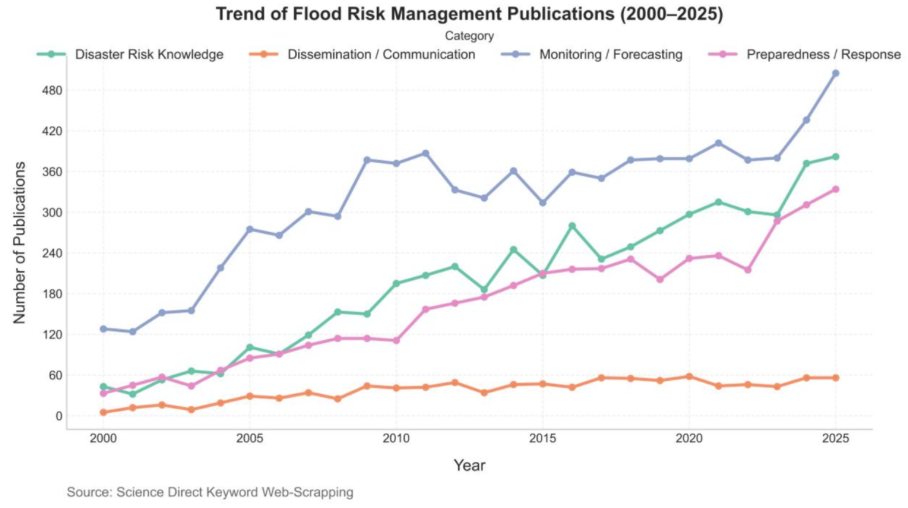
Figure 1: Trend of Flood Risk Management Publications (2000-2025)
The disciplinary divide
One reason lies in how academic research is followed and rewarded. In many disaster-oriented fields including engineering, hydrology and climate science, research is often oriented toward systems, models and technical innovation. Success is measured through prediction accuracy, algorithm performance, and methodological advancement. No doubt, these are essential contributions. However, they primarily operate in what could be described as a “system-to-system” framework: research outputs are designed for journals, technical agencies, and many times for further research. In contrast, disaster risk communication operates in a “system-to-people” space. It asks a different set of questions: Do communities understand the warning? Do they trust it? Will they act on it? These questions are behavioural and social, and they do not always fit comfortably within traditional technical research domains.
A second factor is disciplinary perception. Quantitative modelling, simulation and forecasting are often seen as “hard science,” while communication, perception and behavioural response are sometimes treated as applied concerns. As a result, communication research may receive less funding, fewer dedicated journal spaces, and limited methodological integration within technical projects. Yet early warning systems are not purely technological systems, they are socio-technical systems. Without effective communication, even the most accurate forecast cannot translate into effective outcomes.
There is also a structural issue of academic incentives. Evaluation systems rarely measure whether research findings were translated into actions. As a consequence, researchers optimize for scholarly impact rather than societal uptake. Communication becomes an assumed final step, something that will be handled later by authorities or decision makers, rather than an integral component embedded within the research design itself. This imbalance does not stem from neglect or indifference. Rather, it reflects how disaster science has evolved: rapidly advancing in modelling and prediction, but slower in integrating behavioural andcommunication sciences. The result is a growing technical sophistication at the front end of early warning systems, and a persistent fragility at the last mile.
A call to rethink upon disaster management research
Disaster risk communication cannot be treated as an afterthought. It is not the final step in a technical pipeline. It is the bridge between science and preparedness. If academic research continues to prioritise prediction without equally focusing on how warnings are understood and acted upon, early warning systems will remain technically strong but socially ineffective.
Bridging this gap is not simply about improving messaging. It is about rethinking how research itself is designed, ensuring that communication is embedded from the beginning, not appended at the end. I urge researchers, institutions and funding bodies to reconsider how disaster research is designed and evaluated. By embedding end-user understanding at the heart of research, academia can ensure that its knowledge does not stop at publication, but reaches the people it is ultimately meant to protect.
Sanjay Saifi is a PhD Research Scholar at the Indian Institute of Technology (IIT) Bombay, India, and currently works as a visiting researcher at the Disaster Prevention Research Institute (DPRI), Kyoto University, Japan. His research focuses on disaster risk reduction using geospatial and geovisualization technologies such as Augmented Reality (AR) and Virtual Reality (VR). He is further an enthusiastic field researcher with India’s 44th Scientific Expedition to Antarctica (2024–25 forming his most recent field experience. As an early-career researcher, Sanjay look forward to learning from the expert community and collaborating to contribute toward a more disaster-resilient society.