World Tsunami Museum Conference
The World Tsunami Museum Conference is a series of conferences organized by multi-stakeholders to share experiences, good practices and lessons learned among existing disaster-related museums.
Description
Tsunami museums and other disaster related museums have been established around the world, preserving images of tsunami and disaster damage and records of measures taken. It is important to pass on these records kept in tsunami and disaster museums to the next generation, to share these experiences and lessons learned with the world, and to prepare against future tsunamis and other types of natural hazards, which may strike at any moment.
Considering the importance of tsunami and other disaster-related museums and facilities, this series of conferences is being organized by the UNDRR in partnership with other stakeholders.
The objectives of the World Tsunami Museum Conference (WTMC) is to share and discuss experiences, good practices and lessons learned among existing disaster related museums as well as to foster an international network of disaster museums to learn from each other. The WTMC gathers representatives from existing museum facilities focusing on tsunami and disaster risk reduction around the world to share their activities and contributions and discuss the importance of and the roles of museums in preparing against tsunamis. The WTMC is also attended by students and teachers around the world, national and local governments officials, and other disaster risk reduction-related stakeholders.
Did the Sendai Framework change or contribute to changes in your activities/organization? If so, how?
The series of conferences is guided by the priorities and targets of Sendai Framework for Disaster Risk Reduction with direct contribution to Sendai Framework Priority 1 on Understanding Disaster Risk. By sharing the experiences from past tsunamis and disasters, disaster-related museums are raising awareness and building capacities of individuals to be more resilient to disasters.
What led you to make this commitment/initiative?
What was your position before making this Voluntary Commitment / prior to the Sendai Framework?
In December 2015, a resolution jointly proposed by 142 countries to designate November 5 as “World Tsunami Awareness Day” was adopted by consensus at the United Nations General Assembly. The designation of November 5 comes from the famous “Inamura-no-hi” story about Hamaguchi Goryo, a village leader in Hirogawa-cho (Wakayama Prefecture), who saved the lives of village inhabitants by setting fire to his sheaves of rice, thus quickly disseminating information about a giant tsunami triggered by the Ansei Nankai Earthquake on 5 November 1854. This led to the evacuation of the village to high ground, and he then made an effort to build back better. In later years, “Inamura-no-Hi no Yakata”, or the Hall of the Fire of Rice Sheaves, was established in Hirogawa-cho to hand down the experiences and lessons learned from the tsunamis they experienced to future generations.
As part of the advocacy activities under the World Tsunami Awareness Day, the World Tsunami Museum Conference was initiated in 2016 by the UNDRR receiving financial and substantive support from the Government of Japan.
Deliverables and Progress report
Deliverables
Deliverables are the end-products of the initiative/commitment, which can include issuance of publications or knowledge products, outcomes of workshops, training programs, videos, links, photographs, etc.
The first WTMC was held in Okinawa, Japan to promote cooperation among museums as centers of disaster risk reduction education.
The conference was co-organized by the UNDRR Kobe Office, Ministry of Foreign Affairs (MOFA) of Japan, and the Japan International Cooperation Agency (JICA).
The second WTMC was held in Tokyo, Japan with a theme on "Role of Tsunami Museums from Chronological Perspectives: Keeping the Memories and Lesosns Alive and Passing Them Down for Future Generations."
This was co-organized by UNDRR Kobe Office, MOFA Japan, Economic Research Institute for ASEAN and East Asia (ERIA).
Due to the COVID pandemic, the Third Tsunami Museum Conference was held online inviting six world disaster museum representatives to explain museums' role in educating populations about disaster risks. The 90 minutes show was moderated by Femi Oke, TV anchor.
This was co-organized by the UNDRR and UNESCO.
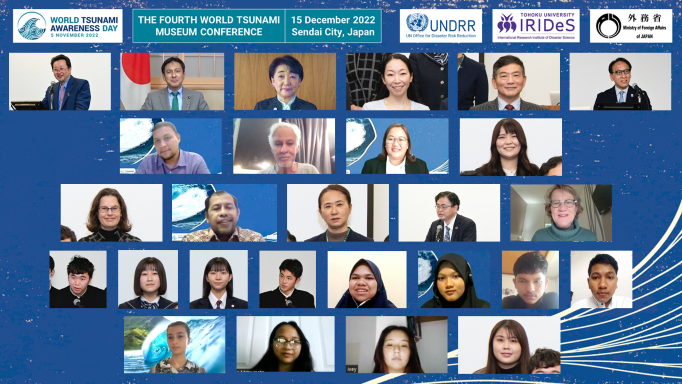
Building on the three previous World Tsunami Museum Conferences, WTMC4 was held with a hybrid modality allowing in-person participants to join the conference in Sendai, Japan and online participants to join remotely. The theme of the conference was “Roles of Youth and Tsunami Museums for resilience of societies."
The conference was co-organized by the UNDRR Kobe Office, MOFA Japan, and IRIDeS Tohoku University.
The Fifth World Tsunami Museum Conference (WTMC5) was held on 14 October 2024 during the Asia-Pacific Ministerial Conference on Disaster Risk Reduction (APMCDRR 2024) in the Philippines.
Building on the four previous World Tsunami Museum Conferences, the theme of WTMC5 was “Empowering the Next Generation - Roles of Disaster Museums for a Resilient Future”. WTMC5 was co-organized by UNDRR, the Ministry for Foreign Affairs of Japan, and the Government of the Philippines.
Porgress report
Under the World Tsunami Awareness Day initiative, four World Tsunami Museum Conferences were organized between 2017 - 2022 by working closely with various stakeholders around the world.
Since the one held in 2018, it has been decided to organize this WTMC every two years. The next one (5th WTMC) will be organized in 2024. This conference has been recognized as a major initiative where disaster-related museums and relevant stakeholders get together to exchange and learn from each other. Also, the important roles by disaster related museums to contribute to building resilience of societies have become strongly recognized thanks to this initiative.
The four World Tsunami Museum Conferences held so far have been providing useful venues for disaster-related museums and related facilities to exchange and share their activities, and to learn from each other to further enhance their important roles to play to contribute to building resilient societies. In particular, the 4th WTMC held in 2022 had youth participation which became significant contributions to the discussions and way forward.
Organizations and focal points
Implementing Organization(s)
- International Research Institute of Disaster Science, Tohoku University 東北大学 災害科学国際研究所
- United Nations Office for Disaster Risk Reduction - Kobe Office
- Ministry of Foreign Affairs of Japan
- Japan International Cooperation Agency
Focal points
If a VC's contact information has been hidden, the SFVC team can forward a message.Partners
- Japanese Association of Museums
- International Council of Museums
- Economic Research Institute for ASEAN and East Asia
- Ministry of Land, Infrastructure, Transport and Tourism 国土交通省
- Ministry of Education, Culture, Sports, Science and Technology
- 内閣府 Cabinet Office (Japan)
- United Nations Educational, Scientific and Cultural Organization (UNESCO)