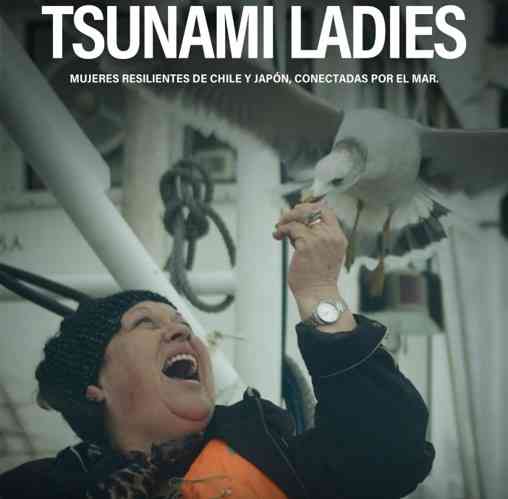
Tsunami Ladies Documentary
In the documentary “Tsunami Ladies,” producers Emiliano Rodríguez Nuesch and Víctor Orellana show how women fed neighbors and helped revive their local economies after the tsunamis that hit Chile in 2010 and Japan the following year.
Description
The commitment aims at highlighting that resilience can be created anywhere, even at the kitchen table. Specifically, this message is conveyed through a documentary titled "Tsunami Ladies" featuring six women from Chile and Japan who survived the massive tsunamis that devastated their villages (Chile in 2010 and Japan the following year). Food played a vital role in helping their communities rebuild and recover. The women fed neighbors and helped revive their local economies after the tsunamis.
The film was produced by Emiliano Rodríguez Nuesch and Víctor Orellana and it was presented during the World Tsunami Awareness Day on 05 November 2020. The documentary is about tsunamis on opposite sides of the Pacific Rim showing the importance of women in disaster risk reduction, decision making and recovery processes.
Explaining prevention and disaster risk reduction through people's stories is a good way to transmit information that so urgently needs to be understood.
Did the Sendai Framework change or contribute to changes in your activities/organization? If so, how?
The Sendai Framework encourages media to take an active and inclusive role in contributing to the raising of public awareness for disaster risk reduction. Furthermore, it specifically encourages simple, transparent, easy-to-understand and accessible formats, such as the documentary, to stimulate a culture of prevention and strong community involvement at all levels of society, in accordance with national practices. In addition, the Sendai Framework states that “women and their participation are critical to effectively managing disaster risk” as well as to strengthen capacity to secure alternate means of livelihood in post-disaster situations.
What led you to make this commitment/initiative?
What was your position before making this Voluntary Commitment / prior to the Sendai Framework?
In the past 100 years, tsunamis have claimed over 260,000 lives, more than any other disaster due to natural hazards. In the tsunamis of Chile in 2010 and Japan in 2011, women took a leadership position in the recovery of their local communities. One of our motivations was to allow these women to exchange their experiences. We also wanted to explore cooking as a bridge between cultures.
Deliverables and Progress report
Deliverables
Deliverables are the end-products of the initiative/commitment, which can include issuance of publications or knowledge products, outcomes of workshops, training programs, videos, links, photographs, etc.
Six women connected by the ocean, thousands of miles away. Three Chilean and three Japanese women who survived a tsunami and led the reconstruction of their communities meet in Japan to share their stories and cook together.
The documentary is a celebration of food as a universal language and its role in prevention and disaster risk reduction.
Tsunamis are quite unusual events, but they are also extremely deadly. In the last 100 years, 58 of them have claimed more than 260,000 lives. An average of 4,600 deaths each time they occur, which exceeds any other disaster caused by natural hazards.
On 05 November 2020, the documentary Tsunami Ladies, produced by Emiliano Rodriguez Nuesch and Victor Orellana, was presented. This documentary focuses on the role of women in the face of the impact of the tsunamis and their leadership in the process of rebuilding communities, expressed through their knowledge of seafood and cooking.
Porgress report
From 2020 to 2022, Tsunami Ladies has been presented in different regions and multiple languages such as Spanish, English and Japanese. It has gained the support of organizations related to citizen resilience efforts.
An English online premiere of the film and a follow up discussion of the documentary was hosted in November 2021 with Dr Lucy Jones and FEMA, with a hundred participants from California.
The Japanese premiere was held during the commemoration of the tenth anniversary of the tsunami that occurred in Japan on March 11, 2011, with two hundred and fifty participants from Japan and other parts of the world.
The Spanish premiere was presented On 2020 World Tsunami Day along with the United Nations Office for Disaster Risk Reduction (UNDRR) Regional Office for the Americas and the Caribbean.
The documentary has been requested by organizations to be broadcast in Japan, America and Caribbean as well as English speaking countries.
The English language online premiere and discussion of the documentary was celebrated in November 2021 with the participation of seismologist Dr Lucy Jones and FEMA, among others.
The Japanese premiere was held during the commemoration of the tenth anniversary of the tsunami that occurred in Japan on March 11, 2011. The event was broadcast in Japanese language and featured the participation of the United Nations Office for Disaster Risk Reduction (UNDRR) Office in Japan, Japan International Cooperation Agency (JICA), the NGO Women’s Eye as well as the protagonists and the producers of the documentary.
The Spanish premiere was presented On 2020 World Tsunami Day along with the United Nations Office for Disaster Risk Reduction (UNDRR) Regional Office for the Americas and the Caribbean.
Organizations and focal points
Implementing Organization(s)
Focal points
Partners