Nuclear Agents
Nuclear agents are derived from neutron radiation (n) which is a neutron emitted by an unstable nucleus, in particular during atomic fission and nuclear fusion. Apart from a component in cosmic rays, neutrons are usually produced artificially. Because they are electrically neutral particles, neutrons can be very penetrating and when they interact with matter or tissue, they cause the emission of beta- and gamma-radiation. Neutron radiation therefore requires heavy shielding to reduce exposure (IAEA, 2004).
Primary reference(s)
IAEA, 2004. Radiation, People and the Environment. International Atomic Energy Agency (IAEA). Accessed 1 December 2019.
Annotations
Additional scientific description
Dispersal of neutron radiation through nuclear weapons, including improvised nuclear devices (IND) results in a nuclear yield unlike radiation dispersal devices (RDD). This nuclear yield is measured in kilotons (kT) and one unit has the explosive energy equivalent to a thousand tons of TNT. Nuclear detonations are capable of producing impacts far surpassing that of any conventional explosive (IAEA, 2004).
A significant effect of a nuclear explosion is the blast generated. The blast originates from the rapidly expanding fireball of the explosion, which generates a pressure wave moving rapidly away from the point of detonation. Initially, near the point of detonation (also referred to as 'ground zero') for a surface nuclear burst, the overpressure is extremely high. With increasing distance from ground zero, the overpressure and speed of the blast wave dissipate to a point at which they cease to be destructive. In the case of a nuclear terrorism incident, the thermal pulse can cause skin burns on those people within a few miles of the incident who have a line-of-sight view of the fireball (IAEA, 2004).
There will be many hazards after a nuclear terrorism incident, including widespread fires and the presence of toxic materials, but one of the most significant in terms of human health for a ground- level or near- ground- level nuclear incident, will be the residual radiation from radioactive fallout and neutron activation of materials. Although the radiation levels are most hazardous in the first few hours, some areas within a few miles downwind may still be hazardous days after the incident. Rapid identification of these fallout areas for implementation of protective measures is one of the highest priorities for emergency management and public health authorities (IAEA, 2004).
Metrics and numeric limits
Identifying the dangerous-radiation zone (exposure rate ≥10 R h-1 , ₃0.1 Gy h-1 air-kerma rate) will have critical implications on response activities in or near fallout areas. The dangerous-radiation zone is an area where large doses could be delivered to emergency responders in a short period of time. The relation of dose and health effect is mainly established via the survivors of the bombs of Hiroshima and Nagasaki, assessed in 1950 and continued by the US Atomic Bomb Causality Commission (ABCC) and its successor, the USA-Japan binational Radiation Effects Research Foundation (RERF) (NCRP, 2010).
After a ground-level nuclear terrorism incident, the dangerous-radiation zone will be created by fallout that is deposited in the first few hours and will have boundaries that may extend for 20 miles (~32 km), depending on the yield and weather. The dangerous-radiation zone will rapidly shrink as the fallout decays and may only be a mile or two long after a few days. As an example, an emergency responder working in an area with an initial 10 R h-1 exposure rate (~0.1 Gy h-1 air-kerma rate) 4 hours after the nuclear terrorism incident will receive ~25 R (~0.25 Gy air kerma) in a 4-hour work period (NCRP, 2010).
Key relevant UN convention / multilateral treaty
Effective national and global response arrangements and capabilities are essential to minimise the impacts from of nuclear and radiological incidents and emergencies. The International Atomic Energy Agency (IAEA) maintains the international Emergency Preparedness and Response (EPR) framework, which is based on international legal instruments (IAEA, 2019).
As part of these activities, the IAEA develops safety standards, guidelines and technical tools; assists Member States in building the capacity for emergency response; and maintains the IAEA Incident and Emergency System to efficiently
The IAEA Preventive Measures for Nuclear and Other Radioactive Material out of Regulatory Control elaborates upon the recommendations given in IAEA Nuclear Security Series No. 15, Nuclear Security Recommendations on Nuclear and Other Radioactive Material out of Regulatory Control, in relation to preventative measures (IAEA, 2019). It serves as a guidance document for Member States interested in strengthening their nuclear security regime as it relates to nuclear and other radioactive material out of regulatory control and in improving their capabilities.
Drivers
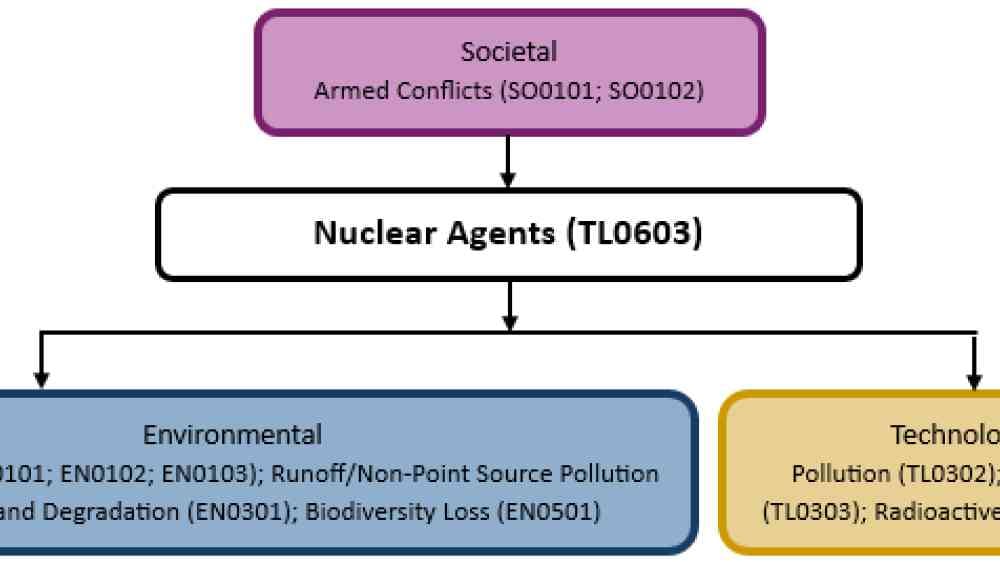
Nuclear agents, resulting in the dispersal of neutron radiation are associated with nuclear weapons, including improvised nuclear devices (IND). Conflicts and accidents at production or storage sites may also release nuclear agents.
Impacts
A life-span study to investigate the health consequences on a large population after the bombs of Hiroshima and Nagasaki, showed that the survivors within 1500 m of the epicentre (shielded whole body kerma >1 Gy) on average had a reduction of 2.6 years of life expectancy due to radiation-induced cancer (Smith, 2007).
Multi-hazard context
The figure below summarises common interactions between nuclear agents and other hazards. This information should be used with caution and not be solely relied upon in Disaster Risk Management, particularly as some interactions may not have been included. Note that hazardous events occurring together or locally in space or time may not necessarily cause, amplify, or be otherwise related to each other. Specific examples of multi-hazard context can be found in the ‘Hazard drivers’ and ‘Impacts’ sections above.
Multi-hazard diagram
Risk Management
Protective actions to prevent or reduce radiation exposure in the case of a radiation emergency situation depend on the type of emergency and may include: taking shelter; evacuation or even permanent relocation from an affected area; restriction of the consumption of contaminated food or water; administration of iodine thyroid blocking (in the case of radioactive iodine release, see the HIP on Iodine/Iodide excess/inadequate intake CH0105)); monitoring and measuring radiation in affected people and the environment; securing radioactive sources and cleaning up affected areas; as well as providing information, risk communication, psychological support, medical care and long-term follow-up to those in need (IAEA, 2021).
An Early Warning System (EWS) related to nuclear agents provides early alerts for events such as the release of nuclear materials, radiation leaks, and nuclear accidents, aiming for immediate response and prevention. This system primarily utilizes radiation detection equipment, satellite data, ground sensors, and automated alert mechanisms to detect signs of nuclear incidents in real -time and send warnings. The EWS quickly detects the release of nuclear materials and sends alerts to regions that may face severe radiation exposure or areas where the materials could spread in the atmosphere, allowing people to take appropriate evacuation or radiation protection measures.
Monitoring
The section and the table below offer an overview of monitoring nuclear agents. This information can be used for forecasting within a national early warning system (EWS). Since EWS capacities and processes differ across countries, the most current and specific information regarding EWS should be obtained from the appropriate national or regional agency/authority responsible for disaster management.
| Which institution(s) produce(s) Disaster Risk Data/Information? | Preparatory Commission for the Comprehensive Nuclear-Test-Ban Treaty Organization (CTBTO); International Atomic Energy Agency (IAEA) |
| How is the Hazard Observed/Monitored/Forecast? | CTBTO operates International Monitoring System (IMS) that consists of 321 monitoring stations hosted by 89 countries. This IMS includes verification methods using seismic stations to monitor underground tests by measuring shockwaves, hydroacoustic stations to detect soundwaves, infrasound stations, and radionuclide stations to detect radioactive particles or gases (CTBTO, No date). IAEA organises visits to nuclear sites |
References
Comprehensive Nuclear-Test-Ban Treaty Organization (CTBTO), no date. The International Monitoring System. Accessed 25 January 2025.
International Atomic Energy Agency (IAEA), 2004. Radiation, people and the environment. Accessed 25 January 2025.
International Atomic Energy Agency (IAEA), 2019. Preventive measures for nuclear and other radioactive material out of regulatory control: Implementing guide. Nuclear Security Series No. 36-G. Accessed 25 January 2025.
International Atomic Energy Agency (IAEA), 2021. Radiation in everyday life. Accessed 25 January 2025.
National Center for Biotechnology Information (NCBI), 2014. Lessons learned from the Fukushima nuclear accident for improving safety of U.S. nuclear plants. Accessed 25 January 2025.
National Council on Radiation Protection and Measurements (NCRP), 2010. Responding to a radiological or nuclear terrorism incident: A guide for decision makers: Report No. 165. Accessed 25 January 2025.
Smith, J.T., 2007. Are passive smoking, air pollution and obesity a greater mortality risk than major radiation incidents? BMC Public Health, 7, p.49. doi:10.1186/1471-2458-7-49. Accessed 25 January 2025.