Radioactive Waste
Radioactive waste is radioactive material for which no further use is foreseen but still contains, or is contaminated with, radionuclides. Radioactive waste can be in gas, liquid or solid form (IAEA, 2018). It may remain radioactive from a few hours to hundreds of thousands of years.
For legal and regulatory purposes, material for which no further use is foreseen that contains, or is contaminated with, radionuclides at activity concentrations greater than clearance levels as established by the regulatory body (Adapted from IAEA, 2018 and IAEA 2022 a).
Primary reference(s)
IAEA, 2018. IAEA Safety Glossary: Terminology used in Nuclear Safety and Radiation Protection, 2018 edition. International Atomic Energy Agency (IAEA). Accessed 25 January 2025
IAEA, 2022 a. IAEA Nuclear Safety and Security Glossary, 2022 (Interim) Edition. International Atomic Energy Agency (IAEA). Accessed 25 January 2025.
Annotations
Additional scientific description
It is common regulatory practice to define terms such as radioactive material and radioactive waste to include only material or waste that is subject to regulation by virtue of the radiological hazard that it poses. Although the exact specifications vary from State to State, this typically excludes material and waste with very low concentrations of radionuclides and those that contain only ‘natural’ concentrations of naturally occurring radionuclides (IAEA, 2018).
Metrics and numeric limits
The International Atomic Energy Agency (IAEA) Glossary of 2018 for radioactive waste classification uses waste classes recommended in IAEA Safety Standards Series No. GSG-1 (IAEA, 2009): High-Level Waste (HLW), Intermediate-Level Waste (ILW), Long-Lived Waste, Low-Level Waste (LLW), Short-Lived Waste, Very Low-Level Waste (VLLW) and Very Short-Lived Waste (VSLW). For a detailed description of each, see IAEA (2009).
Other systems classify waste on other bases, such as according to its origin (e.g., reactor operations waste, reprocessing waste, decommissioning waste and defence waste) (IAEA, 2009).
Key relevant UN convention / multilateral treaty
The Convention on the Prevention of Marine Pollution by Dumping of Wastes and Other Matter (1972), also referred to as the ‘London Convention’ prevents dumping of waste (including radioactive waste) at sea. At the time of writing, there were 87 parties to the London Convention (IMO, 2019).
The Joint Convention on the Safety of Spent Fuel Management and on the Safety of Radioactive Waste Management (United Nations, 1997) entered into force in 2001 and addressed the issue of spent fuel and radioactive waste on a global scale. At the time of writing, there were 71 parties to the convention.
Drivers
Sources of radioactive waste include medical waste, industrial waste, and tailings from naturally occurring radioactive materials in metallic ores, coal, oil, and gas (Rosenfeld & Feng, 2011), as well as decommissioning of nuclear installations and other nuclear facilities, research reactors, research facilities, and from the production and use of radioisotopes (IAEA, 2009). Nuclear wastes are by-products of nuclear weapons production and nuclear power generation, plus residuals of radioactive materials used by industry, medicine, agriculture, and academia (Gee et al., 2005).
Natural hazards such as earthquakes, floods, fires, and tsunamis can pose significant risks to radioactive waste storage facilities. The Fukushima nuclear power plant accident is a notable example demonstrating the impact of earthquakes and tsunamis on nuclear facilities. Radioactive waste storage sites are vulnerable to a chain of hazards, including structural damage caused by earthquakes, fires, cooling system failures, and more (NCBI, 2021).
Impacts
Radioactive waste containing radioactive material remains hazardous to human, animal and plant health and the environment. External hazards (e.g., causing body damage from overexposure to gamma rays) and/or internal hazards (e.g., causing body damage from alpha and beta particles by contaminated food or air) can be present whenever radioactive materials are found.
In general, exposure to large amounts of radioactivity (from radioactive waste or not) can cause nausea, vomiting, hair loss, diarrhoea, haemorrhage, destruction of the intestinal lining, central nervous system damage, and death. It may also cause DNA damage and increase the risk of cancer, particularly in young children and foetuses. Beyond certain thresholds, radioactivity can impair the functioning of tissues and/or organs and can produce acute effects such as skin redness, hair loss, radiation burns, and/or acute radiation syndrome. These effects are more severe at higher doses and higher dose rates. For instance, the dose threshold for acute radiation syndrome is about 1 Sv (1000 mSv) (IAEA, 1997).
Multi-hazard context
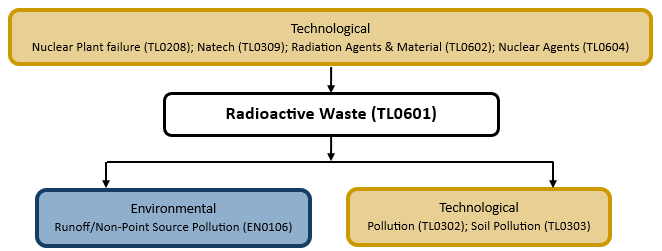
The figure below summarises common interactions between radioactive waste and other hazards. This information should be used with caution and not be solely relied upon in Disaster Risk Management, particularly as some interactions may not have been included. Note that hazardous events occurring together or locally in space or time may not necessarily cause, amplify, or be otherwise related to each other. Specific examples of multi-hazard context can be found in the ‘Hazard drivers’ and ‘Impacts’ sections above.
Multi-hazard diagram
Risk Management
Currently, no method is known to neutralise radioactive waste (Rosenfeld & Feng, 2011) but long-term isolation in a geoenvironment is recommended. Most nuclear waste is radioactive for a few tens of years and is routinely disposed of in near-surface disposal facilities. About 3% of the total volume of radioactive waste is long-lived and highly radioactive requiring isolation from the environment for multiple millennia (World Nuclear Association, 2017).
Communication and stakeholder involvement are essential components for a successful disposal programme. Experience around the world suggests that the scientific and technological bases for the safe disposal of radioactive waste are available — disposal solutions exist or can be developed based on established knowledge. However, concerns and opposition among the public and other stakeholders could slow or even prevent the implementation of needed disposal solutions. IAEA have published practical guidance on communication and stakeholder involvement for countries embarking on, relaunching or revising a disposal programme. It draws upon past experiences and emphasizes that practical implementation requires adjusting to the evolving context as given by the national, social and political circumstances. The primary intended users of this publication include those working in the field of radioactive waste management in government, regulatory bodies and industry, and especially in organisations responsible to for implementing solutions for radioactive waste disposal (IAEA, 2022 b).
Monitoring
IAEA has extensive guidance on radioactive waste monitoring.
References
Gee, G.W., P.D. Meyer and A.L. Ward, 2005. Nuclear waste disposal. In: Encyclopedia of Soils in the Environment. pp. 56-63.
International Atomic Energy Agency (IAEA), 1997. Nuclear safety conventions: Joint Convention on the Safety of Spent Fuel Management and on the Safety of Radioactive Waste Management. International Atomic Energy Agency (IAEA). Accessed 25 January 2025.
International Atomic Energy Agency (IAEA), 2009. Classification of Radioactive Waste. General safety guide No. GSG-1. International Atomic Energy Agency (IAEA). Accessed 25 January 2025.
International Atomic Energy Agency (IAEA), 2018. IAEA Safety Glossary: Terminology used in Nuclear Safety and Radiation Protection, 2018 edition. International Atomic Energy Agency (IAEA). Accessed 25 January 2025
International Atomic Energy Agency (IAEA), 2022a. IAEA Nuclear Safety and Security Glossary, 2022 (Interim) Edition. Accessed 25 January 2025.
International Atomic Energy Agency (IAEA), 2022b. Communication and stakeholder involvement in radioactive waste disposal. Accessed 21 May 2025.
National Center for Biotechnology Information (NCBI), 2014. Lessons learned from the Fukushima nuclear accident for improving safety of U.S. nuclear plants. Accessed 25 January 2025.
International Maritime Organization (IMO), 2019. Convention on the Prevention of Marine Pollution by Dumping of Wastes and Other Matter. Accessed 25 January 2025.
Rosenfeld, P.E. and Feng, L., 2011. Risks of hazardous wastes. Elsevier. Paperback ISBN: 9780323165655; Hardback ISBN: 9781437778427; eBook ISBN: 9781437778434.
United Nations, 1997. Joint Convention on the Safety of Spent Fuel Management and on the Safety of Radioactive Waste Management. Accessed 25 January 2025.
World Nuclear Association, 2017. Radioactive waste – Myths and realities. Accessed 25 January 2025.