
Waste Treatment Lagoons
Waste [treatment] lagoons can be defined as impoundments made by excavation or earth fill for biological treatment of animal and other agricultural waste (Spellman & Bieber, 2012).
Primary reference(s)
Spellman, F.R. and R.M. Bieber, 2012. Environmental Health and Science Desk Reference. Government Institutes, 807.
Annotations
Additional scientific description
In recent decades, livestock production (e.g., pig farms, dairies, poultry industry) has increased rapidly. Increased production comes from industrial farms clustered around major urban centres (FAO, 2007). The livestock waste is a major source of greenhouse gases, air pollutants, harmful pathogens and odour (Sorathiya et al., 2014). Concentrations of animals (including intensive farming) and animal wastes close to dense human populations can cause large-scale environmental problems including soil, water, air pollution, and biodiversity loss and may negatively impact human health. It is potentially more dangerous if such concentrated production is conducted in areas near water sources (FAO, 2007).
The term 'lagoon' is often misused, mistakenly including manure storage basins as lagoons (Hamilton et al., 2006). Manure storage basins are not meant to provide significant biological treatment or long storage periods (Livestock and Poultry Environ- mental Learning Community, 2019).
'Lagoons' can be anaerobic, aerobic, naturally-aerobic, mechanically aerated and facultative, depending on their loading and design (Miller et al., 2011). Lagoons rely on physical, chemical, and biological processes to degrade manure (Hamilton et al., 2006; Miller et al., 2011).
Metrics and numeric limits
Not available.
Key relevant UN convention / multilateral treaty
The UN-Water Policy Brief on the United Nations global water conventions: Fostering sustainable development and peace. (UN-Water, 2022)
Drivers
Effluents from livestock industrial production are commonly discharged into the environment or stored in ‘lagoons’, from which waste may spill or leak into nearby streams and groundwater supplies. Noxious gases escape into the atmosphere, subjecting downwind neighbours to sickening odours and contributing to atmospheric aerosol formation, build-up of greenhouse gases and acid rain (FAO, 2007).
Impacts
The environmental and public health risks of industrial feedlots and effluent lagoons can be limited by ensuring that they are not located too close to each other, to streams and aquifers and to densely populated communities. Environmental damage can be reduced further by encouraging and enforcing standards for the design and construction of buildings and lagoons to conform with approved manure management system (FAO, 2007). Meat processing plants produce large amounts of slaughter- house wastewater, treatment and final disposal (Bustillo-Lecompte and Mehrvar, 2017). Livestock waste lagoons and manure storage basins may spill or leak into nearby streams and groundwater supplies. Further- more, cracks, improper construction, increased rainfall, storm or stronger than normal winds can cause lagoon overflow. Ponds or lagoons used to store effluents should be lined to reduce leaching and be big enough to allow for manure storage at times when application on crops is not suitable, such as during the rainy season (FAO, 2007). Overflow can spread harmful bacteria, pesticides, animal antibiotics, additional oestrogens, heavy metals, and protozoa into the groundwater supply and contaminate surrounding areas and these could be identified as socio-economically generated sediments (Sharma and Singh, 2015).
Pollution associated with animal waste management in intensive livestock production include (FAO, 2007):
- Leaching of nitrates into groundwater, threatening drinking water supplies.
- Eutrophication of surface water, as nitrogen, phosphorus and other nutrients are discharged or run off into streams, damaging wetlands and fragile coastal ecosystems, and fuelling algae ‘blooms’ that use up oxygen in the water, killing fish and other aquatic life.
- Build-ups of excess nutrients and heavy metals in the soil, damaging soil fertility and shrinking arable land resources.
- Contamination of soil and water resources with pathogens, heavy metals or drug residues.
- Release of ammonia, hydrogen sulphide, methane, carbon dioxide and other gases into the air, some of which can negatively impact health hazards, damage crops and ecosystems.
Multi-hazard context
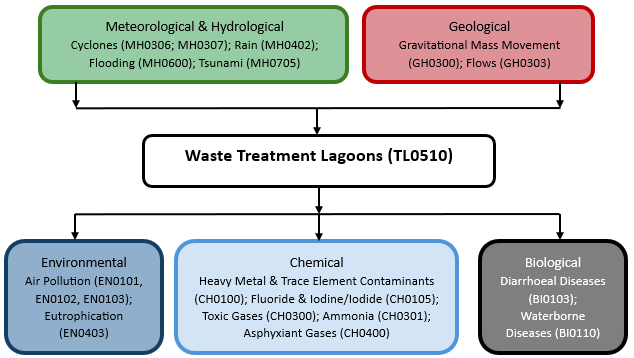
The figure below summarises common interactions between waste treatment lagoons and other hazards. This information should be used with caution and not be solely relied upon in Disaster Risk Management, particularly as some interactions may not have been included. Note that hazardous events occurring together or locally in space or time may not necessarily cause, amplify or be otherwise related to each other. Specific examples of multi-hazard context can be found in the ‘Hazard drivers’ and ‘Impacts’ sections above.
Multi-hazard diagram
Risk Management
Effective policies and legislation to regulate intensive livestock operations and support environmentally and economically sustainable approaches, the use of adequate practices and technologies are of high importance for addressing these challenges and mitigating production of the pollutants. Livestock waste is a major source of nutrients and energy which contributes to improving the circular bioeconomy. Proper management and use of livestock waste as a fertiliser or for conversion into biogas, compost and vermicompost is a useful means to increase crop yield, sustainability, and income (Sorathiya et al., 2014).
Monitoring
FAO provides guidance on wastewater reclamation and reuse systems that should contain both design and operational requirements necessary to ensure reliability of treatment (FAO, no date). Reliability features such as alarm systems, standby power supplies, treatment process, emergency storage or disposal of inadequately treated wastewater, monitoring devices, and automatic controllers are important. From a public health standpoint, provisions for adequate and reliable disinfection are the most essential features of the advanced wastewater treatment process with a monitoring programme that should always be incorporated into the design of overland flow projects both for wastewater and effluent quality and for application rates (FAO, no date).
References
Bustillo-Lecompte, C. and Mehrvar, M., 2017. Slaughterhouse wastewater: treatment, management, and resource recovery. In: Farooq, R. and Ahmad, Z. (eds.) Physico-chemical wastewater treatment and resource recovery. London: IntechOpen.
Food and Agriculture Organization of the United Nations (FAO), 2007. Pollution from industrialized livestock production. Food and Agriculture Organization of the United Nations (FAO). Accessed 20 December 2024.
Hamilton, D.W., B. Fathepure, C.D. Fulhage, W. Clarkson and J. Lalman, 2006. Treatment lagoons for animal agriculture. In: Rice, J.M., D.F. Caldwell and F.J. Humenik (eds.), Animal Agriculture and the Environment. National Center for Manure and Animal Waste Management, pp. 547-574. Accessed 20 December 2024.
Livestock and Poultry Environmental Learning Community (LPELC), 2019. Liquid manure treatment lagoons. Accessed 20 December 2024.
Miller, R., J. Major and P. Trinca, 2011. How a lagoon works: For livestock wastewater treatment. Accessed 20 December 2024.
Sharma, S. and D.N. Singh, 2015. Characterization of sediments for sustainable development: state of the art. Marine Georesources and Geotechnology, 33(5) 10.1080/1064119X.2014.953232
Sorathiya, L.M., Fulsoundar, A.B., Tyagi, K.K., Patel, M.D. and Singh, R.R., 2014. Eco-friendly and modern methods of livestock waste recycling for enhancing farm profitability. International Journal of Recycling of Organic Waste in Agriculture, 3, p.50.
UN-Water, 2020: UN-Water Policy Brief on the United Nations global water conventions: Fostering sustainable development and peace. Geneva, Switzerland.