
Electronic Waste (E-Waste)
Electrical and electronic waste, or E-waste, refers to electrical or electronic equipment that is waste, including all components, sub-assemblies and consumables that are part of the equipment at the time the equipment becomes waste (UNEP, 2019a).
Primary reference(s)
UNEP, 2019. Technical guidelines on transboundary movements of electrical and electronic waste and used electrical and electronic equipment, in particular regarding the distinction between waste and non-waste under the Basel Convention. (Version of 10 May 2019). United Nations Environment Programme (UNEP). Accessed 11 February 2025.
Annotations
Additional scientific description
Electrical and electronic waste is classified both as hazardous waste and non-hazardous waste, according to the Basel Convention on the Control of Transboundary Movements of Hazardous Wastes and their Disposal (UNEP, no date a). It is categorised as hazardous waste when it belongs to any category in Annex I of the Basel Convention unless it does not possess any of the hazardous characteristics included in Annex III to the Convention. For example, e-waste is classified as hazardous waste when it contains toxic substances such as mercury, lead and brominated flame retardants (Basel Convention, 2020).
Besides containing recyclable and recoverable metals and materials such as gold, copper, nickel, silver, rare earths and materials of strategic importance such as indium and palladium, e-waste can contain up to 60 different elements from the period table, including hazardous chemicals, of which some are persistent organic pollutants (POPs) and dioxins listed under the Stockholm Convention on Persistent Organic Pollutants (PACE, 2019).
The distinction between waste and non-waste equipment is important. Some countries may consider used equipment destined for failure analysis, repair, or refurbishment as waste, while others may not. This distinction can affect how the material is classified and regulated.
Metrics and numeric limits
Classification of e-waste that can inform the metrics is now provided in Annex II (Y49 for non-hazardous e-waste) and Annex VIII (A1181 for hazardous e-waste) under the Basel Convention. The previous distinctions between hazardous and non-hazardous e-waste in Annexes VIII and IX (e.g., A1180 and B1110) are no longer applicable.
A record 53.6 million metric tonnes (Mt) of electronic waste was generated worldwide in 2019, up 21 per cent in just five years. The new report (Global e-waste Monitor, 2024) also predicts global e-waste will reach 82 Mt by 2030. A record 62 million tonnes (Mt) of e-waste was produced in 2022, up 82% from 2010. This amount is projected to rise by another 32%, reaching 82 million tonnes by 2030. The annual generation of e-waste is increasing by 2.6 million tonnes per year.
Key relevant UN convention / multilateral treaty
The Basel Convention on the Control of Transboundary Movements of Hazardous Wastes and their Disposal, adopted in 1989, is a key multilateral environmental agreement. As of January 1, 2024, it has 191 Parties. The Convention has undergone significant amendments since its adoption, with the most recent changes related to e-waste management set to take effect on January 1, 2025 (Basel Convention Secretariat, 2024).
Stockholm Convention on Persistent Organic Pollutants (POPs)
https://www.basel.int/countries/statusofratifications/tabid/1341/defaul…
https://www.basel.int/theconvention/overview/textoftheconvention/tabid/…
https://www.unep.org/resources/report/basel-convention-control-transbou…
Stockholm Convention on Persistent Organic Pollutants (POPs)
Drivers
While e-waste is one of the fastest-growing hazardous waste streams globally (UNEP, 2007a; PACE, 2019), the findings from the Global E-Waste Monitor 2017 highlighted the low rate of electronic waste recycled globally (Baldé et al., 2017). By 2016, the world generated 44.7 million metric tonnes of e-waste and only around 20% was recycled through appropriate channels (Baldé et al., 2017). The World Health Organization reported in 2020 that global e-waste is surging and is up 21% in 5 years with a record 53.6 million tonnes of e-waste produced globally in 2019 - the weight of 350 cruise ships the size of the Queen Mary 2; USD 57 billion in gold and other components discarded - mostly dumped or burned (WHO, 2020).
E-waste dumping and open burning is driven and exacerbated by such factors as lack of a formal infrastructure ensuring proper decontamination, dismantling, recycling, recovery of items of economic value, disposal of electronic waste fractions, such as through open burning, poor incineration and use of acid baths for metals extraction, landfilling; lack of environmental protection measures and treatment standards; lack of policies, legislation or insufficient implementation and enforcement of relevant legislation; and illegal export and dumping (Baldé et al., 2017).
E-waste dumping and open burning are driven by multiple factors, as highlighted in the Global E-waste Monitor 2024 and recent WHO reports. These include:
- Insufficient formal infrastructure for proper e-waste management, including decontamination, dismantling, and recycling facilities.
- Lack of environmentally sound disposal methods, leading to harmful practices such as open burning, improper incineration, and use of acid baths for metal extraction.
- Inadequate environmental protection measures and treatment standards.
- Weak or poorly enforced policies and legislation regarding e-waste management.
- Illegal export and dumping of e-waste, often from developed to developing countries.
- Limited awareness of the health and environmental risks associated with improper e-waste handling.
- Economic pressures driving informal recycling practices in many regions.
These factors contribute to a global situation where, as of 2022, only 22.3% of the 62 million tonnes of e-waste generated was documented as being properly collected and recycled. The remaining e-waste often ends up in landfills or is handled through informal and potentially hazardous recycling methods, posing significant risks to human health and the environment.
Impacts
This rapid growth in e-waste. Children and pregnant women are particularly vulnerable to the toxic chemicals in e-waste. Exposure can lead to adverse neonatal outcomes, neurodevelopmental issues, changes in lung function, DNA damage, impaired thyroid function, and increased risk of chronic diseases later in life, such as cancer and cardiovascular disease. https://www.who.int/news/item/15-06-2021-soaring-e-waste-affects-the-health-of-millions-of-children-who-warns
Electrical and E-waste can cause severe damage to human health through exposure to hazardous elements and informal recycling and the environment (Forti et al., 2018), through direct and indirect human exposure and through contamination of soil, groundwater and air. Several health studies suggest effects from exposure to electrical and electronic waste, including adverse perinatal and neonatal outcomes and changes in behavioural and mental health disturbances (Grant et al., 2013; UNEP, 2018, cited in United Nations, 2019; PACE, 2019). Many POPs in electronic waste are also considered to be endocrine-disrupting chemicals (Grant et al., 2013).
The environmental impacts of the first e-products (mainly energy-intensive household appliances) with longer lifetimes were mostly linked to the ‘use’ phase of the products. But as e-products become more advanced, and use an increasing number of resources, the environmental impacts are now shifting from ‘use’ to the ‘production’ and ‘material extraction’ stages. Given the challenges of resource extraction, manufacturing and EoL resource recovery, energy use is no longer the most crucial factor in the lifecycle of modern products such as smartphones. This translates into the use of more land, water, and energy, as well as other socioeconomic issues including health hazards, human rights, and conflicts linked to the mining process. The chemicals used in manufacturing can also leave a long trail of toxicity. For example, fluorinated greenhouse gases, used in manufacturing LCD flat-panel displays, involve chemicals with atmospheric lifetimes beyond 3,000 years and thousands of times more global warming potential than CO2. Manufacturing chips and semiconductors uses a variety of chemicals, including volatile organic compounds. The lack of guiding policies and proper processing infrastructure, rudimentary e-waste recycling practices can lead to serious damage. The infamous e-waste ‘recycling’ sites in Agbogbloshie, Ghana and Guiyu, China are extreme examples of improper e-waste recycling that results in severe air, water, and soil pollution (UNEP, 2019).
Multi-hazard context
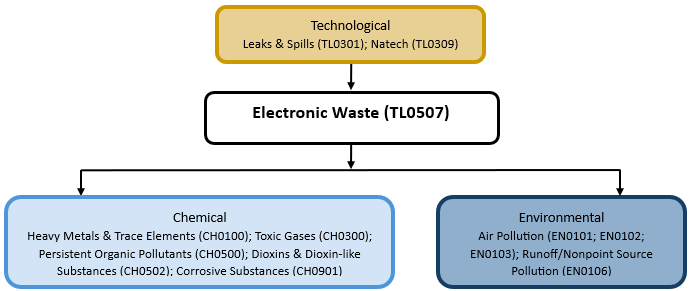
The figure below summarises common interactions between electronic waste and other hazards. This information should be used with caution and not be solely relied upon in Disaster Risk Management, particularly as some interactions may not have been included. Note that hazardous events occurring together or locally in space or time may not necessarily cause, amplify, or be otherwise related to each other. Specific examples of multi-hazard context can be found in the ‘Hazard drivers’ and ‘Impacts’ sections above.
Multi-hazard diagram
Risk Management
Technologies or technical interventions are vital for the WEEE/E-waste management chain to maximize material recovery and minimize the risks. Technical interventions for the collection and transportation of WEEE/E-waste are commonly known as treatment channels and infrastructure. Technical interventions for the treatment of WEEE/E-waste are generally known as treatment technologies. Environmental impacts of treatment technologies (UNEP, 2007b).
Countries that already have WEEE/E-waste regulations often encounter difficulties when putting the regulations into practice. The difficulties are derived from a lack of mechanisms in the flow of WEEE/E-waste in the WEEE/E-waste life cycle. They feel the need to plan and adopt the most effective collection and transport systems to accompany the regulatory systems (UNEP, 2012).
The solution to the e-waste problem is not simply the banning of transboundary movements of e-waste, as domestic generation accounts for a significant proportion of e-waste in all countries. Fundamental to a sustainable solution will be tackling the fact that current practices and illegal trade provide economic stimulus. It is important to recognize local and regional contexts and the social implications of the issue; implementing a high-tech, capital-intensive recycling process will not be appropriate in every country or region. Effective regulation must be combined with incentives for recyclers in the informal sector not to engage in destructive processes. Cheap, safe, and simple processing methods for introduction into the informal sector are currently lacking; hence, it is necessary to create a financial incentive for recyclers operating in the informal sector to deliver recovered parts to central collection sites rather than process them themselves. Multidisciplinary solutions are vital in addition to technical solutions, as is addressing the underlying social inequities inherent in the e-waste business (Sydnes; 2021).
Electronic Waste (e-waste) early warning systems are innovative solutions designed to improve the management and monitoring of electronic waste. Additionally, Early Warning System is a tool that helps companies or relevant organizations predict and monitor in advance whether they are meeting their e-waste collection targets. Based on various data such as past sales figures, the number of households, electricity consumption, income inequality (e.g., the GINI coefficient), and population density, an Artificial Neural Network (ANN) model forecasts the amount of e-waste that will be collected in the future. The forecasted collection amount is then compared with the collection targets set by environmental regulations. If it is expected that the target will not be met, the discrepancy is flagged as a “warning” signal. Once a warning signal is triggered, the company or organization can take measures to improve its collection system or implement additional actions to meet the target (Bolat et al., 2019b).
Monitoring
No Information Available
References
Baldé, C.P., V. Forti, V. Gray, R. Kuehr and P. Stegmann, 2017. Global e-waste monitor 2017: Quantities, flows, and resources. United Nations University, International Telecommunication Union, and International Solid Waste Association. Accessed 11 February 2025.
Basel Convention, 2011. E-Waste Technical Guidelines Finalised and Available Online. Accessed 11 February 2025.
Bolat, B., Temur, G., Celebi, D., Ayvaz, B., and Cebi, F., 2019. Early Warning System Design for WEEE Reverse Logistics Network: A Case Study in Turkey. DOI:10.4018/IJKBO.2019100105. Accessed 3 February 2025.
Forti, V., C.P. Baldé and R. Kuehr, 2018. E-waste Statistics: Guidelines on Classifications, Reporting and Indicators. 2nd Edition. United Nations University, ViE – SCYCLE, Bonn, Germany. Accessed 11 February 2025.
Grant, K., Goldizen, F.C., Sly, P.D., Brune, M.N., Neira, M., van den Berg, M., and Norman, R.E., 2013. Health consequences of exposure to e-waste: a systematic review. The Lancet Global Health, 1:e350-e361.
PACE, 2019. A New Circular Vision for Electronics: Time for a Global Reboot. In support of the United Nations E-waste Coalition. Platform for Accelerating the Circular Economy (PACE). Accessed 11 February 2025.
Sydnes, L.K., 2021. CHEMRAWN in action – This time with e-waste in focus. Chemistry International, DOI: 10.1515/ci-2021-0428. Accessed 11 February 2025.
UN Treaty Collection, 2019. Environment. Chapter XXVII. Basel Convention on the Control of Transboundary Movements of Hazardous Wastes and their Disposal. Accessed 11 February 2025.
UNEP, no date a. Basel Convention on the Control of Transboundary Movements of Hazardous Wastes and their Disposal. United Nations Environment Programme (UNEP). Accessed 11 February 2025.
UNEP, no date b. Basel Convention fact sheet on e-waste. United Nations Environment Programme (UNEP). Accessed 11 February 2025.
UNEP,2007a. E-Waste Inventory Assessment Manual (Volume 1). Accessed 11 February 2025.
UNEP, 2007b. E-Waste Management Manual (Volume 2). Accessed 11 February 2025.
UNEP, 2012. "WEEE/E-Waste 'Take Back System' (Volume 3). Accessed 11 February 2025.
UNEP, 2019a. Technical guidelines on transboundary movements of electrical and electronic waste and used electrical and electronic equipment, in particular regarding the distinction between waste and non-waste under the Basel Convention. (Version of 10 May 2019). United Nations Environment Programme (UNEP). Accessed 11 February 2025.
UNEP, 2019b. Future E-Waste Scenarios report. Accessed 11 February 2025.
United Nations, 2019. The Future is Now: Science for Achieving Sustainable Development. Accessed 11 February 2025.
WHO, 2020. Global e-waste surging: up 21 per cent in 5 years. World Health Organization (WHO). Accessed 11 February 2025.