
Marine Debris
Marine debris is any persistent, manufactured or processed solid material discarded, disposed of or abandoned in the marine and coastal environment. Marine litter consists of items that have been made or used by people and deliberately discarded into the sea or rivers or on beaches; brought indirectly to the sea with rivers, sewage, stormwater or winds; or accidentally lost, including material lost at sea in bad weather (adapted from UN Environment, no date and NOAA, no date).
Primary reference(s)
UN Environment, no date. Marine Litter. Accessed 18 February 2025.
NOAA, no date. National Ocean Service. What are microplastics? National Oceanic and Atmospheric Administration (NOAA). Accessed 18 February 2025.
Annotations
Additional scientific description
Marine debris originates from many sources and causes a wide spectrum of environmental, economic, safety, health and cultural impacts. The very slow rate of degradation of most marine litter items, mainly plastics, together with the ever-growing quantity of debris disposed of, is leading to a gradual increase in marine litter found at sea and on the shores (United Nations, 2017).
Marine debris is present in all marine habitats, from densely populated regions to remote areas far from human activities, from beaches and shallow waters to deep ocean trenches (Wang et al., 2016). The average density of marine debris is estimated to vary from 13,000 to 18,000 pieces per square kilometre (UNEP, 2017). However, data on plastic accumulation in the North Atlantic and Caribbean from 1986 to 2008 showed that the highest concentrations (more than 200,000 pieces per square kilometre) occurred in the convergence zones between two or more ocean currents (Law et al., 2010). Computer model simulations, based on data from about 12,000 satellite-tracked floats deployed since the early 1990s as part of the Global Ocean Drifter Program, confirm that debris will be transported by ocean currents and will tend to accumulate in a limited number of subtropical convergence zones or gyres (Wang et al., 2016).
Marine debris takes many forms, including derelict fishing gear and vessels, abandoned recreational equipment, and discarded consumer plastics, metals, rubber, paper, and textiles. Plastics are by far the most prevalent debris item recorded, contributing an estimated 60% to 80% of all marine debris. Plastic debris continues to accumulate in the marine environment (see Microplastics HIP - CH0504). The density of microplastics within the North Pacific Central Gyre has increased by two orders of magnitude in the past four decades. Marine debris commonly stems from shoreline and recreational activities, commercial shipping and fishing, and dumping at sea. The majority of marine debris (approximately 80%) entering the sea is considered to originate from land-based sources.
Nanoparticles are a form of marine debris, the significance of which is only now emerging. They are minuscule particles with dimensions of 1 to 100 nanometres (a nanometre is one millionth of a millimetre). A large proportion of the nanoparticles found in the ocean are of natural origin. It is the anthropogenic nanoparticles that are of concern. Those originate from two sources: from nanoparticles deliberately created for use in various industrial processes and cosmetics and from the breakdown of plastics in marine debris, fragments of artificial fabrics discharged in urban wastewater, and leaching from land-based waste sites. Recent research has highlighted the potential environmental impacts of plastic nanoparticles: they appear to reduce primary production and uptake of food by zooplankton and filter-feeders (United Nations, 2017).
Metrics and numeric limits
Not available.
Key relevant UN convention / multilateral treaty
Convention on the Prevention of Marine Pollution by Dumping of Wastes and Other Matter (IMO, 2019).
Drivers
Natural hazards such as cyclones, floods, landslides and tsunamis, along with human-induced accidents, can significantly increase the influx of both natural and artificial debris into marine environments. According to the Japan Ministry of the Environment (2012), the 2011 tsunami in Japan released approximately 5 million tons of debris into the ocean within hours. Of this, 3.5 million tons settled on the seafloor, causing severe damage to the benthic ecosystem. Additionally, the radioactive spill from the Fukushima nuclear disaster had devastating effects on the local fishing industry. The remaining 1.5 million tons—equivalent to nearly a full year’s worth of land-based plastic debris input for the entire North Pacific—became floating debris, with portions drifting toward North America and Hawai‘i. This included four 20-metre floating docks, around 1,000 vessels (Maximenko et al., 2018), and other large objects that posed hazards to navigation and remote coastlines. Many nearshore mariculture farms were also dislodged, resulting in a significant increase in floating debris.
Impacts
Marine debris can result in economic losses, habitat damage (including fragile coral reefs), hazards to shipping resulting in costly vessel damage and loss, transport of potentially invasive species that may have devastating impacts on ecosystems, and wildlife injury, illness, and death (NOAA, no date).
Marine debris can affect a wide range of marine life, from small microorganisms to humpback whales. Animals may inadvertently eat debris or become entangled in it. For instance, plastic bags are a common threat to sea turtles, which often mistake them for jellyfish, a common food item. Marine debris also affects other species, such as the endangered Hawaiian monk seal, where one death caused by marine debris is a huge loss (NOAA, no date).
Multi-hazard context
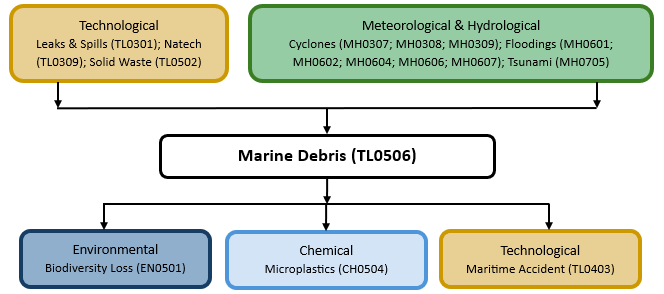
The figure below summarises common interactions between marine debris and other hazards. This information should be used with caution and not be solely relied upon in Disaster Risk Management, particularly as some interactions may not have been included. Note that hazardous events occurring together or locally in space or time may not necessarily cause, amplify or be otherwise related to each other. Specific examples of multi-hazard context can be found in the ‘Hazard drivers’ and ‘Impacts’ sections above.
Multi-hazard diagram
Risk Management
Persistent microplastic waste, originating from various sources and carried by rivers into the ocean, has caused significant biological, ecological, and chemical impacts on marine ecosystems and is recognized as a global issue. Over the past decade, numerous studies have employed remote sensing technologies to detect, monitor, and track marine plastic debris in both coastal and open ocean environments (Waqas et al, 2023). For example, the Integrated Marine Debris Observing System (IMDOS) aims to guide and coordinate a globally sustained monitoring system for marine debris, bridging knowledge gaps and meeting the diverse needs of stakeholders by providing reliable data and information (IOCCP, No date).
Monitoring
As an example, the NOAA Marine Debris Monitoring and Assessment Project (2025) initiative to measure the amount and types of marine debris on shorelines uses a standardised collection method, with a suite of resources and publicly available data, to support participants and volunteers to detect differences in marine debris over time (NOAA, 2025).
References
Carlton, J. T., Chapman, J. W., Geller, J. B., Miller, J. A., Carlton, D. A., McCuller, M. I., et al., 2017. Tsunami-driven rafting, transoceanic species dispersal and implications for marine biogeography. Science 357, 1402–1406. Accessed 3 February 2025
IMO, 2019. Convention on the Prevention of Marine Pollution by Dumping of Wastes and Other Matter. International Maritime Organization (IMO). Accessed 17 February 2025.
International Ocean Carbon Coordination Project, 2025. Integrated Marine Debris Observing System(IMDOS). Accessed 3 February 2025.
Japan Ministry of the Environment, 2012. Estimated Total Amount of Debris Washed Out by the Great East Japan Earthquake. Accessed 3 February 2025
Law, K.L., Moret-Ferguson, S., Maximenko, N.A., Proskurowski, G., Peacock, E.A., Hafner, J., and Reddy, C.M., 2010. Plastic accumulation in the North Atlantic subtropical gyre. Science, 329:1185-1118. 10.1126/science.1192321
Maximenko, N. A., Hafner, J., Kamachi, M., and MacFadyen, A., 2018. Numerical simulations of debris drift from the 2011 tsunami in Japan, verified with boat reports. Mar. Pollut. Bull. 132, 5–25. Accessed 3 February 2025
NOAA, 2025. Marine Debris Monitoring and Assessment Project. National Oceanic and Atmospheric Administration (NOAA). Accessed 8 July 2025
NOAA, no date. Marine Debris. Office for Coastal Management. National Oceanic and Atmospheric Administration (NOAA). Accessed 17 February 2025.
UNEP, 2017. UN Environment contribution to Concept Papers for Partnership Dialogues of The Ocean Conference. United Nations Environment Programme (UNEP). Accessed 17 February 2025.
United Nations, 2017. The First Global Integrated Marine Assessment: World Ocean Assessment I. Cambridge University Press. Accessed 17 February 2025.
Wang, J., K. Kiho, D. Ofiara, Y. Zhao, A. Bera, R. Lohmann and M.C. Baker, 2016. First Global Integrated Marine Assessment: World Ocean Assessment I. Accessed 17 February 2025.
Waqas, M., Wong, M.S., Stocchino, A., Abbas, S., Hafeez, S., Zhu, R., 2023. Marine plastic pollution detection and identification by using remote sensing-meta analysis, Marine Pollution Bulletin, Volume 197, 115746, ISSN 0025-326X. doi: 10.1016/j.marpolbul.2023.115746. Accessed 17 February 2025.