Plastic Waste
Plastic Waste is defined as any discarded plastic (organic, or synthetic, material derived from polymers, resins or cellulose) generated by any industrial process, or by consumers. (Source: GEMET/APD).
Primary reference(s)
UNEP, no date. Plastic Waste. Montevideo Environmental Law Programme. Accessed 11 February 2025
Annotations
Additional scientific description
Plastic is a lightweight, hygienic and resistant material which can be moulded in a variety of ways and used in a wide range of applications. Unlike metals, plastics do not rust or corrode. Most plastics do not biodegrade, but instead photodegrade, a process in which exposure to environmental factors, including sunlight, breaks them down into smaller fragments, eventually forming microplastics, which can persist in the environment for long periods. (UNEP, 2018).
The 14th Meeting of the Conference of the Parties to the Basel Convention defined categories of wastes requiring special consideration (European Commission, 2019). This includes:
- Plastic waste, including mixtures of such waste, with the exception of the following: plastic waste that is hazardous waste pursuant to paragraph 1 (a) of Article 18; plastic waste listed below, provided it is destined for recycling in an environmentally sound manner and almost free from contamination and other types of wastes; and plastic waste almost exclusively consisting of one non-halogenated polymer, including but not limited to the following polymers: polyethylene (PE), polypropylene (PP), polystyrene (PS), acrylonitrile butadiene styrene (ABS), polyethylene terephthalate (PET), polycarbonates (PC), polyurethane (PUR) and polyethers.
- Plastic waste almost exclusively consisting of one cured resin or condensation product, including but not limited to the following resins: urea formaldehyde resins; phenol formaldehyde resins; melamine formaldehyde resins; epoxy resins; and alkyd resins.
Plastic waste almost exclusively consisting of one of the following fluorinated polymers: perfluoroethylene/ propylene (FEP); perfluoroalkoxy alkanes; tetrafluoroethylene/ perfluoroalkyl vinyl ether (PFA); tetrafluoroethylene/ perfluoromethyl vinyl ether (MFA); polyvinylfluoride (PVF); polyvinylidenefluoride (PVDF); and mixtures of plastic waste, consisting of polyethylene (PE), polypropylene (PP) and/or polyethylene terephthalate (PET), provided they are destined for separate recycling of each material and in an environmentally sound manner and almost free from contamination and other types of wastes. Most plastics are usually a blend of polymers and additives (e.g., stabilisers such as lead stabilisers and cadmium stabilisers; plasticisers such as phthalates; flame retardants such as antimony oxides, phosphatases, brominated flame retardants and medium-chain chlorinated paraffins). The elements most commonly found in plastics are carbon, hydrogen, nitrogen, oxygen, chlorine, fluorine and bromine. Some of these elements are hazardous when uncombined but become inert when incorporated into an organic polymer (UNEP, 2023a, 2023b).
The composition of plastic waste does not only depend on the intrinsic composition of the different plastics included, but also on impurities or contaminants. These impurities may arise from the various applications of the plastic, as well as the processes of waste generation and collection. For instance, plastic food packaging may contain food residues, films used in agriculture may contain high percentages of soil and pesticide, and plastic waste from cables may contain residual metals such as copper or aluminium. These contaminants can complicate the recycling and disposal of plastic waste, as they introduce additional challenges for ensuring environmentally sound management. The presence of these impurities highlights the need for effective separation, cleaning, and sorting technologies to improve recycling efficiency and reduce contamination risks (UNEP, 2018). COVID-19 increased single-use plastic waste, though plastics use fell overall. The lockdowns and decline in economic activity during 2020 reduced plastics use by 2.2% from 2019 levels. However, the increase in the use of protective personal equipment and single-use plastics has exacerbated plastic littering.
Plastic pollution is defined broadly as the negative effects and emissions resulting from the production and consumption of plastic materials and products across their entire life cycle. This definition includes plastic waste that is mismanaged (e.g. open-burned and dumped in uncontrolled dumpsites) and leakage and accumulation of plastic objects and particles that can adversely affect humans and the living and non-living environment (UNEP, 2023b).
Over 13,000 substances have so far been associated with plastics, either known for use in plastic production or detected in plastic materials. Chemicals of concern can be released from plastic along its entire life cycle, during not only the extraction of raw materials, production of polymers and manufacture of plastic products, but also the use of plastic products and at the end of their life, particularly when waste is not properly managed, finding their way to the air, water and soils. Some chemicals can pose significant challenges to technological solutions to plastics recycling and material circularity (UNEP, 2023a).
Sources of plastic waste can also be categorized based on applications (e.g., bottles/caps/lids: 14.9 %, PET bottles: 12.5 %, supermarket bags/retail bags: 9.3 %, food bags: 6.5 %, food containers: 2.1 %, etc.) and origin (e.g., municipal solid waste and agro-industrial waste) (Nayanathara et al., 2024). Waste requires a consideration of local circumstances and of both the intrinsic composition of plastic and potential contamination. The presence of impurities and contaminants in the plastics may influence the options for managing the waste in an environmentally sound manner and should be addressed appropriately. Contaminated plastic wastes may be a major or minor hazard depending on the contaminant (UNEP, 2023a).
Metrics and numeric limits
Globally, the annual production of plastics has doubled, soaring from 234 million tonnes (Mt) in 2000 to 460 Mt in 2019. Plastic waste has more than doubled, from 156 Mt in 2000 to 353 Mt in 2019. After considering losses during recycling, only 9% of plastic waste was ultimately recycled, while 19% was incinerated and almost 50% went to sanitary landfills. The remaining 22% was disposed of in uncontrolled dumpsites, burned in open pits or leaked into the environment. In 2019 alone, 6.1 Mt of plastic waste leaked into rivers, lakes and the ocean. The build-up of plastics in rivers implies that leakage into the ocean will continue for decades to come even if mismanaged plastic waste was significantly reduced. Furthermore, cleaning up these plastics is becoming more difficult and costly as plastics fragment into ever smaller particles (OECD, 2022). Every minute, the equivalent of one garbage truck full of plastic is dumped into the ocean (WE, 2016)
Key relevant UN convention / multilateral treaty
Basel Convention on the Control of Transboundary Movements of Hazardous Wastes and their Disposal (1989). At the time of writing, there were 187 parties to the Basel Convention (UN Treaty Collection, 2019). At its 14th meeting, the Conference of the Parties to the Basel Convention adopted decision BC-14/12 by which it amended Annexes II, VIII and IX to the Convention with the objectives of enhancing the control of the transboundary movements of plastic waste and clarifying the scope of the Convention as it applies to such waste (European Commission, 2019).
The following new entries to the Basel Convention Plastic Waste Amendment became effective on 1 January 2021:
• Annex II, new entry Y48: covers plastic waste, including mixtures of with various exceptions listed thereunder, making them subject to the prior informed consent (PIC) procedure.
• Annex VIII, new entry A3210: clarifies the scope of plastic waste presumed to be hazardous and therefore subject to the PIC procedure.
• Annex IX, new entry B3011 replacing existing entry B3010: clarifies the types of plastic waste that are presumed not to be hazardous and, as such, not subject to the PIC
Convention on the Prevention of Marine Pollution by Dumping of Wastes and Other Matter 1972 (IMO, 2020), or ‘London Convention’ for short. This is one of the first global conventions to protect the marine environment from human activities and has been in force since 1975. Its objective is to promote the effective control of all sources of marine pollution and to take all practicable steps to prevent pollution of the sea by dumping of wastes and other matter. Currently, 87 States are Parties to this Convention.
Stockholm Convention on Persistent Organic Pollutants (POPs) (2004)
Drivers
Overconsumption of plastic, lack of regulations and population increase are among the drivers of plastic production plastic waste (OECD, 2022).
Impacts
Plastic pollution, including plastic waste, harms wildlife and damages ecosystems (UNEP, no date) and is responsible for vast economic losses in the tourism, fishing and shipping industries. Worldwide, the total damage to the world’s marine ecosystem due to plastic waste is estimated to total at least USD$ 13 billion per year (Independent Group of Scientists, 2019). As well as harm to wildlife and ecosystems, many plastics may be chemically harmful in other contexts because they are themselves potentially toxic, contain additives or because they absorb other pollutants (Rochman et al., 2013).
The human health risk from microplastics in drinking-water is a function of both hazard and exposure. Potential hazards associated with microplastics come in three forms: the particles themselves which present a physical hazard, chemicals (unbound monomers, additives, and sorbed chemicals from the environment), and microorganisms that may attach and colonize on microplastics, known as biofilms. Based on the limited evidence available, chemicals and microbial pathogens associated with microplastics in drinking-water pose a low concern for human health. Although there is insufficient information to draw firm conclusions on the toxicity of nanoparticles, no reliable information suggests it is a concern (WHO,2019).
WHO,(2019) and SAPEA (2019) identified that there is very little published data is available regarding either exposure to, or the toxicity of microplastics and nanoplastics in humans, . The reports acknowledge the current challenges facing scientists attempting to gather robust information and recommend proceeding to fill knowledge gaps. The SAPEA report states on p. 116 that ‘the absence of evidence of microplastics risks currently does not allow one to conclude that risk is either present or absent with sufficient certainty’ (SAPEA, 2019).
Multi-hazard context
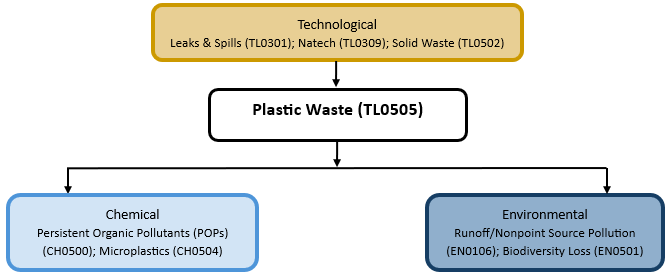
The figure below summarises common interactions between plastic waste and other hazards. This information should be used with caution and not be solely relied upon in Disaster Risk Management, particularly as some interactions may not have been included. Note that hazardous events occurring together or locally in space or time may not necessarily cause, amplify, or be otherwise related to each other. Specific examples of multi-hazard context can be found in the ‘Hazard drivers’ and ‘Impacts’ sections above.
Multi-hazard diagram
Risk Management
Plastic waste recycling faces technical, economic and structural issues that are still to be overcome globally (UNEP, 2023b). Recycling of plastic waste can be supported with legal and economic instruments (UNEP, 2023b). To reduce plastic pollution, it is of critical importance to improve the state of solid waste collection services, strengthen the recycling industry and ensure safe disposal of waste to controlled landfills (UNEP, 2018).
As part of water safety planning, water suppliers should ensure that control measures are effective and should optimise water treatment processes for particle removal and microbial safety, which will incidentally improve the removal of microplastic particles. The report also stated that measures should be taken to better manage plastics and reduce the use of plastics where possible, to minimise plastic and microplastic pollution despite the low human health risk posed by exposure to microplastics in drinking-water, as such actions can confer other benefits to the environment and human well-being (WHO, 2019).
Addressing the issue of plastics waste in a multi-hazard context requires an integrated approach that accounts for the interactions between environmental, anthropogenic, and socio-economic factors. Effective management strategies must include regulatory frameworks, technological advancements, public awareness campaigns, and global cooperation to reduce the environmental and health impacts of plastic waste (Kaza et al., 2018; Da Costa et al., 2020).
Monitoring
The section and the table below offer an overview of monitoring plastic waste. This information can be used for forecasting within a national early warning system (EWS). Since EWS capacities and processes differ across countries, the most current and specific information regarding EWS should be obtained from the appropriate national or regional agency/authority responsible for disaster management.
| Which institution(s) produce(s) Disaster Risk Data/Information? | Academic studies, Environmental Monitoring Programs, International Policies and Conventions. |
| How is the Hazard Observed/Monitored/Forecast? | Marine and Coastal Monitoring, Remote Sensing and Satellite Imaging, Citizen Science and Community-Based Observations, Forecasting Tools and Models |
References
Da Costa, J. P., Mouneyrac, C., Costa, M., Duarte, A. C., & Rocha-Santos, T., 2020. The role of legislation, regulatory initiatives and guidelines on the control of plastic pollution. Frontiers in Environmental Science, 8, 104. Frontiers | The Role of Legislation, Regulatory Initiatives and Guidelines on the Control of Plastic Pollution. Accessed 11 February 2025.
IMO, 2020. Convention on the Prevention of Marine Pollution by Dumping of Wastes and Other Matter 1972. International Maritime Organization (IMO). Accessed 21 May 2025.
Independent Group of Scientists appointed by the Secretary-General, Global Sustainable Development Report, 2019. The Future is Now – Science for Achieving Sustainable Development, (United Nations, New York, 2019). Accessed 21 May 2025
Kaza, Silpa; Yao, Lisa C.; Bhada-Tata, Perinaz; Van Woerden, Frank, 2018. What a Waste 2.0: A Global Snapshot of Solid Waste Management to 2050. Urban Development;. © Washington, DC: World Bank. Accessed 11 February 2025.
Nayanathara, P. G. C., Pilapitiya, T., Sandaruwan Ratnayake, A., 2024. The world of plastic waste: A review. Cleaner Materials 11, 100220. The world of plastic waste: A review - ScienceDirect. Accessed 11 February 2025.
OECD, 2022. Global plastic Outlook: Economic Drivers, Environmental Impacts and Policy Options. OECD Publishing, Paris. DOI: 10.1787/de747aef-en. Accessed 11 February 2025.
SAPEA, Science Advice for Policy by European Academies, 2019. A Scientific Perspective on Microplastics in Nature and Society. Berlin: SAPEA. 10.26356/microplastics. Accessed 21 May 2025
Stockholm Convention, 2004. Stockholm Convention on Persistent Organic Pollutants (POPs), 2004. Accessed 21 May 2025
UN Treaty Collection, 2019. Basel Convention on the Control of Transboundary Movements of Hazardous Wastes and their Disposal. Environment. Chapter XXVII. Accessed 21 May 2025.
UNEP, no date. Tackling marine debris. United Nations Environment Programme (UNEP). Accessed 21 May 2025.
UNEP, 2002. Technical Guidelines for the Identification and Environmentally Sound Management of Plastic Wastes and for their Disposal. UNEP/CHW.6/21. United Nations Environment Programme (UNEP). Accessed 21 May 2025.
UNEP, 2018. Single-use Plastics: A roadmap for Sustainability. United Nations Environment Programme (UNEP). Accessed 21 May 2025.
UNEP, 2023a. Chemicals in Plastics. United Nations Environment Programme (UNEP). Accessed 11 February 2025.
UNEP, 2023b. Turning Off the tap . United Nations Environment Programme (UNEP). Accessed 11 February 2025.
UNEP, 2023c. Microplastics: The long legacy left behind by plastic pollution. United Nations Environment Programme (UNEP). Accessed 21 May 2025
WEF, 2016. Every minute, one garbage truck of plastic is dumped into our oceans. This has to stop , World Economic Forum (MEF). Accessed 21 May 2025
WHO, 2019. Microplastics in Drinking-Water. World Health Organization (WHO). Accessed 11 February21 May 2025.