
Wastewater
Wastewater is regarded as a combination of one or more of the following materials: domestic effluent consisting of ‘blackwater’ (excreta, urine and faecal sludge, contaminants from pharmaceutical and personal care products) and ‘greywater’ (used water from washing and bathing); water from commercial establishments and institutions, including hospitals; industrial effluent, stormwater and other urban runoff; and agricultural, horticultural and aquaculture runoff (UNEP, 2023a).
Primary reference(s)
UNEP, 2023a. Wastewater – Turning Problem to Solution. A UNEP Rapid Response Assessment. Nairobi.
Accessed 20 January 2024
Annotations
Additional scientific description
Insufficient treatment of wastewater and faecal sludge spreads disease and is a driver of antimicrobial resistance (UNEP 2023b). Wastewater is also considered to contain increasing amounts and types of unregulated contaminants and organic compounds of emerging concern, such as human and veterinary antibiotics, and prescription and non-prescription drugs (UNEP, 2023a).
Demand for wastewater as a reliable source of water and nutrients for agriculture is growing under the pressures of population growth, urbanisation, increasing water scarcity and the effects of climate change (WHO, 2019). Wastewater can generate biogas, heat, and electricity. It can produce about five times more energy than is required for its treatment - enough to provide electricity for around half a billion people per year. The untapped potential for wastewater reuse is around 320 billion m3 per year, with the potential to supply more than 10 times the current global desalination capacity. (UNEP, 2023a)
Metrics and numeric limits
WHO produces international norms on water quality and human health in the form of guidelines that are used as the basis for regulation and standard setting world-wide. The Guidelines for drinking-water quality promote the protection of public health by advocating for the development of locally relevant standards and regulations (health-based targets), adoption of preventive risk management approaches covering catchment to consumer (Water Safety Plans) and independent surveillance to ensure that Water Safety Plans are being implemented and effective and that national standards are being met. (WHO, no date).
Key relevant UN convention / multilateral treaty
Convention on the Protection and Use of Transboundary Watercourses and International Lakes also referred to as the Water Convention (1992). Although initially intended for the United Nations Economic Commission for Europe (UNECE) region, in 2016 the Water Convention allowed accession of all United Nations Member States worldwide. At the time of writing, there were 43 parties to the Water Convention. Almost all countries sharing transboundary waters in the UNECE region are Parties to the Convention (UNECE, 2019).
Drivers
Pollution from chemicals and waste is a major driver of biodiversity and ecosystem change, particularly in freshwater and marine habitats (Secretariats of the Basel, Rotterdam Stockholm Conventions, and the Minamata Convention on Mercury 2021; UNEP, 2023c; UNEP, 2023d)
Industrialisation without adherence to environmental standards and lack of wastewater management systems is a driver of contaminated wastewater. Globally, approximately 80% of all wastewater is discharged without adequate treatment (UNESCO, 2017). Wastewater critical infrastructure failure may also lead to the release of untreated wastewater into the environment. Uncontrolled dumpsites, which until the middle of the last century were the dominant disposal choice globally, pose ongoing risks to water quality, public health and the climate (Cristóbal et al., 2022)
Waste disposed of on land can cause long-term pollution of freshwater sources by pathogens, heavy metals, endocrine-disrupting chemicals and other hazardous compounds (Kuchelar & Sudarsan, 2022; Thives et al., 2022).
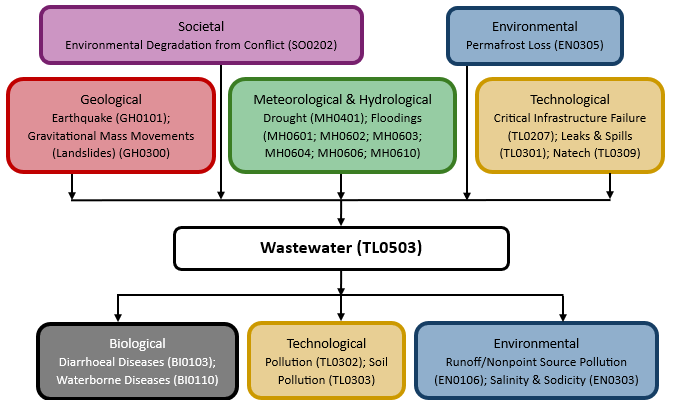
Floods, droughts, earthquakes, and landslides may affect the wastewater management system and lead to the release of wastewater into the environment (UNECE & WHO Europe, 2011).
It is estimated that 20 per cent of anthropogenic methane emissions are caused by the anaerobic decomposition of food and other organic materials left in landfills, open dumps and wastewater (UNEP & Climate and Clean Air Coalition, 2021)
Impacts
Wastewater accounts for about 1.57% of global greenhouse gas emissions, just below the climate harm caused by the global aviation industry (UNEP, 2023a). As of 2014, most cities were missing the appropriate infrastructure and resources to address wastewater management in an efficient and sustainable way (UNDESA 2014, cited in UN Water, no date). Urban areas with high population densities in low-income and lower-middle- income countries are considered particularly at risk (UNEP, 2016). Discharge of wastewater without adequate water treatment may have serious implications for health and well-being (UN Water, 2017).
In parallel, wastewater treatment plant operatives are exposed to a variety of hazardous chemical agents, within the effluents and the reagents used in water processing or generated during water treatment. These chemical agents may cause acute poisoning, chemical accidents (skin burns, injury to the eyes, etc.), damage to the respiratory system, allergies, dermatitis, and chronic diseases (ILO, 2012).
Several water-related diseases, including cholera and schistosomiasis, remain widespread across many developing countries, where only a very small fraction (in some cases less than 5%) of domestic and urban wastewater is treated prior to its release into the environment (UN WWAP, 2017). By 2030, the health and livelihoods of 4.8 billion people could be at risk if current water quality monitoring is not improved (UN-Water, 2024).
Demand for wastewater as a reliable source of water and nutrients for agriculture is growing under the pressures of population growth, urbanisation, increasing water scarcity and the effects of climate change (UNEP, 2023a).
Multi-hazard context
The figure below summarises common interactions between wastewater and other hazards. This information should be used with caution and not be solely relied upon in Disaster Risk Management, particularly as some interactions may not have been included. Note that hazardous events occurring together or locally in space or time may not necessarily cause, amplify, or be otherwise related to each other. Specific examples of multi-hazard context can be found in the ‘Hazard drivers’ and ‘Impacts’ sections above.
Multi-hazard diagram
Risk Management
UNEP contributes to the global efforts around wastewater surveillance for the environment and public health. Wastewater surveillance is a useful method to collect information and tackle diseases as well as land-based sources of pollution. Wastewater surveillance provides an important line of data to support the early detection of COVID-19 and other diseases. In addition, it also provides useful data to tackle land-based sources of pollution, maintain ecosystems services and protect freshwater and marine ecosystems. This trend is encouraging for the future of health systems and sound environmental management, but there is a need to expand this positive trend further and enhance the good practices and significant efforts to monitor and assess water quality. UNEP is managing a wastewater surveillance initiative with the goal of expanding wastewater surveillance programmes. The target of this initiative is Africa, where the goal is to help reduce wastewater and nutrient pollution, reduce risks for ecosystems and human health, and overall improve socio-economic and environmental conditions. The surveillance initiative involves all sub-regions of Africa and selected countries to advance capacity-building, transfer of knowledge and awareness raising through tailored training, awareness and communication material, and practical implementation of wastewater surveillance at selected airports and ports across Africa. (UNEP, 2025)
As a research project supported by the European Union and Interreg, the Multi-hazard framework for water-related risk management (MUHA) project aimed at supporting Water Utilities, Civil Protection organizations, and Water Authorities to identify and mitigate hazardous events, contributing to water supply resiliency through Water Safety Plans (WSP). The project focused on four major hazards: floods, droughts, accidental pollution, and earthquakes. It sought to improve the methodology for developing WSP, a comprehensive risk assessment and risk management approach from catchment to consumer, ensuring the safety of drinking water supply. The project also aimed to harmonize Water Safety Plans and disaster response mechanisms at the transnational level. A risk assessment methodology was developed to evaluate the probability and severity of hazardous events, ensuring improved preparedness, response, and resilience (MUHA partnership, 2022).
Early warning for wastewater is primarily conducted for two purposes: epidemiological surveillance and environmental monitoring. For example, Digital-water City’s Early Warning System is a tool able to identify the Occurrence of a contamination/hazard event in real-time or even beforehand during the production of reclaimed wastewater to improve the safeguard of public health and the environment. The EWS in the wastewater reuse sector has been designed to combine risk management with digitalization to ensure safe practices under automatized and continuous control. The EWS allows wastewater utilities to control, monitor, and share with stakeholders and users, data related to the safe reuse of treated water, maximizing the benefits of effective water reuse in agriculture. The system processes the available monitoring and operational data of the treatment plant within an interoperable platform and embeds machine learning algorithms for online data assessment, detection of outliers, failure analysis and prediction of contamination events at the outflow of the treatment plant. The system is connected with the local development of a risk management plan to ensure the safety and acceptability of water reuse practices (Digital-water.City, no date).
Monitoring
The section and the table below offer an overview of monitoring arsenic. This information can be used for forecasting within a national early warning system (EWS). Since EWS capacities and processes differ across countries, the most current and specific information regarding EWS should be obtained from the appropriate national or regional agency/authority responsible for disaster management.
| Which institution(s) produce(s) Disaster Risk Data/Information? | Private companies / public agencies managing wastewater facilities; Environment Protection Agencies, Health Agencies |
| How is the Hazard Observed/Monitored/Forecast? | Epidemiological surveillance of contamination by pathogens. For example, Digital-Water Ccity’s Early Warning System (EWS) is a tool able to identify the Occurrence of a contamination/hazard event in real-time or even beforehand during the production of reclaimed wastewater to improve the safeguard of public health and the environment. The EWS in the wastewater reuse sector has been designed to combine risk management with digitalization to ensure safe practices under an automatized and continuous control. The EWS allows wastewater utilities to control, monitor, and share with stakeholders and users, data related to the safe reuse of treated water, maximizing the benefits of effective water reuse in agriculture. The system processes the available monitoring and operational data of the treatment plant within an interoperable platform and embeds machine learning algorithms for online data assessment, detection of outliers, failure analysis and prediction of contamination events at the outflow of the treatment plant. The system is connected with the local development of a risk management plan to ensure the safety and acceptability of water reuse practices (Digital-water.City, No date). |
References
Cristóbal, J., Vázquez-Rowe, I., Margallo, M., Ita-Nagy, D., Ziegler-Rodriguez, K. and Laso, J., 2022. Climate change mitigation potential of transitioning from open dumpsters in Peru: Evaluation of mitigation strategies in critical dumpsites. Science of The Total Environment, 846, 157295. [online]. DOI: 10.1016/j.scitotenv.2022.157295. Accessed 21 May 2025.
Digital-water.City, no date. Early warning system for safe reuse of treated wastewater for agricultural irrigation. [online]. Accessed 21 May 2025.
International Labour Organization (ILO), 2012. Operator, Wastewater Treatment Plant: International Hazard Datasheets on Occupation. [online]. Accessed 3 February 2025.
Kuchelar, P. and Sudarsan, J.S., 2022. Heavy metal assessment of groundwater on the periphery of a semi-urban solid waste dumpsite and mitigation strategy. In: Panneerselvam, B., Pande, C.B., Muniraj, K., Balasubramanian, A. and Ravichandran, N., eds. Climate Change Impact on Groundwater Resources. Cham: Springer, pp.241–255. [online]. DOI: 10.1007/978-3-031-04707-7_13. Accessed 21 May 2025.
MUHA Partnership, 2022. Multihazard framework for water related risks management (MUHA). Interreg, co-funded by the European Union. [online]. Accessed 3 February 2025.
Secretariats of the Basel, Rotterdam, Stockholm Conventions and the Minamata Convention on Mercury, 2021. Interlinkages between the Chemicals and Waste Multilateral Agreements and Biodiversity: Key Insights. [online]. Accessed 21 May 2025.
Thives, L.P., Ghisi, E., Thives Júnior, J.J. and Vieira, A.S., 2022. Is asbestos still a problem in the world? A current review. Journal of Environmental Management, 319, 115716. [online]. Accessed 21 May 2025.
United Nations Department of Economic and Social Affairs (UNDESA), 2014. Population Division: World Urbanization Prospects. [online]. Accessed 21 May 2025
United Nations Economic Commission for Europe (UNECE), 2019. Water Convention. [online]. Accessed 21 May 2025.
United Nations Economic Commission for Europe (UNECE) and World Health Organization Regional Office for Europe (WHO Europe), 2011. Guidance on Water Supply and Sanitation in Extreme Weather Events. [online]. Accessed 21 May 2025.
United Nations Environment Programme (UNEP), 2016. A snapshot of the world’s water quality: Towards a global assessment. [online]. Accessed 3 February 2025.
United Nations Environment Programme (UNEP), 2023a. Wastewater – Turning Problem to Solution. 23 August. [online]. Accessed 3 February 2025.
United Nations Environment Programme (UNEP), 2023b. Bracing for Superbugs: Strengthening Environmental Action in the One Health Response to Antimicrobial Resistance. [online]. Accessed 3 February 2025.
United Nations Environment Programme (UNEP), 2023c. Pollution Action: The missing link in biodiversity protection. [online]. Accessed 21 May 2025.
United Nations Environment Programme (UNEP), 2023d. Five drivers of the nature crisis. [online]. Accessed 21 May 2025.
United Nations Environment Programme (UNEP), 2025. Wastewater Surveillance. [online]. Accessed 21 May 2025.
United Nations Environment Programme (UNEP) and Climate and Clean Air Coalition (CCAC), 2021. Global Methane Assessment: Benefits and Costs of Mitigating Methane Emissions. Nairobi: UNEP. [online]. Accessed 21 May 2025.
United Nations Educational, Scientific and Cultural Organization (UNESCO), 2017. Wastewater: An Untapped Resource. [online]. Accessed 3 February 2025.
United Nations Statistics Division (UNSD), 2024. Progress on Ambient Water Quality – 2024 Update. [online]. Accessed 3 February 2025.
United Nations Water (UN Water), 2017. Untreated Wastewater - A Growing Danger. [online]. Accessed 3 February 2025.
United Nations Water (UN Water), no date. Water quality and wastewater. [online]. Accessed 21 May 2025.
United Nations World Water Assessment Programme (UNWWAP), 2017. The United Nations water development report, 2017: Wastewater: the untapped resource. [online]. Accessed 21 May 2025.
World Health Organization (WHO), 2019. Wastewater. [online]. Accessed 3 February 2025.
World Health Organization (WHO), no date. Drinking-water quality guidelines in Water Sanitation and Health. [online]. Accessed 21 May 2025.