
Solid Waste
Solid waste covers discarded materials that are no longer required by the owner or user. Solid waste includes materials that are in a solid or liquid state but excludes wastewater and small particulate matter released into the atmosphere (United Nations, 2014).
Primary reference(s)
United Nations Environment Programme, 2024. Global Waste Management Outlook 2024. Accessed 11 February 2025.
Annotations
Additional scientific description
Solid waste may include such materials as: municipal solid waste including general domestic garbage such as food waste, ash and packaging materials; human faeces disposed of in garbage; building and construction waste (including asbestos); hazardous waste (including PFAs and other chemicals); healthcare waste; and disaster waste. Examples of disaster waste include waste from damaged infrastructure, plastic water bottles, packaging from other emergency supplies and other waste from relief operations, rubble resulting from the disaster, mud and slurry deposited by the disaster, fallen trees and rocks obstructing transport and communications (WHO, 2024). Controlled waste is collected and then either recycled or disposed of in a controlled facility. Uncontrolled waste is either not collected, and thus dumped or burned in the open, or collected and then dumped or burned at its final destination (UNEP, 2024).
Low-income countries have proportionally larger rural populations, which means more people live close to locations where food is produced. In these countries, less packaging is used to transport food from rural to urban areas. Packaging therefore makes up a smaller proportion of Municipal Solid Waste (MSW). This can be seen in the composition of MSW in Sub-Saharan Africa and South America. These regions have a higher relative proportion of food waste, not because they waste more food than other regions but because there is a smaller share of packaging waste in their MSW stream. Higher- income, more urbanised populations require more packaging to transport food safely from rural to urban areas. Moreover, higher-income consumers tend to prioritise convenience, resulting in more single-use products and packaging from home deliveries and takeout food being found in the MSW stream. These consumers also have more disposable income to spend on goods such as clothing and personal hygiene products. The impact of their consumption patterns on MSW composition can be seen, for example, in MSW composition in North America and Northern and Western Europe. Other factors affecting MSW composition include climate (more garden waste may be generated in areas with high rainfall), population density and cultural practices (UNEP, 2024).
Conceptual and methodological problems of statistics on solid waste have long been identified. Across countries and regions, there are significant challenges in terms of waste data and availability. One important issue is the lack of standardisation in measurement and reporting; another is the lack of well-developed monitoring systems in many countries, which means adequate estimates do not exist for simple indicators such as total collected waste and the share of collected waste deposited in controlled landfills. Although there are significant relationships between waste generation and indicators such as the Human Development Index, share of urban population, gross national income and adult literacy rates, analysis shows that the best model fit is linear regression using only GDP per capita, (UNEP, 2024).
Metrics and numeric limits
Global municipal solid waste generation, by householders; retailers and other small businesses; public service providers; and other similar sources, was estimated at 2.1 billion tonnes/year in 2020 and at 23 billion tonnes/year in 2024. Owing to a combination of economic and population growth, it is projected to increase by 56 per cent to 3.8 billion tonnes by 2050 if urgent action is not taken (UNEP, 2024).
The global share of uncontrolled MSW disposal (dumping and open burning; see Section 2.3.6) is projected to increase slightly, from 38 per cent in 2020 to 41 per cent by 2050. However, when projected MSW growth (Section 2.1) is factored in, this proportional increase will mean an almost two-fold increase in uncontrolled MSW, from 806 million tonnes in 2020 to 1.6 billion tonnes in 2050 (UNEP, 2024).
Key relevant UN convention / multilateral treaty
Basel Convention on the Control of Transboundary Movements of Hazardous Wastes and their Disposal (1989). At the time of writing, there were 187 parties to the Basel Convention (UN Treaty Collection 2019).
Basel Convention Amendments on Plastic Waste (2019) and E-waste (2021-2022).
UNEP’s Global Framework on Chemicals and Waste (2023).
OECD waste policy updates (2023-2024)
Drivers
Solid waste generation, and in particular Municipal Solid Waste (MSW) is linearly related to GDP and waste management issues lead to the accumulation of waste. For example, the number of fast-growing middle-income countries, where waste management issues are especially prominent, is increasing. In 2020, 38 % of the MSW generated globally was uncontrolled. (UNEP, 2024). Some 2.7 billion people do not have their waste collected: 2 billion in rural areas and 700 million in urban areas. This amounts to 540 million tonnes of MSW, or around 27 % of the global total, not being collected (UNEP, 2024).
Impacts
Poor waste management (including ineffective collection and disposal) causes air, soil and water pollution (UN Environment, no date). Waste, including solid waste, influences the triple- planetary crisis of:
- Climate change: Transporting, processing and disposing of waste generates CO2 and other greenhouse gases and airborne pollutants that contribute to climate change.
- Biodiversity Loss: Indiscriminate waste disposal practices can introduce hazardous chemicals into soil, water bodies and the air, causing long-term, potentially irreversible damage to local flora and fauna, negatively impacting biodiversity, harming entire ecosystems, and entering the human food chain.
- Pollution: Between 400,000 and 1 million people die every year as a result of diseases related to mismanaged waste including diarrhoea, malaria, heart disease and cancer (Williams et al., 2019).
Solid waste creates favourable habitats for insects, rodents and other disease vectors and thereby increases the risk of diseases such as dengue, malaria and yellow fever (WHO, 2013; Sphere Association, 2018). In addition, communities may scavenge among solid waste, leading to increased cases of disease such as dysentery and exposure to other noxious or toxic substances. Meanwhile, indiscriminate dumping of waste can also block water courses causing flooding (WHO, 2013), causing contamination of the environment and impacting aquatic ecosystems, including the marine environment. People passing through solid waste- containing areas are exposed to the risk of injuries from broken glass, needles, etc. and exposure to contaminants. Waste has a demoralising impact on communities and may lower morale (WHO, 2013).
Multi-hazard context
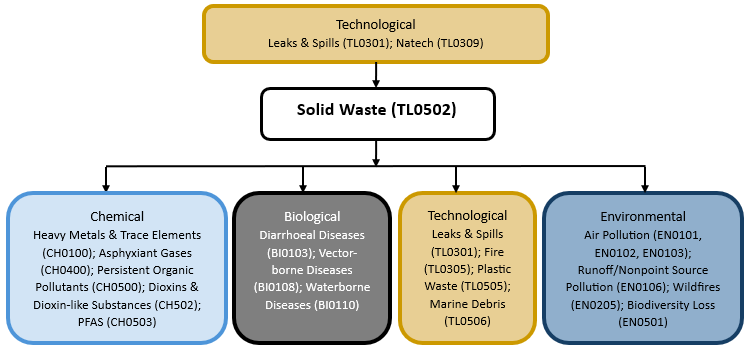
The figure below summarises common interactions between solid waste and other hazards. This information should be used with caution and not be solely relied upon in Disaster Risk Management, particularly as some interactions may not have been included. Note that hazardous events occurring together or locally in space or time may not necessarily cause, amplify, or be otherwise related to each other. Specific examples of multi-hazard context can be found in the ‘Hazard drivers’ and ‘Impacts’ sections above.
Multi-hazard diagram
Risk Management
There is an urgent need for both upstream measures to reduce resource use and waste generation, and downstream measures to reduce the environmental impacts of waste. Different sectors play different roles in delivering these measures (UNEP, 2024).
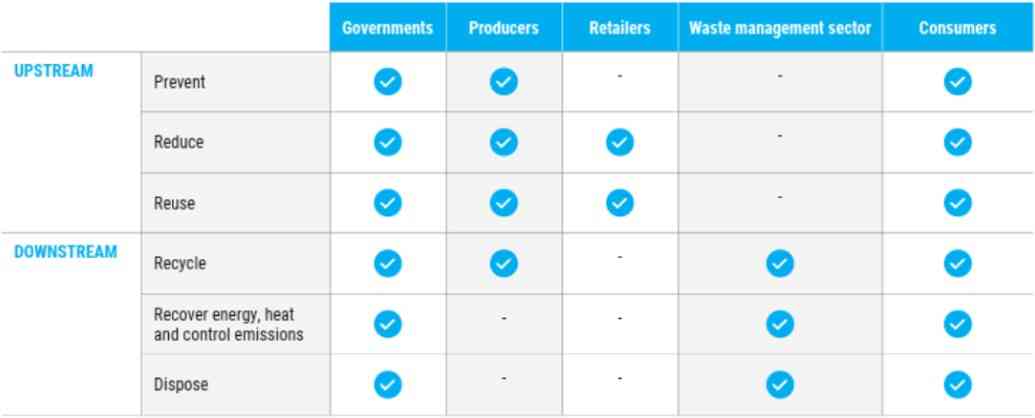
Reuse and recycling reduce demand for energy-intensive and environmentally damaging raw material extraction, enable waste to be valued as a resource, and prevent pollution from waste leaking into the environment. Reuse features more highly on the waste hierarchy as it does not involve energy-intensive processes in the way that recycling can (UNEP, 2024). However, recycling is not the ultimate goal of waste management: it is always better to reduce waste by preventing it in the first place, or reuse materials that would otherwise become waste, than to produce waste and then recycle it.
A circular economy is a model of production and consumption that involves sharing, leasing, reusing, repairing, refurbishing and recycling existing materials and products for as long as possible to extend the life cycle of the products, thereby reducing the extraction of new resources in favour of reusing existing ones (WHO, 2024).
Extended producer responsibility (EPR) is a policy approach that makes producers responsible for their products along the entire lifecycle, including at the post-consumer stage. By doing so, it helps achieve environmental goals such as recycling targets. At the same time, EPR generates funding from producers that help to pay for the collection, sorting and recycling of waste products, as well as generates detailed information on production, products, waste generation and treatment. The OECD's guidance identifies principles on the use of EPR, outlines possible options and details the benefits and trade-offs of different approaches. In this way, the OECD helps to harmonise the use of EPR schemes across countries. (OECD, 2016)
Thermal waste-to-energy, also known as incineration with energy recovery, is a waste treatment method used in a relatively small number of countries. Waste-to-energy represents linear resource use since materials that are combusted can never be recovered and used again. Although waste-to-energy technologies are widely used in some industrialised countries, questions persist concerning the adoption of these technologies. GHGs and other airborne pollutants emitted from combustion processes may also hinder countries’ abilities to meet obligations related to their Nationally Determined Contributions (NDCs) and emission trading scheme allowances (UNEP, 2024).
The safe disposal of solid waste is critical for public health since solid waste poses a hazard in emergencies (WHO, 2013; 2024). The Sphere Handbook (Sphere Association, 2018) is the internationally recognised tool (but non-legally binding) in the field of humanitarian standards, including for solid waste management.
Monitoring
No information Available
References
Organization for Economic Cooperation and Development (OECD), 2016. Extended producer responsibility and economic instruments. [online] Accessed 21 May 2025.
Sphere Association, 2018. The Sphere Handbook: Humanitarian Charter and Minimum Standards in Humanitarian Response. 4th Edition. Accessed 21 May 2025.
United Nations Environment Programme (UNEP), 2024. Global Waste Management Outlook 2024: Beyond an age of waste – turning rubbish into a resource. [online]. Accessed 21 May 2025.
United Nations Treaty Collection, 2019. Chapter XXVII. Environment. Basel Convention on the Control of Transboundary Movements of Hazardous Wastes and their Disposal. [online]. [Accessed 11 February 2025.
Williams, M., Gower, R., Green, J., Whitebread, E., Lenkiewicz, Z. and Schröder, P., 2019. No Time to Waste: Tackling the Plastic Pollution Crisis Before It’s Too Late. Teddington, United Kingdom: Tearfund. [online]. Accessed 11 February 2025.
World Health Organization (WHO), 2013. Technical notes on drinking-water, sanitation and hygiene in emergencies: Solid waste management in emergencies. World Health Organization (WHO). Accessed 11 February 2025.
World Health Organization (WHO), 2024. Compendium of WHO and other United Nations Guidance on Health and Environment – Chapter 4. Solid Waste. [online]. Accessed 11 February 2025.