
Disaster and Conflict Waste
Disaster and conflict waste is the waste generated by the impact of a disaster or conflict, both as a direct effect of the disaster or conflict as well as in the post-disaster and post-conflict phase as a result of poor waste management (UNEP/OCHA, 2011).
Primary reference(s)
UNEP/OCHA, 2011. Disaster Waste Management Guidelines. Annex X: Terminology. United Nations Environment Programme (UNEP) / United Nations Office for the Coordination of Humanitarian Affairs (OCHA). Accessed 29 January 2025.
Annotations
Additional scientific description
Disaster waste includes: concrete, stone, brick, wood, steel, glass and associated hazardous building materials (e.g. asbestos); spillage of tailings, industrial toxic and hazardous waste from dumps/stacks/ landfills; clay and tar elements from damaged buildings and infrastructures; household furnishings; parts from the power and telephone grids such as electrical poles, wire, electronic equipment, transformers; parts from water and sewage distribution systems; natural debris such as clay, mud, trees, branches, bushes, palm tree leaves; chemicals, dyes and other raw materials from industries and workshops; waste from relief operations; damaged boats, cars, buses, bicycles; unexploded ordnance (e.g., landmines); waste from munitions and damaged military installations, equipment and machinery, including fuels and lubricants; waste from disaster settlements and camps including food waste, packaging materials, excreta and other wastes from relief supplies; pesticides and fertilisers; household cleaners; paint, varnish and solvents; and healthcare waste (UNEP/OCHA Joint Environment Unit, 2011; UNDP, 2016).
Metrics and numeric limits
Not available.
Key relevant UN convention / multilateral treaty
Not relevant.
Drivers
Disaster and conflict waste is an important factor to consider in preparedness, humanitarian response, recovery, remediation and environmental decontamination preceding or following a disaster or conflict. Response and recovery may generate various amounts of waste (e.g., irretrievably damaged or contaminated objects and structures) or waste by-products such as relief packaging (UNEP/OCHA JEU, 2024) and water run-off from disinfection procedures.
Impacts
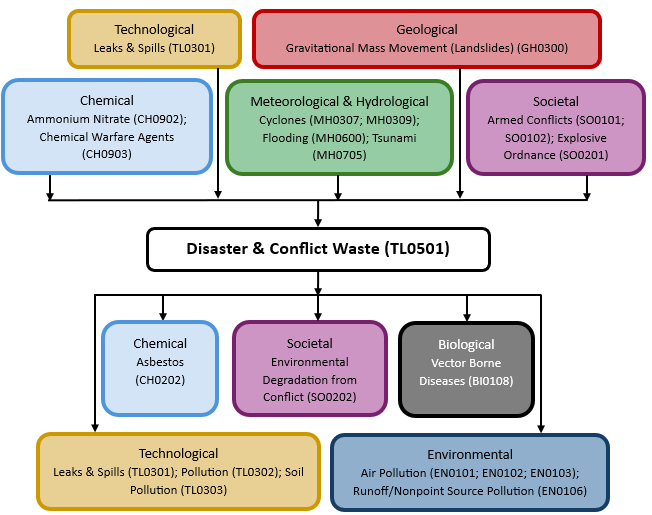
Disaster and conflict waste can contribute to contamination of air, water and soil causing secondary impacts such as risk of vector borne diseases as well as air pollution, water pollution and soil pollution. Several chemicals may be involved, including but not limited to, chemical warfare agents (CH0903), asbestos (CH0202), persistent organic pollutants (CH0500), and pesticides (CH0501). Long term impacts may occur for humans and the environment.
Multi-hazard context
The figure below summarises common interactions between disaster and conflict waste and other hazards. This information should be used with caution and not be solely relied upon in Disaster Risk Management, particularly as some interactions may not have been included. Note that hazardous events occurring together or locally in space or time may not necessarily cause, amplify, or be otherwise related to each other. Specific examples of multi-hazard context can be found in the ‘Hazard drivers’ and ‘Impacts’ sections above.
Multi-hazard diagram
Risk Management
For large-scale incidents, normal waste disposal routes may be inadequate and overburdened. Laboratory analysis may be required prior to disposal to identify such properties as ignitability, corrosiveness, reactivity and toxicity, which would inform the treatment and waste disposal options (PHE, 2019; UKHSA, 2016). Material testing of recyclable materials (e.g. concrete, stone) is also required to assure compliance with national and international standards for use in relevant applications (e.g. roads).
In addressing these issues, various aspects need to be examined such as type, amount and location of waste (e.g., hazardous, non-hazardous), legislation concerning disposal site selection, , capacity of disposal facilities, availability of technical expertise and equipment, agricultural and environmental impacts following disposal, , potential impact of biological agents, chemical agents and radioactive materials during handling and after disposal, land and property rights, opportunities for livelihood creation, timing and speed of waste removal, human remains and societal/ethical issues (PHE, 2015; UKHSA, 2024, UN and Partners 2024).In conflict-affected/disaster settings, hazardous wastes that are frequently encountered during debris and municipal solid waste management activities include Unexploded Ordnance (UXOs), asbestos (as part of building rubble), infectious health care waste and other hazardous wastes such as expired and obsolete hazardous pesticides, equipment containing polychlorinated biphenyls (PCBs) and oils (e.g., electrical transformers) and other types of hazardous wastes (UNDP, 2016).
To the extent feasible, reuse and recycling of the waste should be prioritized to promote resource circularity, particularly of the mineral fraction which typically constitutes 70-90% of the total disaster or conflict debris by volume. For this purpose, the waste should ideally be sorted on-site during demolition operations, and if not feasible at the debris disposal or recycling site, into four main categories: i) recyclable; ii) protected; iii) non-recyclable and iv) hazardous wastes (UN and Partners, 2024).
A temporary disposal site, a place where disaster waste is safely placed, stored and processed for a predefined period after a disaster or conflict, should be selected following a rapid environmental assessment, and emissions should be minimised in relation to appropriate and available technology (UNDP, 2016).
Monitoring
Developing policies and laws to achieve the goals of sustainable development, public education, improving the quality of urban planning, natural disaster insurance, and continuous monitoring of the surrounding environment are important for monitoring of waste (Naderi et al, 2025).
References
Naderi, A., Zoroufchi Benis, K., Dowlati, M., Seyedin, H., Behnami, A., Farzadkia, M., 2025. Identifying methods and challenges of waste management in natural disasters. Journal of Environmental Management, Vol. 373, 123514. ISSN 0301-4797. doi: 10.1016/j.jenvman.2024.123514Accessed 21 May 2025.
Public Health England (PHE), 2015. UK Recovery Handbook for Biological Incidents 2015. Accessed 21 May 2025.
Public Health England (PHE), 2019. UK Recovery Handbook for Chemical Incidents Version 1.1. Accessed 21 May 2025.
UK Health Security Agency (UKHSA), 2016. Recovery, remediation and environmental decontamination. Resources for the management of chemical, radiation, and biological incidents, including UK recovery handbooks. Accessed 29 October 2024.
UK Health Security Agency (UKHSA), 2024. UK Recovery Handbook for Radiation Incidents 2024 Version 5. Accessed 21 May 2025.
United Nations Environment Programme (UNEP)/United Nations Office for the Coordination of Humanitarian Affairs (OCHA) Joint Environment Unit, 2011. Disaster waste management guidelines. Accessed 29 October 2024.
United Nations (UN) and Partners, 2024. Gaza Debris Management Framework. Accessed 29 January 2025.
United Nations Development Programme (UNDP), 2016. Guidance Note: Municipal solid waste management in crisis and post-crisis settings. Accessed 21 May 2025.
United Nations Environment Programme (UNEP), Iraq Ministry of Environment, 2020. Environmental Management Guidelines for Debris Recycling Sites in Iraq. Accessed 21 May 2025.