
Inland Water Ways Transportation Accident
An inland waterway transportation accident is an unwanted or unintended sudden event or a specific chain of such events occurring in connection with inland water vessel operations, which have harmful consequences (United Nations, European Union and the International Transport Forum at the OECD, 2019).
Primary reference(s)
United Nations, European Union and the International Transport Forum at the OECD, 2019. Glossary for transport statistics. 5th Edition. Accessed 28 January 2025
Annotations
Additional scientific description
The Glossary for Transport Statistics prepared by the United Nations, the European Union and the International Transport Forum at the Organisation for Economic Co-operation and Development (2019) gives additional information for Inland Waterways Transportation Accidents, and describes these as an event that has resulted in any of the following: the death of, or serious injury to, a person that is caused by, or in connection with, the operations of an Inland Waterway Transport (IWT) vessel; or the loss of a person from an IWT vessel that is caused by, or in connection with, the operations of an IWT vessel; or the loss, presumed loss or abandonment of an IWT vessel; or material damage to an IWT vessel; or the stranding or disabling of an IWT vessel, or the involvement of an IWT vessel in a collision; or material damage to the inland waterways' infrastructures external to a vessel that could seriously endanger the safety of the vessel or another vessel or an individual; or damage to the environment brought about by the damage of an IWT vessel or IWT vessels being caused by, or in connection with, the operations of an IWT vessel or IWT vessels. (United Nations, European Union and the International Transport Forum at the OECD, 2019)
Any accident in connection with the normal operation of the vessel, including when it is in port or at anchor, is covered. Harmful consequences of inland water ways transportation accidents may include fatalities, injuries, environmental damage, or infrastructure loss,
Metrics and numeric limits
Statistically agreed metrics for an Inland Waterway Accident are as follows (European Union and the International Transport Forum at the Organisation for Economic Co-operation and Development, 2019):
- Fatal accident: any injury resulting in a person killed.
- Non-fatal accident: any injury incident other than a fatal accident.
- Person killed: any person killed immediately or dying within 30 days as a result of an injury accident excluding suicides.
- Person injured: any person who as a result of an injury accident was not killed immediately or not dying within 30 days but sustained an injury, normally needing medical treatment, excluding attempted suicides.
A suicide or an attempted suicide is a deliberate act to injure oneself fatally and is therefore not considered as an accident. However, if a suicide or an attempted suicide causes injury to another person on an IWT vessel, then this is regarded as an injury accident (United Nations, European Union and the International Transport Forum at the Organization for Economic Co-operation and Development, 2019).
Key relevant UN convention / multilateral treaty
The multilateral convention relating to the limitation of the liability of owners of inland navigation vessels (CLN) (UN Treaty Collection, 1973).
Inland Waterways & Environmental Protection OECD, 2021
The UN Convention on the Law of the Non-Navigational Uses of International Watercourses (UN Watercourses Convention, UNWC) is a significant international treaty adopted by the UN General Assembly on May 21, 1997. It promotes cooperation among watercourse states, and establishes fundamental principles and rules regarding the use, management, and protection of international watercourses (United Nation, 1997).
Drivers
The United Nations, European Union and the International Transport Forum at the Organisation for Economic Co-operation and Development (2019) details drivers of this hazard as collision, storm, overloading, stability failure, excessive current, and bottom damage. Issues such as low visibility from weather and other issues and human error are associated with inland water ways transportation accidents. For malicious acts refer to societal hazards.
As an example of an inland waterway transport accident, a large container ship named the Ever Given ran aground after apparently being hit by a sudden strong wind in the Suez Canal, causing a major global shipping disruption in March 2021. The Ever Given, which is 400 meters long, ran aground and became wedged sideways across the waterway. This caused a traffic jam of over 300 vessels, including bulk carriers and oil tankers. The blockage lasted for six days before the ship was refloated. Many supply chain impacts occurred as a result (SAFETY4SEA, 2023).
Impacts
In a report from the European Conference of Ministers of Transport., data showed that most accidents in the inland waterway transport do not lead to human losses, but only to damage to the infrastructure, vessel and perhaps cargo (ECMT, 2006)
In a report for the Department of Transport and Regional Economics by the University of Antwerp, Netherlands on innovative inland navigation, Verberght (2019) identified that it is difficult to find reliable accident data in inland navigation, and that the main cause of accidents in inland waterway transportation is human errors. Accidents usually cost time, not only for those who are part of the accident, but also for all the vessels that are obliged to wait until the wreckage is salvaged. (Verberght, 2019)
Inland water locations consistently account for more than half of all accidental drowning deaths in the UK, on average 250 each year. In almost half of all known incidents, the person had no intention of being in the water (ROSPA, 2018).
Multi-hazard context
The figure below summarises common interactions between inland waterways transportation accidents and other hazards. This information should be used with caution and not be solely relied upon in Disaster Risk Management, particularly as some interactions may not have been included. Note that hazardous events occurring together or locally in space or time may not necessarily cause, amplify, or be otherwise related to each other. Specific examples of multi-hazard context can be found in the ‘Hazard drivers’ and ‘Impacts’ sections above.
Multi-hazard diagram
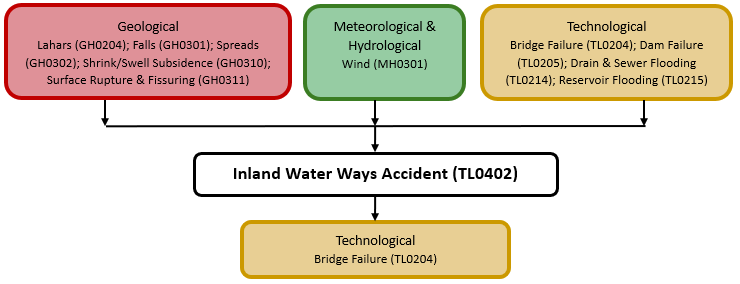
Many hazards impact on the multi-hazard context of inland water ways transportation accidents and include storms causing vessels to capsize as well as wind, fog, floods, and droughts as well as excessive currents and collisions leading to oil spills from accidents, and health impacts such as waterborne disease outbreaks following vessel accidents. Impacts on supply chains are of import.
Risk Management
The UK Inland Waterways Association Safety Policy (2012) presents information on the roles and responsibilities of those involved in their association and subsidiaries to prevent and reduce the risk of accidents occurring. The UK Marine Accident Investigation Branch, under regulations via the Merchant Shipping Act, can undertake investigations with the following remit: “The sole objective of the investigation of an accident... shall be the prevention of future accidents through the ascertainment of its causes and circumstances. It shall not be the purpose of an investigation to determine liability nor, except so far as is necessary to achieve its objective, to apportion blame” (ROSPA, 2018).
The US Coastguard, in 2024, published their USCG Amalgamated Navigation Rules International & U.S. Inland in 2023 This amalgamation of the International Regulations for Preventing Collisions at Sea (72 COLREGS), and the U.S. Inland Navigation Rules (33 CFR 83), as amended; their Annexes; and, some associated provisions, and adopts a single compact layout that denotes textual differences between each set of Rules.(USCG, 2024)
Monitoring
Real-time data such as vessel positions, speed, and direction are used to monitor the situation in inland waterways. It calculates collision probabilities and issues alerts with recommendations for avoiding accidents. The system relies on technologies like AIS and radar to continuously monitor vessel movements. By improving decision-making, it helps prevent accidents and enhances safety in inland waterway transportation (Cheng et al., 2020).
In both Europe and Asia, River Information Services (RIS) are well-documented and utilized for policy and planning, particularly in the context of inland navigation. The European Union, for example, has a directive (2005/44/EC) on harmonized RIS to ensure safety, efficiency, and environmental protection of inland waterways (EUR-Lex, 2005). Similar systems are also used in various Asian countries to improve navigation and traffic management.
In the UK, the scope of the Merchant Shipping (Accident Reporting and Investigation) regulations means that the Navigation Authorities have a duty to report accidents and serious injuries to the Chief Inspector of Marine Accidents and investigate and report on the circumstances, including making recommendations to prevent a recurrence. (AINA, 2015)
References
Association of Inland Navigation Authorities (AINA), 2015. Good practice guide: Managing inland waterway safety risks. Association of Inland Navigation Authorities (AINA). Navigationsafety2015v2.pdf. Accessed 2 April 2025.
Cheng, Z., Yailing, L., & Wu, B. (2020). Early warning method and model of inland ship collision risk based on early warning system.
European Conference of Ministers of Transport (ECMT), 2006. Strengthening inland waterway transport: Pan-European co-operation for progress. Accessed 21 May 2025.
European Union (EU), 2005. Safe and efficient river transport: River information services. Access to European Union Law (EUR-Lex). Accessed 21 May 2025.
Royal Society for the Prevention of Accidents (ROSPA), 2018. Managing safety at inland waters. Accessed 2 April 2025.
SAFETY4SEA, 2023. Ever Given: The grounding that changed the world’s view of shipping. Accessed 21 May 2025.
UK Inland Waterways Association, 2012. Safety policy: Roles and responsibilities. Health & Safety Policy - The Inland Waterways Association Accessed 21 May 2025.
United Nations Treaty Collection, 1973. Chapter XI: Transport and communications: D. Water transport: 1. Convention relating to the limitation of the liability of owners of inland navigation vessels (CLN). Accessed 21 May 2025.
United Nations, 1997. Convention on the law of the non-navigational uses of international watercourses. Accessed 28 January 2025.
United Nations, European Union and the International Transport Forum at the Organisation for Economic Co-operation and Development (OECD), 2019. Glossary for Transport Statistics, 5th Edition. Accessed 21 May 2025.
United States Coast Guard (USCG), 2024. USCG Amalgamated Navigation Rules International & U.S. Inland. Accessed 21 May 2025.
Verberght, E., 2019. Innovative Inland Navigation research (INN-IN) conducted for one year by the University of Antwerp in assignment of the Central Commission for the Rhine (CCNR), Palais du Rhin, 2 Place de la République, 67000 Strasbourg. Accessed 21 May 2025.