Air Transportation Accident
An air transportation accident is defined as an occurrence associated with the operation of an aircraft which takes place between the time any person boards the aircraft with the intention of flight until such time as all such persons have disembarked, in which one of the following applies: a person is fatally or seriously injured, the aircraft sustains damage or structural failure, and the aircraft is missing or is completely inaccessible (United Nations, European Union, the International Transport Forum at the OECD, 2019:119).
Primary reference(s)
United Nations, European Union and the International Transport Forum at the OECD, 2019. Glossary for transport statistics. 5th Edition. Accessed 27 January 2025.
Annotations
Additional scientific description
Additional information on air transportation accidents from the Glossary for Transport Statistics (United Nations, European Union and the International Transport Forum at the OECD, 2019) is as follows:
- A person is fatally or seriously injured where this is as a result of being in the aircraft, or direct contact with any part of the air- craft, including parts which have become detached from the aircraft, or direct exposure to jet blast, except when the injuries are from natural causes, self-inflicted or inflicted by other persons, or when the injuries are to stowaways hiding outside the areas normally available to the passengers and crew.
- The aircraft sustains damage or structural failure where this adversely affects the structural strength, performance or flight characteristics of the aircraft, and would normally require major repair or replacement of the affected component (except for engine failure or damage, when the damage is limited to the engine, its cowlings or accessories; or for damage limited to propellers, wing tips, antennas, tyres, brakes, fairings, small dents or puncture holes in the aircraft skin).
- The aircraft is missing or is completely inaccessible - an aircraft is considered to be missing when the official search has been terminated, and the wreckage has not been located.
Metrics and numeric limits
The International Civil Aviation Organization (ICAO) is a UN agency, established in 1944 to manage the administration and governance of the Convention on International Civil Aviation (Chicago Convention). ICAO hosts an application which provides occurrence data as well as accident and fatality statistics up to 2019 (ICAO, 2019; ICAO, 2024).
Statistically agreed metrics for air transportation accidents (United Nations, European Union and the International Transport Forum at the OECD, 2019) are as follows:
- Fatal injury: an injury resulting in death within 30 days of the date of the accident.
- Non-fatal injury: an injury, other than a fatal injury, which is sustained by a person in an accident.
- Serious injury: a non-fatal injury which is sustained by a person in an accident and which requires hospitalisation for more than 48 hours, commencing within seven days from the date the injury was received; or results in a fracture of any bone (except simple fractures of fingers, toes, or nose); or involves lacerations which cause severe haemorrhage, nerve, muscle or tendon damage; or involves injury to any internal organ; or involves second or third-degree burns, or any burns affecting more than 5% of the body surface; or Involves verified exposure to infectious substances or injurious radiation.
- Slight injury: a non-fatal injury, other than a serious injury, which is sustained by a person in an accident.
Key relevant UN convention / multilateral treaty
Convention for the Unification of Certain Rules for International Carriage by Air, also known as the Montreal Convention, adopted in 1999 by ICAO member states (IATA, 1999; UN Treaty Collection, 1999).
Drivers
The ICAO lists the drivers of air accidents as being runway safety-related events, loss of control in flight, controlled flight into terrain, and malicious events (ICAO, 2019). According to statistics, up to 80% of all aviation accidents are attributed to human error. The most critical periods are during take-off, landing, and the moments surrounding these events. Pilot errors account for 53% of aviation accidents, followed by mechanical failures (21%) and weather conditions (11%) (Gunturkun, 2023). Airport proximity to dense urban areas and inadequate land use planning around airports can exacerbate risks related to aviation accidents, especially during take-off and landing phases which account for the majority of accidents.
Impacts
From 2022 to 2023, there was a 3.1% increase in the total number of accidents, as reported by States, noting that flight departures increased by around 13% during the same period of time. The global accident rate of 1.87 accidents per million departures in 2023 decreased by 17.9% from the 2022 rate of 2.05 accidents per million departures (ICAO, 2024)
Multi-hazard context
The figure below summarises common interactions between air transportation accidents and other hazards. This information should be used with caution and not be solely relied upon in Disaster Risk Management, particularly as some interactions may not have been included. Note that hazardous events occurring together or locally in space or time may not necessarily cause, amplify, or be otherwise related to each other. Specific examples of multi-hazard context can be found in the ‘Hazard drivers’ and ‘Impacts’ sections above.
Multi-hazard diagram
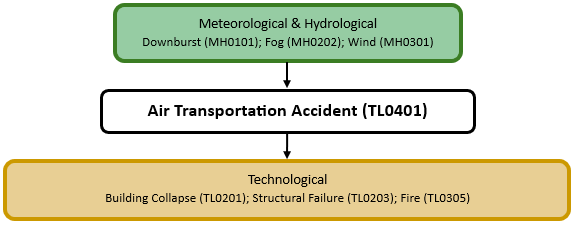
Air transportation is affected by cross-hazard interactions, such as volcanic ash clouds, for example, from the Eyjafjallajökull eruption in 2010, which caused airspace closures (NCAS, no date). In addition, during the COVID -19 pandemic, flights were reduced by 43% in 2020 compared to 2019 (Bielecki et al, 2020)
Risk Management
The ICAO describes the overall purpose of their Global Aviation Safety Plan (GASP) as being to guide the harmonized development of regional and state safety planning, supported by regional safety activities coordinated by the regional aviation safety groups (ICAO, 2022).
The ICAO is coordinating an international effort to bring together expertise from such organizations as the World Health Organization (WHO), the International Air Transport Association (IATA), the Airports Council International (ACI) and other partners to assist in preparedness planning, not only for pandemic influenza but for other communicable diseases or other types of public health event that might cause a public health emergency (ICAO, no date). The ICAO has published guidelines for states concerning the management of communicable diseases posing a serious public health risk (ICAO, 2009). These guide- lines are generic, in that they are applicable to many communicable diseases, not only influenza, and can form the basis for the management of other types of public health events, such as a nuclear power plant explosion that may emit a radioactive plume that impinges on aircraft routes. They will continue to be modified as more information is gained on preparedness planning. They are based on the WHO International Health Regulations (WHO, 2016), .
and use- planning around airports is crucial for minimizing the impact of aviation accidents by ensuring safety for both air and ground populations. It involves controlling land use within a defined area around the airport to reduce the risk of accidents and potential consequences. This includes zoning regulations, height restrictions, and population density controls to minimize potential casualties and damage from aviation incidents (FAA, 2022)
Monitoring
ICAO's Aviation Weather Centers (AWCs) are facilities that provide aviation weather services, including forecasts and observations, to support safe and efficient air travel. The Federal Aviation Administration (FAA) Weather Camera Program improves aviation safety and efficiency by providing pilots with near real-time visual weather data (FAA, 2025). NASA's Aviation Safety Program focuses on developing technologies related to weather information to reduce aviation accidents. The weather information system consists of three key elements: Weather Products, Data Distribution, and User Interface. High-precision weather information is generated using onboard sensors, ground-based systems, and satellite technologies. In collaboration with the FAA, the program aims to deliver weather observation data within 5 minutes and provide analysis and forecasts within 15 minutes through data links. Additionally, advanced weather radar technology is utilized to identify turbulence in the aircraft's flight path. In this system, atmospheric data is analysed to predict how the aircraft may react to specific conditions. The system presents a real-time assessment of risk levels to enhance situational awareness for pilots (Stough, 2000).
GIS-based monitoring systems can integrate multiple data sources to evaluate spatial risk patterns around airports. Studies, such as Septanaya et al. (2024), have demonstrated that integrating spatial planning with aviation safety monitoring can improve risk assessment and management.
References
Bielecki, M., Patel, D., Hinkelbein, J., Komorowski, M., Kester, J., Ebrahim, S., Rodriguez-Morales, A. J., Memish, Z. A., & Schlagenhauf, P., 2021. Air travel and COVID-19 prevention in the pandemic and peri-pandemic period: A narrative review. Travel Medicine and Infectious Disease, 39, 101915. doi: 10.1016/j.tmaid.2020.101915. Accessed 20 May 2025.
Gunturkun, R., 2023. The effect of human factors in aviation accidents. International Journal of Research in Engineering and Science, 11(10). ISSN 2320-9364. Accessed 28 January 2025.
Federal Aviation Administration (FAA), 2022. Compatible land use. Accessed 20 May 2025.
Federal Aviation Administration (FAA), 2025. FAA Weather Cameras. Accessed 20 May 2025.
International Air Transport Association (IATA), 1999. Montreal Convention 1999. Accessed 27 January 2025.
International Civil Aviation Organization (ICAO), no date. Public health and aviation. Accessed 27 January 2025.
International Civil Aviation Organization (ICAO), 2009. Guidelines for states concerning the management of communicable disease posing a serious public health risk. Accessed 27 January 2025.
International Civil Aviation Organization (ICAO), 2019. Accident statistics. Accessed 27 January 2025.
International Civil Aviation Organization (ICAO), 2022. Global aviation safety plan. Accessed 27 January 2025.
International Civil Aviation Organization (ICAO), 2024. Safety report. Accessed 20 May 2025.
National Centre for Atmospheric Science (NCAS), no date. Eyjafjallajökull 2010: How Icelandic volcano eruption closed European skies. Accessed 20 May 2025.
Septanaya, I. D. M. F., Ariastita, P. G., & Anindya, A. F., 2024. Assessing the alignment of spatial planning directives and aviation safety and security aviation operations within the Airport Public Safety Zone (PSZ): A case study at Iswahjudi Military Airport, Indonesia. International Review for Spatial Planning and Sustainable Development D: Planning Assessment, 13(2), 235–260. Accessed 20 May 2025.
United Nations Treaty Collection (UNTC), 1999. Convention for the unification of certain rules for international carriage by air. Accessed 20 May 2025.
United Nations, European Union and the International Transport Forum at the Organisation for Economic Co-operation and Development (OECD), 2019. Glossary for transport statistics. 5th Edition. Accessed 20 May 2025.
World Health Organization (WHO), 2016. International Health Regulations, 2005. 3rd Edition. Accessed 20 May 2025.