
Rail Accident
A rail accident is a sudden event or a specific chain of such events (occurring during train operation) which has harmful consequences (United Nations, European Union and the International Transport Forum at the OECD, 2019).
Primary reference(s)
United Nations, European Union and the International Transport Forum at the OECD, 2019. Glossary for transport statistics. 5th Edition. Accessed 28 January 2025
Annotations
Additional scientific description
United Nations, European Union and the International Transport Forum at the Organisation for Economic Co-operation and Development Glossary (2019) states that the statistically agreed definitions for Rail Accident are as follows (United Nations, European Union and the International Transport Forum at the OECD, 2019):
- Accident: An unwanted or unintended sudden event or a specific chain of such events (occurring during train operation) which has harmful consequences.
- Incident: Any occurrence, other than an accident, highlighting a potential safety issue in railway operations. (Sometimes also referred to as accident precursor, or near-miss.)
- Significant accident: Any accident involving at least one rail vehicle in motion, resulting in at least one killed or seriously injured person, or significant damage to stock, track, other installations or environment, or extensive disruption to traffic. Accidents in workshops, warehouses and depots are excluded. This definition is used by the UIC (Union Internationale des Chemins de Fer).
- Significant damage to stock, track, other installations or environment: Damage that exceeds an internationally agreed thresh- old. (The threshold for significant damage, adopted by the UIC, was set at EUR 150,000 in 2007.)
- Extensive disruption to traffic: Extensive disruption to traffic occurs when train services on at least one main railway line are suspended for more than six hours.
- Injury accident: Any accident involving at least one rail vehicle in motion, resulting in at least one killed or injured person. Accidents in workshops, warehouses and depots are excluded. (This definition includes accidents with slightly injured persons and is similar to that used in road accident statistics.)
- Serious injury accident: Any accident involving at least one rail vehicle in motion, resulting in at least one killed or seriously injured person. Accidents in workshops, warehouses and depots are excluded. (This definition is normally used by the UIC for railway accidents and excludes the accidents with slightly injured persons. Figures collected under this definition cannot be compared directly to the number of road accidents which includes accidents with slightly injured persons.)
- Casualty: Any person killed or injured as a result of an injury accident, excluding attempted suicides.
- Person killed: Any person dying immediately or within 30 days as a result of an injury accident, excluding suicide. (It includes passengers, employees and other specified or unspecified persons involved in a rail injury accident. A killed person is excluded if the competent authority declares the cause of death to be suicide, i.e., a deliberate act to injure oneself resulting in death. For countries that do not apply the threshold of 30 days, conversion coefficients are estimated so that comparisons on the basis of the 30 day-definition can be made.)
- Person injured: Any person who as a result of an accident was not killed immediately or not dying within 30 days, but sustained an injury, normally needing medical treatment, excluding attempted suicide. (Injuries include cases such as, but not limited to, a cut, fracture, sprain, or amputation. Persons with lesser wounds, such as minor cuts and bruises are not normally recorded as injured. An injured person is excluded if the competent authority declares the cause of the injury to be attempted suicide by that person, i.e., a deliberate act to injure oneself resulting in injury, but not in death.)
- Person seriously injured: Any person injured who was hospitalised for more than 24 hours as a result of an accident, excluding attempted suicide.
- Person slightly injured: Any person injured normally needing medical treatment, excluding attempted suicide, not classified as seriously injured. (Persons with lesser wounds, such as minor cuts and bruises are not normally recorded as injured.)
- Collision:
- Collision of two or more rail vehicles (Any front to front, front to end or a side impact between a part of a train and a part of another train or rail vehicle, or with shunting rolling stock).
- Collision of rail vehicle with an obstacle within the clearance gauge (An impact between a part of a train and objects fixed or temporarily present on or near the track (except at level crossings if lost by a crossing vehicle or user), including impacts with overhead contact lines).
- Derailment: Any case in which at least one wheel of a train leaves the rails. (Derailments as a result of collisions are excluded. These are classified as collisions.)
- Level crossing accidents: Any accident at a level crossing involving at least one railway vehicle and one or more crossing vehicles, other users of the road such as pedestrians or other objects temporarily present at or near the track (Sometimes also referred to as grade crossing accident.)
- Accidents to persons caused by rolling stock in motion: Accidents to one or more persons that are either hit by a railway vehicle or part of it or hit by an object attached to it or that has become detached from the vehicle. Persons that fall from railway vehicles are included, as well as persons that fall or are hit by loose objects when travelling on-board vehicles.
- Fires in rolling stock: Fires and explosions that occur in railway vehicles (including their load) when they are running between the departure station and the destination, including when stopped at the departure station, the destination station or intermediate stops, as well as during re-marshalling operations.
- Accident involving the transport of dangerous goods: Any accident or incident that is subject to reporting in accordance with the Regulation concerning the International Carriage of Dangerous Goods by Rail (OTIF, 2021).
- Suicide: An act to deliberately injure oneself resulting in death, as recorded and classified by the competent national authority.
- Attempted suicide: An act to deliberately injure oneself resulting in serious injury, but not in death, as recorded and classified by the competent national authority.
- Category of person in railway accident statistics:
- Rail passenger: Any person, excluding members of the train crew, who makes a trip by rail. For accident statistics, passengers trying to embark/disembark onto/from a moving train are included.
- Employees or contractor: Any person whose employment is in connection with a railway and is at work on duty at the time of the accident. It includes the crew of the train and persons handling rolling stock and infrastructure installations.
- Level crossing user: Persons using a level crossing to cross the railway line by any means of transportation or by foot.
- Trespasser (unauthorised persons on railway premises): Any persons present in railway premises where such presence is forbidden, with the exception of level crossing users.
- Others:
- Other person at platform: means any person at a railway platform who is not defined as 'passenger', 'employee or contractor', 'level crossing user', 'other person not at a platform' or 'trespasser'.
- Other person not at platform: means any person not at a railway platform who is not defined as 'passenger', 'employee or contractor', 'level crossing user', 'other person at a platform' or 'trespasser'.
Metrics and numeric limits
Not reported globally.
Key relevant UN convention / multilateral treaty
Not identified.
Drivers
Collisions, derailments, level crossing accidents, accidents to persons caused by rolling stock in motion, and fires in rolling stock (United Nations, European Union and the International Transport Forum at the OECD, 2019). Natural hazards significantly exacerbate the challenges faced by already stressed railway infrastructure, primarily due to overloaded networks. Floods, heavy rainfall, earthquakes, cyclones, heavy snowfall, low visibility due to fog and landslides are major causes of rail accidents. For example, cyclones can damage trees along tracks, disrupting transport, while powerful cyclones may also damage bridges (Joshi et al., 2024).
The intensification of commuting flows along rail corridors creates varying safety challenges based on industry-specific travel patterns. Research shows that commuting inefficiency varies significantly across economic sectors (Ling et al., 2024), which can lead to temporal congestion patterns around rail infrastructure. These patterns, when combined with increasing urbanization along rail corridors, create distinct accident vulnerability profiles that require targeted mitigation strategies.
Impacts
Railway accidents have significant impacts, including potential fatalities and injuries, extensive disruptions to train services, and damage to railway infrastructure and the environment (Hong et al. 2023). Accidents can also lead to psychological impacts on survivors (Maltais et al, 2022). and economic consequences for the rail industry and affected communities.
Railway accidents involving chemical, nuclear, and explosive cargo are a serious concern due to the potential for widespread harm and environmental damage. Several incidents highlight the risks associated with transporting such materials by rail, including derailments, collisions, and explosions. As an example, on February 3, 2023, a Norfolk Southern freight train carrying hazardous materials from Madison, Illinois, to Conway, Pennsylvania, derailed in East Palestine, Ohio. Of the 150 rail cars, 38 derailed; 11 of those 38 cars contained hazardous chemicals that derailed, igniting and fuelling fires that damaged 12 other non-derailed cars (Welsh et al, 2024)
As an example of a railway accident with significant impacts, Maltais et al (2023) reported that on the night of July 6, 2013, a train comprised of 63 tank cars carrying crude oil derailed in the downtown area of Lac-Mégantici (QC, Canada). The derailment triggered explosions, burning a large portion of the city centre, killing 47 people and destroying 66 homes and 44 businesses. This event also forced the evacuation of over 2000 people, of a population of 6000 inhabitants. The entire population experienced the impact of this technological disaster, caused by a lack of railway track maintenance and human neglect, among others (Maltais et al, 2022).
Multi-hazard context
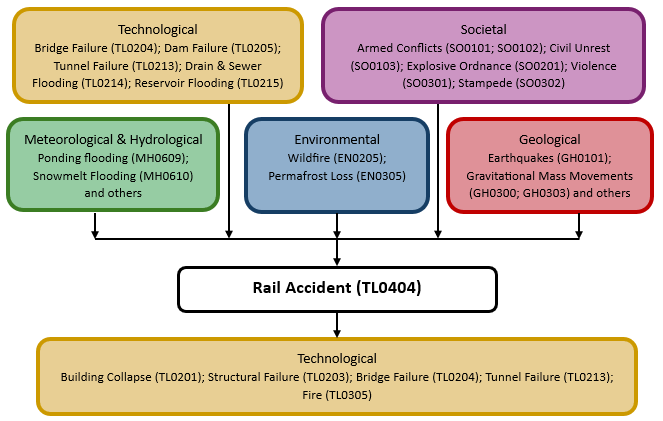
The figure below summarises common interactions between rail accidents and other hazards. This information should be used with caution and not be solely relied upon in Disaster Risk Management, particularly as some interactions may not have been included. Note that hazardous events occurring together or locally in space or time may not necessarily cause, amplify, or be otherwise related to each other. Specific examples of multi-hazard context can be found in the ‘Hazard drivers’ and ‘Impacts’ sections above.
Multi-hazard diagram
Risk Management
The Railway Safety Directive was published with the purpose of establishing and improving rail safety and security standards across the European Union (ORR, 2004). This framework also includes Common Safety Targets (CST) to develop and improve safety performance (European Union Agency for Railways, 2023).
It should be noted that, in contrast to other modes of transport, a large majority of rail accident fatalities occur to level crossing users or trespassers on rail tracks, as opposed to railway passengers (European Union Agency for Railways, 2020). This thus presents different hazard management challenges than for other modes of transport.
Rail safety risk management should consider wider transportation network changes and their socioeconomic implications. Recent research across China's Yangtze River Delta shows that transport network modifications produce varying socioeconomic effects across different urban contexts (Qu et al., 2024). These insights should inform risk management strategies around rail infrastructure, particularly regarding land use regulations and infrastructure investment priorities. A regional, network-based approach to risk management can identify vulnerable nodes where accident impacts would have disproportionate socioeconomic consequences, enabling more targeted mitigation measures.
Monitoring
Early detection and preventive maintenance of potential rail accidents before they occur have proven to be highly cost-effective. Continuous monitoring of critical components not only enhances safety but also significantly boosts infrastructure availability, as monitoring systems enable repairs or replacements during routine maintenance periods. As a result, the railway industry and researchers worldwide have been developing integrated, robust methods for ongoing monitoring and maintenance of railway infrastructure. With advancements in sensors and information technology, the health of railway infrastructure is now continuously tracked using sensors on rolling stock (such as for rail and pantograph monitoring), near the track (such as for switch engine monitoring), and through crowd-sensing techniques (e.g., mobile phones measuring vibrations, temperature, pressure, etc.). This ongoing monitoring helps manage railway system performance. Additionally, databases built from continuous data collection grow over time, creating challenges in transmission, storage, and analysis. For example, high-frequency data from onboard axle box acceleration systems and laser Doppler vibrometers faces difficulties in being transferred to cloud systems or databases due to existing communication bandwidth limitations. To address this, data pre-processing and on-premises analytics could help reduce the data load. Moreover, new standards are necessary for managing data from multiple measurement sources and emerging sensing technologies, such as satellite data. In summary, the railway industry and academia are actively addressing these challenges, with increased collaboration potentially unlocking optimal solutions and overcoming barriers to the adoption of AI. (Phusakulkajorn et al., 2023).
Effective rail safety monitoring requires integration across multiple urban scales and systems. Urban systems science approaches that connect micro-level rail operations with macro-level urban development patterns can identify emerging safety risks before traditional monitoring detects them (Yang & Zhang, 2025). This integration is particularly powerful when combined with digital twin technologies that simulate interactions between transportation networks and urban development, providing predictive risk assessment capabilities rather than just reactive monitoring (Fang et al.,2022)
References
European Union Agency for Railways (ERA), 2023. Report: 2023 Assessment of Achievement of Safety Targets. Accessed 28 January 2025.
European Union Agency for Railways (ERA), 2020. Report on Railway Safety and Interoperability in the EU. Accessed 28 January 2025.
Fang, Z., Jin, Y., & Yang, T., 2022. Incorporating planning intelligence into deep learning: A planning support tool for street network design. Journal of Urban Technology, 29(2), 99–114. Accessed 21 May 2025.
Hong, W.-T., Clifton, G., & Nelson, J.D., 2023. Railway accident causation analysis: Current approaches, challenges and potential solutions. Accident Analysis & Prevention, 186, 107049. doi: 10.1016/j.aap.2023.107049 Accessed 21 May 2025.
Joshi, D., Takeuchi, W., Kumar, N., & Avtar, R., 2024. Multi-hazard risk assessment of rail infrastructure in India under local vulnerabilities towards adaptive pathways for disaster resilient infrastructure planning. Progress in Disaster Science, 21, 100308. Accessed 28 January 2025.
Ling, C., Niu, X., Yang, J., Zhou, J., & Yang, T., 2024. Unravelling heterogeneity and dynamics of commuting efficiency: Industry-level insights into evolving efficiency gaps based on a disaggregated excess-commuting framework. Journal of Transport Geography, 115, 103820. doi: 10.1016/j.jtrangeo.2024.103820. Accessed 21 May 2025.
Maltais, D., Généreux, M., Roy, M., Fortin, G., Pouliot, E., Bergeron-Leclerc, C., Cherblanc, J., Labra, O., Lachance, L., & Paquette, L., 2022. Psychological, physical and behavioral health of adults, 3 years after exposure to a train derailment. Inquiry, DOI: 10.1177/00469580221125765. Accessed 21 May 2025.
Office of Rail and Road (ORR), 2004. European Railway Safety Legislation: The Railway Safety Directive. Accessed 1 December 2019.
Intergovernmental Organisation for International Carriage by Rail (OTIF), 2021. RID 2021. Accessed 21 May 2025.
Phusakulkajorn, W., Nunez, A., Wang, H., Zoeteman, A., Ripke, B., Dollevoet, R., Schutter, B., & Li, Z., 2023. Artificial Intelligence in railway infrastructure: Challenges and future opportunities. Intelligent Transportation Infrastructure, 2. doi: 10.1093/iti/liad016. Accessed 28 January 2025.
Qu, J., Yang, T., Nam, K., Kim, E., Chen, Y., & Liu, X., 2024. Transport network changes and varying socioeconomic effects across China’s Yangtze River Delta. Journal of Transport Geography, 121, 104051. doi: 10.1016/j.jtrangeo.2024.104051. Accessed 21 May 2025.
United Nations, European Union & International Transport Forum at the Organisation for Economic Co-operation and Development (OECD), 2019. Glossary for Transport Statistics, 5th Edition. Accessed 21 May 2025.
Welsh, S., Youn, S., Nichols, A., Na, S., & Shen, R., 2024. Transportation of hazardous material via railroad: Incident investigation and a case study of derailment in 2023. Process Safety Progress, 43(3), 570–578. doi: 10.1002/prs.12598. Accessed 21 May 2025.
Yang, T., & Zhang, Y., 2025. Urban systems science and cross-scale dynamics: A conceptual framework to advance integrated planning and governance. Transactions in Planning and Urban Research, 4(1), 1–11. doi: 10.1177/27541223251325264. Accessed 21 May 2025.