Avalanche
An avalanche is a mass of snow and ice falling suddenly down a mountain slope and often taking with it earth, rocks and rubble of every description (WMO, 1992).
Primary reference(s)
WMO, 1992. International Meteorological Vocabulary, WMO-No. 182. World Meteorological Organization (WMO). Accessed 16 May 2025.
Annotations
Additional scientific description
An avalanche is a rapid flow of snow down a hill or mountainside (NSIDC, 2021). Although avalanches can occur on any slope given the right conditions, certain times of the year and certain locations are more dangerous than others. Winter, particularly from December to April in the Northern Hemisphere, is when most avalanches tend to happen.
There are different types of avalanche (SLF, no date a):
- Loose snow avalanches start from a single point and form when snow is not well bonded. A loose snow avalanche consisting of dry powder generally requires a slope angle of 40°. In very steep terrain, as individual snow particles become loose, roll downwards and bump into more particles, they form an inverted-V-shaped avalanche. Because loose snow avalanches usually carry less snow and travel more slowly than slab avalanches, they are also less dangerous.
- Slab avalanches can only form when the snowpack comprises multiple layers of snow. Slab avalanches are characterised by the simultaneous release of a cohesive snow layer (slab). Steeper than around 30°, slab avalanches are usually bigger than a typical skier avalanche (which is on average 50 m wide, 150-200 m long and 50 cm thick) and reach speeds of 50-100 km/h.
- Gliding avalanches, like slab avalanches, have a distinct, broad fracture line, but differ from other types of avalanches in as much as the entire snowpack is released. The slope must be sufficiently steep, but gliding can occur at a slope angle of just 15°. Gliding avalanches can occur only on a smooth substratum, typically consisting of flattened grass or slabs of rock.
- Powder avalanches arise mostly from slab avalanches. A powder cloud forms in the presence of a large altitude difference when a sufficient quantity of snow becomes suspended in the air. Powder avalanches can reach speeds of 300 km/h and cause tremendous damage.
- Wet-snow avalanches are usually triggered naturally, most often by a big rise in temperature. Meltwater or occasionally rainwater penetrating the snowpack weakens the bonds between the snow crystals, thereby destabilising layers in which the water accumulates. Both loose snow avalanches and slab avalanches can consist of wet snow.
Metrics and numeric limits
Not available.
Key relevant UN convention / multilateral treaty
Sendai Framework for Disaster Risk Reduction 2015-2030.
Drivers
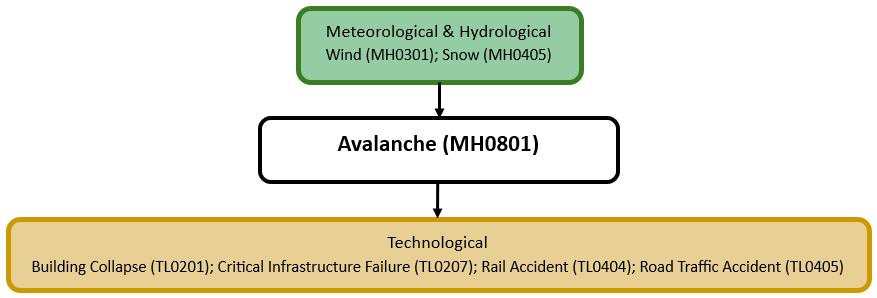
Avalanche danger is enhanced in some circumstances, commonly in windy conditions on fresh snow slopes; when there is rapid, significant, warming of the snow to above 0°; and on steeper, shadier slopes (White risk, no date).
Impacts
Avalanches damage buildings and infrastructure in their path and may affect road and train transportation.
Multi-hazard context
The figure below summarises common interactions between avalanches and other hazards. This information should be used with caution and not be solely relied upon in Disaster Risk Management, particularly as some interactions may not have been included. Note that hazardous events occurring together or locally in space or time may not necessarily cause, amplify, or be otherwise related to each other. Specific examples of multi-hazard context can be found in the ‘Hazard drivers’ and ‘Impacts’ sections above.
Multi-hazard diagram
Risk Management
Avalanche protection and control measures include early warning which is key. The European Avalanche Warning Services (EAWS) brings together 29 avalanche warning services from 16 countries (EAWS, 2020).
By way of controlled explosions, artificial avalanche triggering aims temporarily to safeguard possible starting zones, avalanche paths and deposition zones, and to prevent large avalanches and lengthy closures (SLF, no date b).
Defensive structures prevent the formation of avalanches. In other circumstances, when an avalanche is released, it can be diverted or intercepted by a dam. Other means of protection against avalanches include physical structures for buildings and snow sheds. In order to stop an avalanche completely, depending on its speed, a dam may need to be more than 20 m high. Many dams have a dual function: they protect against avalanches in winter, and against flooding and debris flows once the snow has melted. Snow sheds are known as avalanche galleries or tunnels and are the classic structures for protecting transportation routes. Among the typical measures for protecting buildings are wall reinforcement, the erection of a solid structure (Spaltkeil), which is rather like a log splitting wedge, to break the avalanche, and a building design (Ebenhöch) in which the roof seamlessly merges with the terrain or an embankment (SLF, no date c).
Monitoring
The section above and the table below offer an overview of monitoring avalanches. This information can be used for forecasting within a national early warning system (EWS). Since EWS capacities and processes differ across countries, the most current and specific information regarding EWS should be obtained from the appropriate national or regional agency/authority responsible for disaster management.
| Which institution(s) produce(s) Disaster Risk Data/Information? |
|
How is the Hazard Observed/Monitored/Forecast? | Avalanches are monitored using weather stations, snow sensors, and trained observer observations to track snowfall, temperature changes, and snowpack stability. Scientists analyse wind patterns, terrain conditions, and past avalanche activity to assess risk levels. Advanced models forecast the risk of snow movement, helping forecasters predict when and where avalanches may occur. Early warnings assist ski resorts, mountaineers, and emergency responders in reducing risks and protecting lives in avalanche-prone areas. |
References
EAWS, 2020. Our Mission. European Avalanche Warning Services (EAWS). Accessed 16 May 2025.
NSIDC, no date. Cryosphere Glossary: Avalanche. National Snow and Ice Data Center (NSIDC). Accessed 16 May 2025.
SLF, no date a. Avalanche protection. WSL Institute for Snow Avalanche Research SLF. Accessed 16 May 2025.
SLF, no date b. Artificial Avalanche Triggering. Accessed 16 May 2025.
SLF, no date c. WSL Institute for Snow and Avalanche Research SLF. Accessed 16 May 2025.
White Risk, no date. Effect of Weather and Temperature on Avalanche Hazard. Accessed 16 May 2025.