
Ground Frost
Ground frost is a covering of ice, in one of its many forms, produced by the sublimation of the water vapour on objects colder than 0°C (WMO, 1992).
Ground frost occurs when the temperature of the upper layer of the soil is less than 0°C (WMO, 1992).
Primary reference(s)
WMO, 1992. International Meteorological Vocabulary. WMO-No. 182. World Meteorological Organization (WMO). Accessed 16 May 2025.
Annotations
Additional scientific description
A ground frost refers to the formation of ice on the ground, objects or trees, whose surfaces have a temperature below the freezing point of water. During situations when the ground cools faster than the air, a ground frost can occur without an air frost. A grass frost, an un-official type of ground frost, can occur when other surfaces – such as concrete or road surfaces – do not experience a frost, due to their better ability to retain warmth. It is possible for a grass frost to occur in late spring or even early summer when the risk of more widespread frosts has disappeared (UK Met Office, 2019).
Metrics and numeric limits
Not available.
Key relevant UN convention / multilateral treaty
Sendai Framework for Disaster Risk Reduction 205-2030.
Drivers
No Information Available
Impacts
Rather than cold temperature, frost damage to crops results mainly from extracellular (i.e., not inside the cells) ice formation inside plant tissue, which draws out water and dehydrates the cells, causing injury to the cells. Following cold periods, plants tend to harden against freeze injury and lose this hardening after a warm spell. A combination of these and other factors determines the temperature at which ice forms inside the plant tissue and when damage occurs (Snyder and Melo-Abreu, 2005).
Multi-hazard context
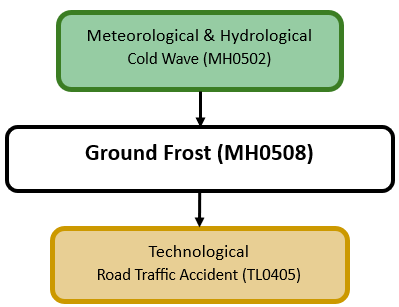
The figure below summarizes common interactions between ground frost and other hazards. This information should be used with caution and not be solely relied upon in Disaster Risk Management, particularly as some interactions may not have been included. Note that hazardous events occurring together or locally in space or time may not necessarily cause, amplify, or be otherwise related to each other. Specific examples of multi-hazard context can be found in the ‘Hazard drivers’ and ‘Impacts’ sections above.
Multi-hazard diagram
Risk Management
The FAO recommends risk management methods which include passive and active protection methods:
- Passive protection includes methods that are implemented before a frost night to help avoid the need for active protection. The main passive methods are site selection, managing cold air drainage, plant selection, canopy trees, plant nutritional management, proper pruning, plant covers, avoiding soil cultivation, irrigation, removing cover crops, soil covers, trunk painting and wraps, bacteria control, and planting date for annual crops. Passive methods are usually less costly than active methods and often the benefits are sufficient to eliminate the need for active protection (Snyder and Melo-Abreu, 2005).
- Active protection methods include heaters, wind machines, helicopters, sprinklers, surface irrigation, foam insulation, and combinations of methods. All methods and combinations of methods are undertaken during a frost night to mitigate the effects of sub-zero temperatures. The cost of each method varies depending on local availability and costs. In some cases, a frost protection method has multiple uses (e.g., sprinklers can also be used for irrigation) and the benefits from other uses need to be subtracted from the total cost to fairly evaluate the benefits in terms of frost protection (Snyder and Melo- Abreu, 2005).
Examples of national alerting parameters include those for a Frost Advisory by Canada (Government of Canada, 2019) and a Frost Warning by China (China Meteorological Administration, 2012).
Monitoring
The section above and the table below offer an overview of monitoring ground frost. This information can be used for forecasting within a national early warning system (EWS). Since EWS capacities and processes differ across countries, the most current and specific information regarding EWS should be obtained from the appropriate national or regional agency/authority responsible for disaster management.
| Which institution(s) produce(s) Disaster RiskData/Information? |
|
| How is the Hazard Observed/Monitored/Forecast? | Ground frost is monitored using weather stations, satellites, and ground sensors to track temperature dropsand frost formation. These warnings assistfarmers and energyproviders in protecting crops andpublic health fromextreme cold. |
References
China Meteorological Administration, 2012. Weather Warnings: Frost. Accessed 16 May 2025.
Government of Canada, 2019. Alerting Parameters Environment Canada uses for Issuing a Frost Advisory. Accessed 16 May 2025.
Snyder, R. L., and Melo-Abreu, J. P., 2005. Chapter 2 – Recommended methods of frost protection. In Frost protection: Fundamentals, practice and economics (Vol. 1). Rome: Food and Agriculture Organization of the United Nations. Accessed 16 May 2025.
UK Met Office, 2019. What is frost?. Accessed 16 May 2025.