Glaze
Glaze is a smooth compact deposit of ice, generally transparent, formed by the freezing of super-cooled drizzle droplets or raindrops on objects with a surface temperature below or slightly above 0°C (WMO, 2017).
Primary reference(s)
WMO, 2017. International Cloud Atlas: Glaze. World Meteorological Organization (WMO). Accessed 16 May 2025.
Annotations
Additional scientific description
The deposit of ice formed by the freezing of fog or cloud droplets not supercooled at the time of impact with objects at temperatures well below 0°C, is known as glaze. Glaze on the ground must not be confused with ground ice which, on a road surface, is known as 'black ice' (WMO, 2017).
Glaze covers all parts of surfaces exposed to precipitation. It is generally fairly homogeneous and morphologically resembles clear ice. At or near the ground, glaze forms when drizzle droplets or raindrops become supercooled as they fall through a layer of air at a sub-frost point temperature. In the free atmosphere, glaze is observed when aircraft are exposed to supercooled precipitation. Glaze forms by the slow freezing of supercooled liquid water and so penetrates the air gaps between the particles of ice before freezing (WMO, 2017).
Metrics and numeric limits
Not available.
Key relevant UN convention / multilateral treaty
Sendai Framework for Disaster Risk Reduction 2015-2030.
Drivers
Glaze is denser, harder, and more transparent than either rime or hoarfrost. Its density may be as high as 0.8 or 0.9 g/cm3. Factors that favour glaze formation are large drop size, rapid accretion, slight supercooling, and slow dissipation of heat of fusion. The opposite effects favour rime formation. The accretion of glaze on terrestrial objects constitutes an ice storm as a type of aircraft icing it is called clear ice. Glaze, as well as rime, may form on ice particles in the atmosphere. Ordinary hail is composed entirely (or nearly so) of glaze; the alternating clear and opaque layers of some hailstones represent glaze and rime, deposited under varying conditions around the growing hailstone (AMS, 2012).
Impacts
Glaze is commonly associated with freezing rain events and can have significant consequences in terms of public safety and infrastructure.
Impacts on Transportation and Public Safety: Glaze poses severe risks to transportation systems. The ice-covered surfaces create extremely slippery conditions, leading to increased vehicle accidents and difficulties in pedestrian mobility. According to the Federal Highway Administration (FHWA), over 24% of weather-related vehicle crashes in the United States are due to "snow, slushy or icy pavement” (FHWA, 2024). Freezing rain events that produce glaze often result in road closures, airport shutdowns, and delays in public transit systems.
Damage to Infrastructure: One of the most significant impacts of glaze is on critical infrastructure, particularly power systems (Huang et al., 2022). The weight of the ice can cause power lines to snap or utility poles to collapse, resulting in widespread power outages. For instance, the 1998 North American Ice Storm caused severe power disruptions, with over 4 million people affected and economic damages estimated at $4.4 billion (Gyakum and Roebber, 2001). The accumulation of ice on structures such as bridges, roofs, and communication towers can also lead to structural failures.
Multi-hazard context
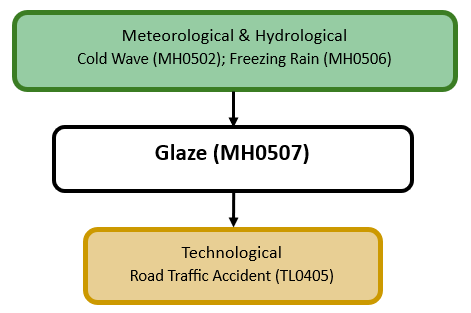
The figure below summarises common interactions between glaze and other hazards. This information should be used with caution and not be solely relied upon in Disaster Risk Management, particularly as some interactions may not have been included. Note that hazardous events occurring together or locally in space or time may not necessarily cause, amplify, or be otherwise related to each other. Specific examples of multi-hazard context can be found in the ‘Hazard drivers’ and ‘Impacts’ sections above.
Multi-hazard diagram
Risk Management
No information available.
Monitoring
The section above and the table below offer an overview of monitoring glaze. This information can be used for forecasting within a national early warning system (EWS). Since EWS capacities and processes differ across countries, the most current and specific information regarding EWS should be obtained from the appropriate national or regional agency/authority responsible for disaster management.
| Which institution(s) produce(s) Disaster Risk Data/Information? |
|
| How is the Hazard Observed/Monitored/Forecast? | Glaze is monitored using weather radar and ground-based sensors to track precipitation type, air temperature, and surface conditions conducive to glaze formation. Meteorologists analyse temperature inversions, wind patterns, and humidity levels to predict when liquid precipitation will freeze upon contact with the ground. Advanced computer models forecast possible ice/glaze accumulation, helping forecasters issue early warnings. These warnings assist transportation agencies and the general public in preparing for hazardous walkways and roads and other related impacts. |
References
AMS, 2012. Glossary of Meteorology: Glaze. American Meteorological Society (AMS). Accessed 16 May 2025.
FHWA, 2024. Road Weather Management. Snow and Ice. U.S. Department of Transportation Federal Highway Administration. Accessed 16 May 2025.
Gyakum, J. R. and Roebber, P. J., 2001. The 1998 Ice Storm – Analysis of a Planetary-Scale Event. Accessed 16 May 2025.
Huang, W., Hu, B., Shahidehpour, M., San, Y., Sun, Q. and Yan, M., 2022. Preventative Scheduling for Reducing the Impact of Glaze Icing on Transmission Lines. IEEE Transactions on Power Systems, 37(2): 1297-1310. Accessed 16 May 2025.
WMO, 2017. International Cloud Atlas: Glaze. World Meteorological Organization (WMO). Accessed 16 May 2025.