
Frost (Hoar Frost)
A hoar frost is a deposit of ice produced by the deposition of water vapour from the surrounding air and is generally crystalline in appearance (WMO, 2017).
Primary reference(s)
WMO, 2017. International Cloud Atlas: Hoar Frost. World Meteorological Organization (WMO). Accessed 16 May 2025.
Annotations
Additional scientific description
There are two types of hoar frost: hoar frost (proper) and advection hoar frost.
Hoar frost: A deposit of ice that generally assumes the form of scales, needles, features or fans and which forms on objects the surface of which is sufficiently cooled, generally by nocturnal radiation, to bring about the deposition of the water vapour contained in the ambient air. Hoar frost proper is ordinarily deposited on objects at or near the ground, mainly on their horizontal surfaces. Hoar frost is observed especially during the cold part of the year when the air is calm, and the sky is clear (WMO, 2017).
Advection hoar frost: A deposit of ice that generally assumes crystalline form and which forms on objects, the surface of which is sufficiently cold to bring about deposition of the water vapour contained in the air coming into contact with this surface, usually through a process of advection. Advection hoar frost is deposited mainly on vertical exposed surfaces. It is observed when relatively warm damp air suddenly invades a region where the temperature of the exposed surfaces is below 0°C and below the frost-point of the advected air (WMO, 2017).
Metrics and numeric limits
Not available.
Key relevant UN convention / multilateral treaty
Sendai Framework for Disaster Risk Reduction 2015-2030.
Drivers
Hoar frost can form as a result of high humidity, light winds, and low temperatures, causing gaseous water vapour to transform directly into a solid state upon contact with solid surfaces – a process referred to as sublimation. Hoar frost typically “forms in the areas around the top of low stratus or fog, or where radiation is reflected away at fog margins at temperatures well below freezing” (MeteoSwiss, no date).
Impacts
The extent of frost damage is determined by how quickly the temperature takes to get to zero, the length of time temperatures stay below zero, and how far below zero the temperature falls. The effects of frost are particularly evident on vegetation, with frost impacting plant growth and seed production, with ripple effects for the agricultural sector (Wassan et al., 2021). According to the Australian Grains Research and Development Corporation (GRDC), the extent and type of frost damage depends on the growth stage of the plant at the time of the frost event, with, for example, crops such as wheat demonstrating high susceptibility to frost at flowering, while barley is increasingly susceptible during grain fill stage (GRDC, no date).
Multi-hazard context
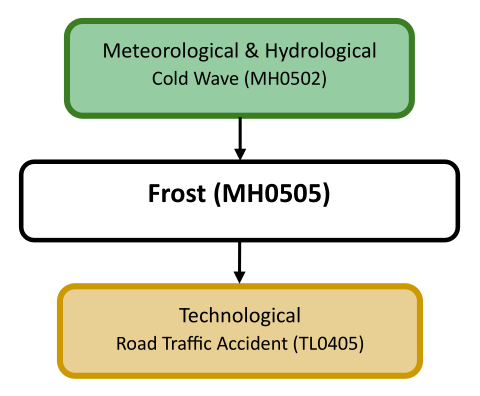
The figure below summarises common interactions between frost and other hazards. This information should be used with caution and not be solely relied upon in Disaster Risk Management, particularly as some interactions may not have been included. Note that hazardous events occurring together or locally in space or time may not necessarily cause, amplify, or be otherwise related to each other. Specific examples of multi-hazard context can be found in the ‘Hazard drivers’ and ‘Impacts’ sections above.
Multi-hazard diagram
Risk Management
No Information Available
Monitoring
The section above and the table below offer an overview of monitoring frost. This information can be used for forecasting within a national early warning system (EWS). Since EWS capacities and processes differ across countries, the most current and specific information regarding EWS should be obtained from the appropriate national or regional agency/authority responsible for disaster management.
| Which institution(s) produce(s) Disaster Risk Data/Information? |
|
| How is the Hazard Observed/Monitored/Forecast? | Frost is monitored using weather stations, satellites, and ground sensors to track temperature drops and frost formation. Meteorologists use weather models to forecast freezing temperatures and issue early warnings. These warnings assist farmers and energy providers in protecting crops, infrastructure, and public health from extreme cold. |
References
Grains Research and Development Corporation (GRDC), no date. Frost management: Tips for identifying frost damage. Accessed 16 May 2025.
Wassen, S., Xi, C., Binte-Imran, L., 2021. Effect of frost on plants, leaves, and forecast of frost events using convolutional neural networks. International Journal of Distributed Sensor Networks, 17(10). Accessed 16 May 2025.
WMO, 2017. International Cloud Atlas: Hoar Frost. World Meteorological Organization (WMO). Accessed 16 May 2025.