
Cold Wave
A cold wave is a period of marked and unusual cold weather characterised by a sharp and significant drop in air temperatures near the surface (maximum, minimum and daily average) over a large area and persisting below certain thresholds for at least two consecutive days during the cold season (WMO, 2020).
Primary reference(s)
WMO, 2020. Guidelines on the Definition and Monitoring of Extreme Weather and Climate Events. World Meteorological Organization (WMO). Accessed 16 May 2025.
Annotations
Additional scientific description
In the United States, the US National Weather Service defines a cold wave as a rapid fall in temperature within 24 hours to temperatures requiring substantially increased protection to agriculture, industry, commerce, and social activities. The criterion for a cold wave is thus twofold: the rate of temperature fall, and the minimum to which it falls. The latter depends on region and time of year (AMS, 2019).
In China, a cold wave is defined as disastrous weather in winter. Cold air coming down from high latitudes strengthens quickly under special weather conditions when entering middle and low latitude areas, which will bring a sharp temperature decrease, gales, snowfall and rainfall. When southward cold air reaches a certain standard, it will become a cold wave (China Meteorological Administration, 2012). A cold wave should not be confused with a ‘cold spell’, which instead refers to persistently below-average temperature conditions occurring during the warm season, which can also have severe impacts on society, in particular for human health and agriculture (WMO, 2020).
Metrics and numeric limits
The World Meteorological Organization guidelines on the definition and monitoring of extreme weather and climate events advise the following (WMO, 2020):
- Index: Daily values of Tmax, Tmin, and/or average temperature. Another index could be computed using temperature change in the 24 hours prior to the onset of the event.
- Threshold: Determined based on historical values of the index.
- Temporal: Station-level information on starting date, ending date, and duration of the event. Persistence of conditions for a cold wave are two days.
- Spatial: Calculate the area affected, by providing the percentage of stations where the threshold was surpassed; locate the coordinates of the impacted stations and the center with the highest/lowest values of the indices; and optional, but recommended if resources are available, to use a geographical information system (GIS) to calculate the area affected by the event, the magnitude, and severity.
Key relevant UN convention / multilateral treaty
Sendai Framework for Disaster Risk Reduction 2015-2030.
Drivers
No Information Available
Impacts
Human health impacts from cold waves include mortality from ischaemic heart disease and cerebrovascular disease both of which increase in cold weather. An increase in respiratory disease is generally attributed to cross-infection from indoor crowding, and the adverse effects of cold on the immune system’s resistance to respiratory infection, as well as to the fact that low temperatures assist survival of bacteria in droplets (Eurowinter Group, 1997).
Living in a cold house can affect health at any age, not just in old age, for a variety of reasons. Although the extra deaths in elderly people are caused mainly by cardiovascular and respiratory disease, far greater numbers have minor ailments that lead to a huge burden of disease, costs to the health system, and misery. Compared with those who live in a warmer house, respiratory problems are roughly doubled in children, arthritis and rheumatism increase, and mental health can be impaired at any age. Adolescents who live in a cold house have a five-fold increased risk of multiple mental health problems (Dear and McMichael, 2011).
Multi-hazard context
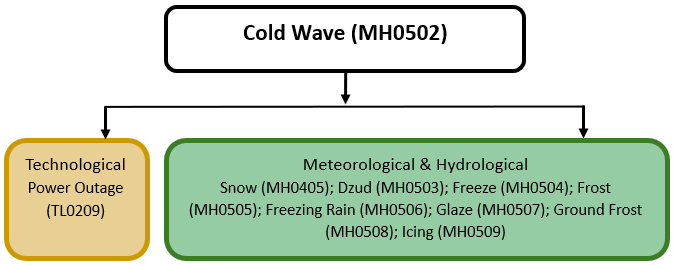
The figure below summarises common interactions between cold waves and other hazards. This information should be used with caution and not be solely relied upon in Disaster Risk Management, particularly as some interactions may not have been included. Note that hazardous events occurring together or locally in space or time may not necessarily cause, amplify, or be otherwise related to each other. Specific examples of multi-hazard context can be found in the ‘Hazard drivers’ and ‘Impacts’ sections above.
Multi-hazard diagram
Risk Management
As an example, the Cold Weather Plan for England first launched in 2011 helps prevent the major avoidable effects on health during periods of cold weather in England (UK Government, 2020). National Alerting parameters for Cold Wave Warning are available in China (China Meteorological Administration, 2012).
Monitoring
The section above and the table below offer an overview of monitoring cold waves. This information can be used for forecasting within a national early warning system (EWS). Since EWS capacities and processes differ across countries, the most current and specific information regarding EWS should be obtained from the appropriate national or regional agency/authority responsible for disaster management.
| Which institution(s) produce(s) Disaster Risk Data/Information? |
|
| How is the Hazard Observed/Monitored/Forecast? | Cold waves are monitored using satellites and weather stations with temperature sensors to track sudden drops in temperature, wind chill, and atmospheric pressure changes. Meteorologists analyse polar air movements, jet stream shifts, and moisture levels and advanced weather models to predict extreme cold events, enabling forecasters to issue early warnings. These alerts assist communities, energy providers, and emergency responders prepare for health risks, heating demands, and potential disruptions to infrastructure and transportation. |
References
AMS, 2019. Glossary of Meteorology: Cold wave. American Meteorology Society (AMS). Accessed 16 May 2025.
China Meteorological Administration, 2012. Weather Warnings: Cold Wave. Accessed 16 May 2025.
Dear, K.B.G. and M.J. McMichael, 2011. The health impacts of cold homes and fuel poverty. British Medical Journal, 342. Accessed 16 May 2025.
Eurowinter Group, 1997. Cold exposure and winter mortality from ischaemic heart disease, cerebrovascular disease, respiratory disease, and all causes in warm and cold regions of Europe. Lancet, 349:1341-1346.
UK Government, 2020. Cold weather plan for England. Accessed 16 May 2025.
WMO, 2020. Guidelines on the Definition and Monitoring of Extreme Weather and Climate Events. World Meteorological Organization (WMO). Accessed 16 May 2025.
Zhang, X., L. Alexander, G.C. Hegerl, P. Jones, A.K. Tank, T.C. Peterson, B. Trewin and F.W. Zwiers, 2011. Indices for monitoring changes in extremes based on daily temperature and precipitation data. WIREs Climate Change, 2:851-870.