Tropical Cyclone
A tropical cyclone is a cyclone of tropical origin of small diameter (some hundreds of kilometres) with a minimum surface pressure in some cases of less than 900 hPa, very violent winds and torrential rain; sometimes accompanied by thunderstorms. It usually contains a central region, known as the 'eye' of the storm, with a diameter of the order of some tens of kilometres, and with light winds and a more or less lightly clouded sky (WMO, 2023).
Alternative definition: A tropical cyclone is a warm-core, non-frontal synoptic-scale cyclone, originating over tropical or subtropical waters, with organised deep convection and closed surface wind circulation about a well-defined centre (WMO, 2024).
Note: Typhoon, hurricane, cyclone, and tropical cyclone are different terms for the same weather phenomenon in different geographical regions (WMO, 2023):
- In the western North Atlantic, central and eastern North Pacific, Caribbean Sea and Gulf of Mexico, such a weather phenomenon is called a ‘hurricane’;
- In the western North Pacific, it is called a ‘typhoon;
- In the Bay of Bengal and Arabian Sea, it is called a ‘cyclone’; In the western South Pacific and southeast Indian Ocean, it is called a ‘severe tropical cyclone’;
- In the southwest India Ocean, it is called a ‘tropical cyclone’.
Primary reference(s)
WMO, 2017. Manual on Codes, International Codes, Volume I.2, WMO-No. 306. World Meteorological Organization (WMO). Accessed 16 May 2025.
Annotations
Additional scientific description
A tropical cyclone is a rapidly rotating storm that begins over tropical oceans, and they it can vary in speed, size, and intensity (WMO, 2025).
The typhoon season in the western North Pacific region typically runs from May to November. The Americas/Caribbean hurricane season runs from 1 June to 30 November, peaking in August and September. The cyclone season in the South Pacific and Australia normally runs from November to April. In the Bay of Bengal and Arabian Sea, tropical cyclones usually occur from April to June, and from September to November. The East Coast of Africa normally experiences tropical cyclones from November to April (WMO, 2023).
Metrics and numeric limits
Tropical cyclones above a particular wind speed are classified for public safety.
Depending on the maximum sustained wind speed, tropical cyclones are designated as follows:
- Tropical depression is when the maximum sustained wind speed is less than 63 km/h.
- Tropical storm is when the maximum sustained wind speed is more than 63 km/h. It is then also given a name.
- Hurricane, typhoon, tropical cyclone, very severe cyclonic storm - depending on the basin - when the maximum sustained wind speed exceeds 116 km/h or 63 knots.
The table below provides more detail on tropical cyclone classifications and development thresholds in the five Tropical Cyclone Committees (WMO, 2023).

Key relevant UN convention / multilateral treaty
Sendai Framework for Disaster Risk Reduction.
Drivers
No Information Available
Impacts
Tropical cyclones can have far-reaching impacts, particularly in low-lying coastal areas located in the direct path of the storm. The severity of these impacts depends on the cyclone's size, intensity, and the combination of hazards such as wind speed, rainfall, storm surges, and flooding. While winds can cause significant damage, it is often the rainfall and storm surges that lead to catastrophic effects like flooding and landslides, especially in coastal and mountainous regions. Flooding can occur well ahead of landfall and persist long after, continuing to pose a risk to both lives and infrastructure, especially in densely populated or low-lying areas (UNDAC, 2024). These conditions can devastate infrastructure, disrupt communication lines, damage power grids, and result in significant casualties (UNDAC, 2024).
The health impacts of tropical cyclones can be both direct and indirect, increasing the risk of drowning, physical trauma, and the spread of water- and vector-borne diseases. Floodwaters often carry sewage, chemicals, and sharp debris, which can cause injuries, diseases, and electrocution. Additionally, the disruption of public health systems during and after the cyclone limits access to essential healthcare services. Aside from physical health risks, mental health is significantly impacted, as many individuals experience stress, trauma, and anxiety in the aftermath of such disasters. Cyclone-related damage to basic infrastructure like food and water supplies and safe shelter only exacerbates these issues, increasing the risk of food insecurity and long-term health challenges (WHO, 2025; UNDAC, 2024).
The socio-economic consequences of tropical cyclones are equally severe, as these events can cause long-term economic losses by destroying businesses, farms, and fisheries, resulting in income loss for affected families. The destruction of crops, livestock, and fisheries, along with flooding and saltwater intrusion, leads to immediate food shortages and long-term disruptions in the food supply chain. These impacts further undermine public health by increasing malnutrition and decreasing food security. Recovery is often slow, as repeated cyclones can compromise agricultural land, making it harder for communities to rebuild their food stocks and livelihoods (UNDAC, 2024).
Multi-hazard context
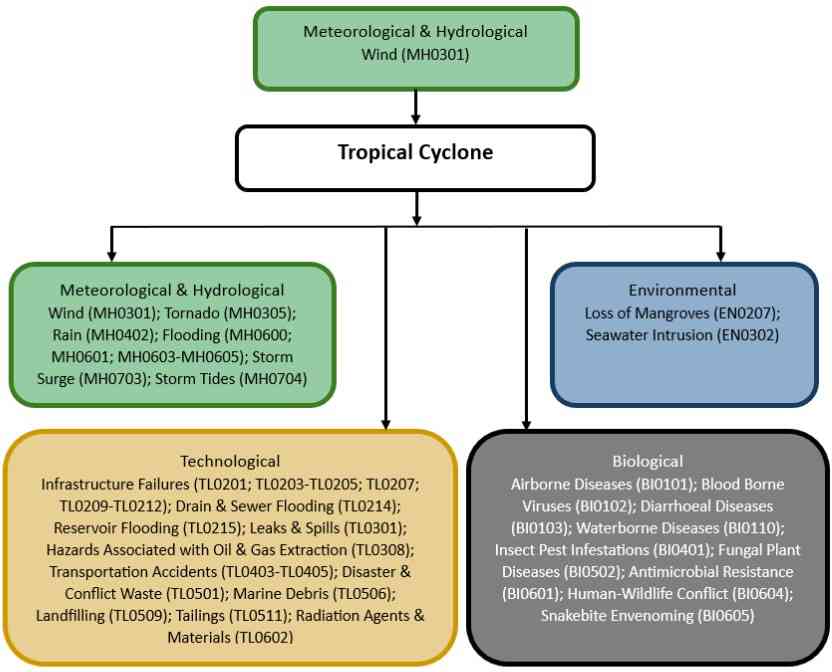
The figure below summarises common interactions between tropical cyclones and other hazards. This information should be used with caution and not be solely relied upon in Disaster Risk Management, particularly as some interactions may not have been included. Note that hazardous events occurring together or locally in space or time may not necessarily cause, amplify, or be otherwise related to each other. Specific examples of multi-hazard context can be found in the ‘Hazard drivers’ and ‘Impacts’ sections above.
Multi-hazard diagram
Risk Management
Meteorologists around the world use modern technology such as satellites, weather radars and computers etc. to track tropical cyclones as they develop. Tropical cyclones are often difficult to predict, because they can suddenly weaken or change their course. However, meteorologists use state-of-the-art technologies and develop modern techniques such as numerical weather prediction models to predict how a tropical cyclone evolves, including its movement and change of intensity, when and where one will hit land and at what speed. Official warnings are then issued by the National Meteorological Services of the countries concerned (WMO, 2023).
Tropical cyclones may damage infrastructure, including power lines, leading to power outages that can lead to electrocution, fires and burns and carbon monoxide poisoning from gasoline-powered electrical generators.
The World Health Organization (WHO) works with Member States to build resilient and proactive health systems that can anticipate the needs and challenges during emergencies so that they are more likely to reduce risks and respond effectively when needed. During disasters, such as tropical cyclones, the WHO helps to restore primary care services so that facilities can deliver essential services, including immunisation, basic treatment for common illnesses, acute malnutrition and maternal care, while ensuring the ongoing supply of medications for people living with HIV, tuberculosis or diabetes. As the health cluster lead for global emergencies, the WHO also works with partners to ensure appropriate food supplementation; to assemble mobile health teams and outreach; to conduct epidemic surveillance, early warning and response; and to call for emergency funding to support health action (WHO, 2025).
The World Meteorological Organization (WMO) framework allows the timely and widespread dissemination of information about tropical cyclones. As a result of international cooperation and coordination, tropical cyclones are increasingly being monitored from their early stages of formation. The activities are coordinated at the global and regional level by the WMO through its World Weather Watch and Tropical Cyclone Programmes. The Regional Specialised Meteorological Centres with the activity specialisation in tropical cyclones, and Tropical Cyclone Warning Centres, all designated by the WMO, function within its Tropical Cyclone Programme. Their role is to detect, monitor, track and forecast all tropical cyclones in their respective regions. The Centres provide, in real-time, advisory information and guidance to the National Meteorological Services (WMO, 2023).
Monitoring
The section above and the table below offer an overview of monitoring tropical cyclones. This information can be used for forecasting within a national early warning system (EWS). Since EWS capacities and processes differ across countries, the most current and specific information regarding EWS should be obtained from the appropriate national or regional agency/authority responsible for disaster management.
| Which institution(s) produce(s) Disaster Risk Data/Information? |
|
| How is the Hazard Observed/Monitored/Forecast? | Tropical cyclones are monitored using satellites, weather radar, ocean buoys, and specialiszed reconnaissance aircraft to track their development and progression. Meteorologists analyse sea surface temperatures, atmospheric pressure, and wind patterns and use advanced weather models combined with real-time observational data to forecast storm intensity and path. These forecasts enable timely warnings to be issued, helping coastal communities, emergency responders, and infrastructure managers prepare for hazards such as destructive winds, heavy rainfall, storm surges, and flooding. |
References
National Oceanic and Atmospheric Administration (NOAA), no date. Saffir-Simpson Hurricane Wind Scale. National Oceanic and Atmospheric Administration (NOAA). Accessed 16 May 2025.
United Nations Disaster Assessment and Coordination (UNDAC), 2024. UNDAC Handbook – 8th Edition: Hazard Impact Summaries. Accessed 16 May 2025.
World Health Organization (WHO), 2025. Tropical cyclones. World Health Organization (WHO). Accessed 16 May 2025.
World Meteorological Organization (WMO), 2023. Tropical Cyclone Forecasting. Accessed 16 May 2025.
World Meteorological Organization (WMO), 2023. Classification of Tropical Cyclones: Fact Sheet. Accessed 16 May 2025.
World Meteorological Organization (WMO), 2025. Tropical Cyclone. Accessed 16 May 2025.