
Sand haze
A dust haze (or sand haze) is a suspension in the air of dust or small sand particles, raised from the ground prior to the time of observation by a dust storm or sandstorm. The dust storm or sandstorm may have occurred either at or near the observation site or far from it (WMO, 2025).
Primary reference(s)
WMO, 2025. Dust haze. International Cloud Atlas. Accessed 16 May 2025.
Annotations
Additional scientific description
Although the World Meteorological Organization (WMO) defines a dust episode with the aforementioned characteristics as "dust haze," the American Meteorological Society (AMS) describes a similar phenomenon as "sand haze."
According to the American Meteorological Society, sand haze is the reduced visibility in the atmospheric boundary layer caused by suspended particles of soil, mixed into the air during strong winds. Sand haze is particularly prevalent in desert regions where there is little moisture and few plants to hold the sand grains to the surface. After sandstorm the larger sand grains will fall out of the air quickly, leaving a sand haze of medium size particles (1-100 μm diameters, including silt and fine sand) and small particles (coarse (2.5-10 µm), fine (<2.5 µm)) (AMS, 2024).
The International Knowledge Centre for Engineering Sciences and Technology (IKCEST) has also called dust haze an "atmospheric brown cloud". According to Specifications for Surface Meteorological Observation of China Meteorological Administration, dust haze is defined as: "a huge amount of dry dust particles that are extremely subtle are flowing evenly-scattered in air, making air unclear with the visibility no more that 10km and bringing yellow and red colour to lighting facilities. They seem a little blue if they are under darkness (IKCEST, 2018).
Metrics and numeric limits
According to the China Meteorological Bureau 2003 Dust haze (or sand haze) is identified primarily by visibility thresholds and particulate matter concentrations. It is defined as a reduction in visibility to less than 10 kilometres due to high concentrations of particulate matter in the air (Weiping et al., 2003). According to the China Meteorological Press 2014, dust haze is a daily visibility <10 km with relative humidity <90%. This definition can be divided into light (8-10 km), medium (5-8 km) and heavy dust haze (<5 km). These thresholds provide a clear framework for observing and categorising haze events based on their intensity (Liu et al., 2014).
Particulate matter (PM) concentrations are a significant factor in dust haze formation. In regions such as Inner Mongolia and northern China, "dusty air" days have been associated with PM10 concentrations ranging between 50 and 200 µg/m³. These high concentrations contribute to persistent haze, especially under calm weather conditions when particulate matter remains suspended in the lower atmosphere (Hoffman, 2008).
Relative humidity plays a critical role in the formation and persistence of dust haze. It is typically observed when relative humidity levels are below 90%, as low humidity prevents the aggregation and settling of fine particles. This allows smaller particles, such as silt and clay, to remain suspended in the atmosphere for extended periods, maintaining reduced visibility conditions (Liu et al., 2014).
The size distribution of particles in dust haze events varies depending on the source and environmental conditions. After a sand storm, larger sand particles settle quickly, while finer particles between 1-100 µm (including silt and clay) stay airborne, forming the visible haze. Smaller particles, often less than 1 µm in diameter, including clay and mineral dust, contribute significantly to the longevity of dust haze in the atmosphere (AMS, 2024).
Key relevant UN convention / multilateral treaty
Considering that dust haze (or sand haze) originates from dust storms and sand storms, most multilateral conventions and treaties established to address these hazards on a global scale can also be effectively applied to mitigate the risks associated with dust haze.
United Nations Coalition on Combating Sand and Dust Storms (FAO, no date).
International Partnership for Sand and Dust Storms Early Warnings (WMO, no date).
United Nations Environment Assembly (UNEA) Resolutions on Sand and Dust Storms (UNEA, no date).
United Nations Decade on Combating Sand and Dust Storms (2025–2034) (United Nations, no date).
United Nations Convention to Combat Desertification (UNCCD) (UNCCD, no date).
United Nations Framework Convention on Climate Change (UNFCCC) (UNFCCC, no date).
Drivers
Dust/sand haze is caused by both natural and human factors. Natural drivers include strong winds, arid climates, and sparse vegetation, which allow dust and sand particles to become airborne. Human activities like overgrazing, deforestation, unsustainable farming, and land degradation worsen the problem. Climate change intensifies these events by increasing droughts, reducing soil moisture, and boosting wind speeds. Urbaniszation and industrialiszation also add particulate matter through emissions and construction (Middleton et al., 2024).
Impacts
Dust haze contains fine particulate matter, including sulphates, nitrates, black carbon, and mineral dust. Particles smaller than 10 microns (PM10) can lodge in the lungs, while those under 2.5 microns (PM2.5) can enter the bloodstream, causing cardiovascular and respiratory diseases, lung cancer, and other health issues. Dust also carries pathogens like bacteria and fungi that can spread infectious diseases (WHO, 2018; Agache et al., 2024). Even low levels of particulate pollution have harmful health effects, with no safe threshold (WHO, 2018).
Economically, dust haze reduces crop yields, disrupts transportation due to low visibility, and raises healthcare costs. Psychologically, prolonged exposure can lead to stress and anxiety, especially in affected communities (WHO, 2024).
Multi-hazard context
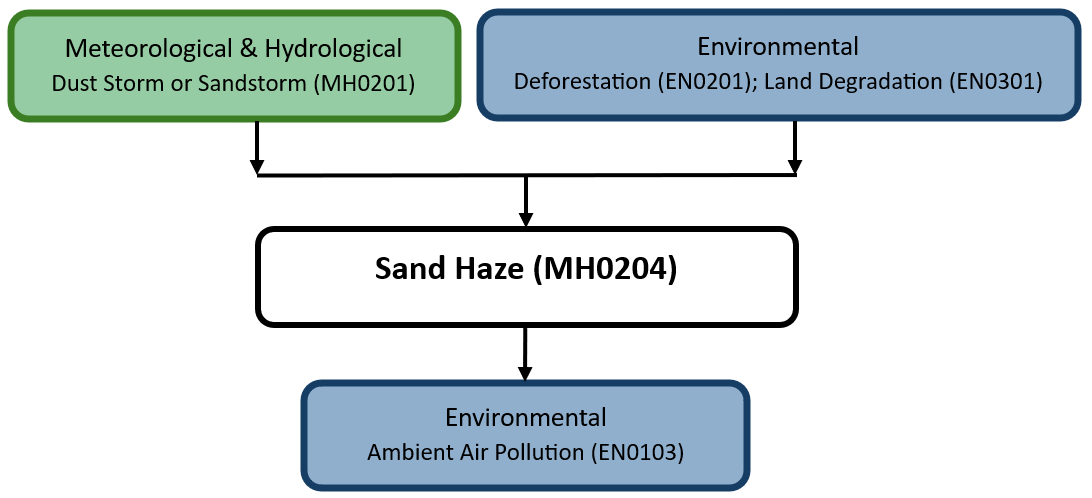
he figure below summarises common interactions between sand haze and other hazards. This information should be used with caution and not be solely relied upon in Disaster Risk Management, particularly as some interactions may not have been included. Note that hazardous events occurring together or locally in space or time may not necessarily cause, amplify, or be otherwise related to each other. Specific examples of multi-hazard context can be found in the ‘Hazard drivers’ and ‘Impacts’ sections above.
Multi-hazard diagram
Risk Management
Effective strategies include early warning systems, sustainable land management, and international collaboration. Early warnings from organisations like the WMO help communities prepare for dust storms. Global partnerships, such as the UN Coalition on Combating Sand and Dust Storms, foster coordinated mitigation efforts (Middleton et al., 2024).
The Sand and Dust Storm Warning Advisory and Assessment System (SDS-WAS), established by the World Meteorological Organization (WMO), enhances global coordination in monitoring, forecasting, and assessing sand and dust storms (WMO, no date a). Operating through regional centres in Barcelona, Beijing, and Barbados, SDS-WAS supports early warning systems and risk mitigation efforts in sectors such as health, aviation, and agriculture (WMO, no date b). It also contributes to the work of the United Nations Coalition on Combating Sand and Dust Storms by improving access to timely, science-based information for decision-making.
Sustainable land management practices, including reforestation and soil conservation, address root causes. Climate change adaptation policies, like reducing emissions and improving water management, help mitigate long-term impacts. Public health measures, such as stricter air quality standards, protective equipment, and awareness campaigns, reduce health risks (Middleton et al., 2024; Salehi et al., 2019).
Monitoring
The section above and the table below offer an overview of monitoring sand haze. This information can be used for forecasting within a national early warning system (EWS). Since EWS capacities and processes differ across countries, the most current and specific information regarding EWS should be obtained from the appropriate national or regional agency/authority responsible for disaster management.
| Which institution(s) produce(s) Disaster Risk Data/Information? |
|
| How is the Hazard Observed/Monitored/Forecast? | Sand haze (dust haze) is monitored using satellites, ground-based air quality sensors, and weather radar to track airborne dust levels and visibility conditions. Meteorologists analyse wind patterns, humidity, and desert surface conditions to predict when and where haze will form and how far it will spread. Computer models simulate dust movement, helping forecasters issue warnings. These alerts protect public health, transportation, and industries by providing guidance on air quality and visibility hazards. |
References
Agache, I., Akdis, C., Al-Hemoud, A., et al. (2024) ‘Climate change and allergic diseases: A scoping review’, The Journal of Climate Change and Health.
Aghababaeian, H., Ostadtaghizadeh, A., Ardalan, A., et al. (2021) ‘Global health impacts of dust storms: A systematic review’, Environmental Health Insights, 15, p. 11786302211018390.
American Meteorological Society (AMS), 2024. Sand haze. Glossary of Meteorology. Accessed: 16 May 2025.
Hoffmann, S. (2008) ‘Temporal variations in PM₁₀ and particle size distribution during Asian dust storms in Inner Mongolia’, Atmospheric Environment, 42(36), pp. 8422–8431.
International Knowledge Centre for Engineering Sciences and Technology (IKCEST), 2018. The definition of dust-haze. Accessed 16 May 2025.
Liu, T., Zhang, Y.H., Xu, Y.J., et al. (2014) ‘The effects of dust–haze on mortality are modified by seasons and individual characteristics in Guangzhou, China’, Environmental Pollution, 187, pp. 116–123.
Middleton, N. and Al-Hemoud, A. (2024) ‘Sand and dust storms: Recent developments in impact mitigation’, Sustainability, 16(16), p. 7121.
Salehi, S., Ardalan, A., Garmaroudi, G., et al. (2019) ‘Conceptual definition and framework of climate change and dust storm adaptation: A qualitative study’, Journal of Environmental Health Science and Engineering, 17, pp. 797–810.
Weiping, Y., Shijian, Z. and Wei, W. (2003) Specifications for surface meteorological observation. Beijing: China Meteorological Press.
World Health Organization (WHO), 2016. Ambient air pollution: A global assessment of exposure and burden of disease. Geneva: World Health Organization. Accessed 16 May 2025.
World Health Organization (WHO), 2018. Ambient (outdoor) air pollution. World Health Organization. Accessed 16 May 2025.
World Health Organization (WHO), 2024. Sand and dust storms. World Health Organization. Accessed 24 January 2025.
World Meteorological Organization (WMO), no date a. Sand and Dust Storm Warning Advisory and Assessment System (SDS-WAS). Accessed 16 May 2025.
World Meteorological Organization (WMO), no date b. Sand and dust storms. Accessed 16 May 2025.
World Meteorological Organization (WMO), no date c. Dust haze. International Cloud Atlas. Accessed 31 January 2025.