Dust storm or Sandstorm
A dust storm is an ensemble of particles of dust or sand energetically lifted to great heights by a strong and turbulent wind (WMO, 2017).
Primary reference(s)
WMO, 2017. Dust Storm or Sandstorm. International Cloud Atlas, World Meteorological Organization (WMO). Accessed 19 November 2019.
Annotations
Additional scientific description
Dust storms or sandstorms generally occur in areas where the ground is covered with loose dust or sand. Sometimes, after having travelled great distances, they may be observed over areas where no dust or sand covers the ground. The forward portion of a dust storm or sandstorm may have the appearance of a wide and high wall that advances fairly rapidly. Walls of dust or sand often accompany a cumulonimbus that may be hidden by the dust or sand particles. They may also occur without any clouds along the forward edge of an advancing cold air mass (WMO, 2017).
Metrics and numeric limits
Emissions of sand and dust particles in the air typically have a wind threshold value ranging from about 4 m/s in desert areas to close to 10 m/s in semi-arid regions. As a first approximation, and being fully aware that visibility in sandstorms and dust storms may be influenced by the optical characteristics of the aerosols (chemical composition, particle size spectra) and lighting conditions (solar azimuth, background luminance, presence of medium or high cloud), the following thresholds, which are familiar to human observers and automated systems alike, are recommended (ICAO, 2009):
| VIS <3000 m visibility and gusts of >=20 kt | ‘light’ sandstorm or dust storm |
| VIS <1500 m visibility and gusts of >=30 kt | ‘moderate’ sandstorm or dust storm |
| VIS <500 m and gusts of >= 40 kt | ‘heavy’ sandstorm or dust storm |
Key relevant UN convention / multilateral treaty
The UN Sand and Dust Storm (SDS) Coalition includes the World Meteorological Organization, United Nations Convention to Combat Desertification, United Nations Development Programme, United Nations Environment Programme, Food and Agriculture Organization, World Health Organization, World Bank, etc. and was launched at the United Nations Convention to Combat Desertification (UNCCD) Conference of the Parties on 6 September 2019 (United Nations, 2019).
Drivers
Sand and dust storms are a meteorological hazard, which is related to the process of wind erosion of surface soil and the mineral dust aerosol emission to the atmosphere. They are frequent in northern Africa, the Middle East and Europe, the Arabian Peninsula, Central Asia, northern India, north-western China, southern Mongolia and adjacent Asian countries (WMO, 2019).
Impacts
In desert regions of Australia and the USA, they can seriously threaten human health, agriculture, aviation, ground transportation, the solar energy industry, air quality, infrastructure and industry, as well as aquatic and terrestrial ecological systems. Dust aerosol can carry irritating spores, bacteria, viruses and persistent organic pollutants. Sand and dust storms also transport nutrients to the oceans and affect marine biomass production, which in turn influences greenhouse gas emissions in the marine environment (WMO, 2019).
In terms of health impacts from dust storms and sandstorms, the UNCCD recognizes that sand and dust storms cause numerous human health problems in different regions around the world, especially in arid and semi-arid regions, and that there is a need to reinforce protective strategies to reduce the negative impacts of sand and dust storms on human health (United Nations, 2019).
Examples of national guidance on the health impacts from dust storms and sandstorms include (i) a fact sheet provided by the Australian Government on the health impacts of dust storms where exposure can produce common symptoms that include iItchy or burning eyes,; throat irritation;, skin irritation,; coughing or sneezing;, and/or respiratory or breathing difficulties, including asthma attacks (Australian Capital Territory, 2018) and (ii) a guidance sheet on acute exposure and threats to respiratory health prepared by the American Thoracic Society (2018).
Multi-hazard context
The figure below summarises common interactions between dust storms or sandstorms and other hazards. This information should be used with caution and not be solely relied upon in Disaster Risk Management, particularly as some interactions may not have been included. Note that hazardous events occurring together or locally in space or time may not necessarily cause, amplify or be otherwise related to each other. Specific examples of multi-hazard context can be found in the ‘Hazard drivers’ and ‘Impacts’ sections above.
Multi-hazard diagram
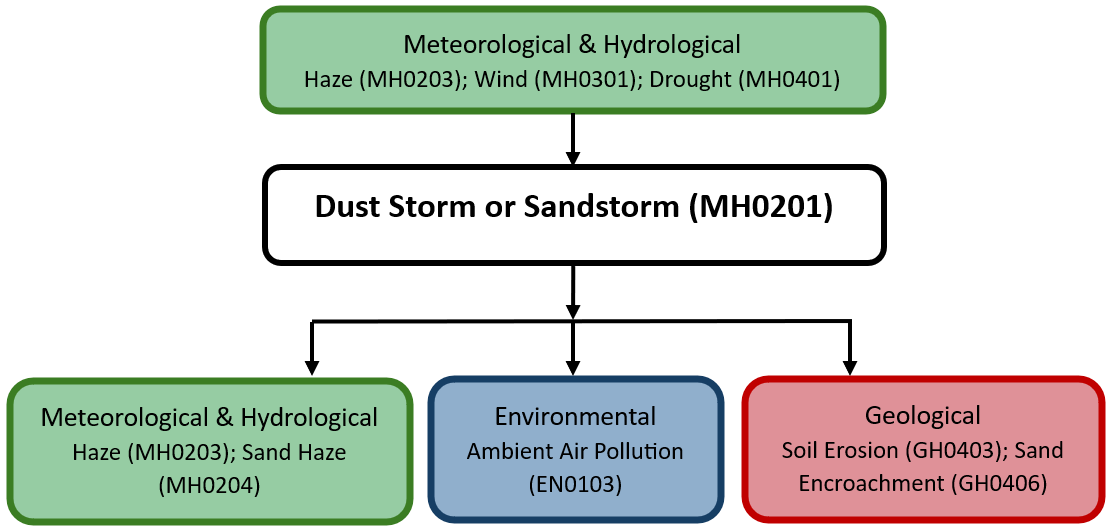
Risk Management
The World Meteorological Organization Sand and Dust Storm Warning Advisory and Assessment System (SDS-WAS) enhances the ability of countries to deliver timely, quality sand and dust storm forecasts, observations, information, and knowledge to users through an international partnership of research and operational communities. It operates through the Global SDS-WAS Steering Committee and three regional nodes: for (i) Northern Africa, Middle East and Europe, (ii) Asia, and (iii) the Americas (Baklanov, 2018).
Monitoring
The section above and the table below offer an overview of monitoring dust storms or sandstorms. This information can be used for forecasting within a national early warning system (EWS). Since EWS capacities and processes differ across countries, the most current and specific information regarding EWS should be obtained from the appropriate national or regional agency/authority responsible for disaster management.
| Which institution(s) produce(s) Disaster Risk Data/Information? |
|
| How is the Hazard Observed/Monitored/Forecast? | Dust storms and sandstorms are monitored using weather satellites, ground-based sensors, and LiDAR technology to track airborne dust levels, wind speeds, and visibility. Meteorologists analyse wind patterns, soil conditions, and atmospheric stability to predict when and where storms may form. Computer models simulate dust movement, helping forecasters issue early warnings. These alerts help protect public health, transportation, and infrastructure from the hazards of reduced visibility and poor air quality. |
References
American Thoracic Society, 2018. Sand and Dust Storms: Acute Exposure and Threats to Respiratory Health. Patient Education: Rapid Response Series. Accessed 16 May 2025.
Australian Capital Territory, 2018. Dust Storms: Health Impacts. Accessed 16 May 2025.
Baklanov, A., 2018. Overview of World Meteorological Organization Sand and Dust Storm Warning Advisory and Assessment System (WMO SDS-WAS) Program. Accessed 16 May 2025.
International Civil Aviation Organization (ICAO), 2009. Quantitative Criteria for ‘Sandstorm’ and ‘Dust Storm’ – Sandstorm & Duststorm Quantitative Criteria for Aviation SIGMET. ICAO. Accessed 16 May 2025.