
Downburst
A downburst is a violent and damaging downdraught reaching the ground surface, associated with a severe thunderstorm (WMO, 1992).
Primary reference(s)
WMO, 1992. International Meteorological Vocabulary, WMO-No. 182. 2nd Edition. World Meteorological Organization (WMO). Accessed 15 May 2025.
Annotations
Additional scientific description
A downburst is a strong downdraft that induces an outburst of damaging winds at or near the ground. Downbursts are classified based on the horizontal extent of their outflow:
- Microburst: Affecting areas less than 4 kilometres in diameter.
- Macroburst: Covering areas greater than 4 kilometres in diameter.
Wind speeds within downbursts can reach up to 67 meteres per second (approximately 240 kilometres per hour). These events typically last between 5 to 30 minutes and can cause significant damage comparable to that of tornadoes. Downbursts pose particular hazards to aviation due to the rapid changes in wind speed and direction they can induce (National Oceanic and Atmospheric Administration [NOAA], 2023).
Metrics and numeric limits
Comparison of a microburst and the larger macroburst (NOAA, 2019):
| Microburst | Macroburst |
|---|---|
| Damaging winds extending up to 2.5 miles (4 km) | Damaging winds extending more than 2.5 miles (4 km) |
| Lasts 5 to 15 minutes | Lasts 5 to 30 minutes |
| Can cause damaging winds up to 168 mph (270 kph) | Damaging winds, causing widespread, tornado-like damage, up to 134 mph (216 kph) |
Key relevant UN convention / multilateral treaty
Not applicable.
Drivers
Downbursts are powerful, localized columns of sinking air that rapidly descend from thunderstorms and impact the ground with intense winds, often exceeding 100 km/h. A combination of evaporative cooling and precipitation drag within the storm primarily drives these hazardous wind events. As rain or hail falls through a dry or cooler layer of air below the thunderstorm, it evaporates or melts, cooling the air and making it denser. This denser air plunges downward rapidly, accelerating under gravity. When this downdraft hits the surface, it spreads out radially, generating damaging straight-line winds that can flatten trees, overturn vehicles, and pose serious risks to aviation. Strong temperature gradients and high atmospheric instability can further intensify downbursts. While often confused with tornadoes due to their destructive nature, downbursts produce different wind patterns and are classified as non-rotational. Understanding the atmospheric conditions that lead to downbursts is critical for public safety and aviation operations. (National Weather Service [NWS], 2023).
Impacts
Downbursts are a particular hazard to aircraft at low level, especially on take-off or landing. An aircraft approaching a downburst will first encounter a strong headwind, which will lead to an increase in indicated airspeed. When trying to fly a set airspeed on approach, a pilot might therefore be tempted to reduce power. This would be very dangerous because, as the aircraft passes through the downburst, the wind becomes a tailwind and the indicated airspeed and lift drop. The significant downward force of air in the downburst may be enough to force the aircraft into the ground or at least cause it to lose a significant amount of height. The subsequent loss of performance, as the aircraft encounters tailwinds, may cause further loss of height and be enough to cause the aircraft to stall (SKYbrary, no date). One of the most notable downburst-related aviation accidents occurred in 1985, when Delta Air Lines Flight 191 crashed while attempting to land at Dallas/Fort Worth International Airport, killing 137 people after encountering a powerful microburst (National Weather Service [NWS], no date). Internationally, the 1974 crash of Martinair Flight 138 in Sri Lanka, which resulted in 191 fatalities, was also linked to wind shear and downburst conditions during approach (Department of Civil Aviation, 1975). These tragedies spurred global advancements in wind shear detection systems and pilot training for weather-related hazards.
Multi-hazard context
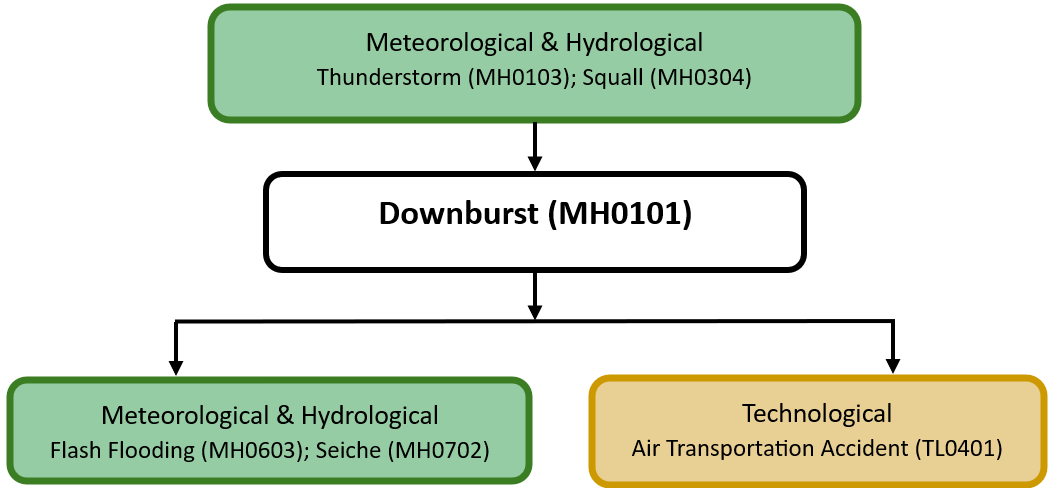
The figure below summarises common interactions between downbursts and other hazards. This information should be used with caution and not be solely relied upon in Disaster Risk Management, particularly as some interactions may not have been included. Note that hazardous events occurring together or locally in space or time may not necessarily cause, amplify, or be otherwise related to each other. Specific examples of multi-hazard context can be found in the ‘Hazard drivers’ and ‘Impacts’ sections above.
Multi-hazard diagram
Risk Management
Many lives have been saved because of the reduction, if not elimination, of potential airline crashes caused by dangerous wind shear conditions on take-off and landing. These saved lives are the result of training pilots on the dangers of microbursts and the installation of Doppler radars at major airports across the United States to warn pilots when microbursts are present (Wilson and Wakimoto, 2001).
Monitoring
The section above and the table below offer an overview of monitoring downbursts. This information can be used for forecasting within a national early warning system (EWS). Since EWS capacities and processes differ across countries, the most current and specific information regarding EWS should be obtained from the appropriate national or regional agency/authority responsible for disaster management.
| Which institution(s) produce(s) Disaster Risk Data/Information? |
|
| How is the Hazard Observed/Monitored/Forecast? | Downbursts are monitored using Doppler radar, which detects rapid changes in wind speed and direction, and surface weather stations that measure sudden pressure drops and temperature shifts. Meteorologists observe storm structures, especially strong thunderstorms, to identify conditions favourable for downbursts, such as intense rainfall and evaporative cooling. Forecasting downbursts is challenging due to their sudden nature, but advanced models and real-time radar data help predict their likelihood, allowing for warnings to protect aviation, infrastructure, and communities from dangerous wind impacts. |
References
Department of Civil Aviation, 1975. Report on the accident to Martinair DC 8 PH-MBH on 4 December 1974. Accessed 16 May 2025.
National Oceanic and Atmospheric Administration (NOAA), 2019. How do downbursts form? National Weather Service, National Oceanic and Atmospheric Administration. Accessed 15 May 2025.
National Weather Service (NWS), 2023. Downbursts. National Oceanic and Atmospheric Administration. Accessed 15 May 2025.
National Weather Service (NWS), no date. Remembering Delta Flight 191. National Oceanic and Atmospheric Administration. Accessed 16 May 2025.
SKYbrary (no date) Microburst. Accessed 15 May 2025.
Wilson, J.W. and Wakimoto, R.M., 2001. ‘The discovery of the downburst: T. T. Fujita’s contribution’, Bulletin of the American Meteorological Society, 82, pp. 49–62. Accessed 15 May 2025.