
Sand Encroachment
Sand encroachment is the accumulation of wind-borne sand. It commonly affects coasts, watercourses, and both cultivated and uncultivated land, typically occurring in arid to semi-arid regions. As sand accumulations move, they can bury towns, roads, oases, crops, market gardens, irrigation channels, and dams, leading to significant material and socioeconomic damage (cf. FAO, 2010).
Primary reference(s)
FAO, 2010. Fighting sand encroachment. Lessons from Mauritania. Food and Agriculture Organization of the United Nations (FAO). Accessed 13 February 2025.
Annotations
Additional scientific description
Sand accumulation forms vary depending on the landform, the type of surface they encroach upon, the presence or absence of vegetation, and the size of the sand grains (Hamdan et al., 2016). When the wind weakens, it loses its capacity to carry sand particles, causing them to be deposited (FAO, 2010).
Sand grain movement is controlled by:
- Avalanche effect: this is the result of saltation. As the grains of sand fall back, they displace more particles. The more intense the wind's saltation process, the greater the number of particles set in motion, until a saturation point is reached, where the quantity lost is equal to the quantity gained at any given moment. The distance needed to reach the saturation point depends on the sensitivity of a soil to erosion: on a very fragile soil, it can occur over a distance of about 50 m, but requires more than 1000 m on a very cohesive soil (FAO, 2010).
- Sorting - the sorting mechanism concerns the wind's displacement of the finest and lightest particles, leaving behind the larger particles. This process gradually impoverishes the soil, since the organic matter made up of small light elements is the first to be removed (FAO, 2010).
- Corrosion - corrosion is the mechanical attack on the surface as the sand-laden wind blows over it. In arid regions, it is the aggravating cause of soil erosion and is seen in parallel streaks or the polishing of rocks (FAO, 2010).
Metrics and numeric limits
The scale of sand encroachment depends on wind speed, which determines the sand removal force; the greater the speed, the higher the carrying capacity. Another key factor is the size and density of the sand particles. Sandy encroachments can vary from 50 cm in height, 150 cm in length and 40 cm in breadth, to 20 to 40 km long and 50 to 200 m wide (Al-Helal and Al-Awadhi, 2006). Sand encroachment reporting should indicate the accumulation location, scale, sand sources, and transport zones, as well as composition, topography and vegetation loss if known.
Key relevant UN convention / multilateral treaty
Sendai Framework for Disaster Risk Reduction 2015-2030.
Drivers
Several factors contribute to the formation and movement of sand masses. These include strong winds blowing across large areas, sparse or stunted vegetation, and degraded soil that is dry, bare, or prone to mobility (Khalaf and Al-ajmi, 1993; FAO, 2010).
Impacts
All forms of sand encroachment, regardless of size or duration, can create hazardous conditions, particularly affecting soil, vegetation, villages, roads (Boulghobra et al., 2015), railways, and irrigation channels:
- The wind first carries off the finer parts of the soil, thus weakening the soil structure. As the soil becomes sandier, it is more vulnerable to the wind and has a reduced water retention capacity. The terrain is gradually broken up by the creation of small mounds surrounding the woody and grassy vegetation as this degrades. The land gradually becomes unsuitable for cultivation (FAO, 2010).
- The wind has both mechanical and physiological effects on vegetation. The mechanical effects occur as carried soil particles collide with stalks and leaves, abrading their tissue. In areas where particles are carried off, roots become exposed, and vegetation risks uprooting (FAO, 2010). Physiologically, the wind increases evaporation, drying out plants, particularly during the dry season in Kuwait. The wind's evaporative power is proportional to the square root of its speed. Moreover, the reduced water retention capacity of the soil leads to water stress. The surrounding or moving mass of dry air tends to absorb humidity and exacerbate water deficit and this deficit is the main factor determining local vegetation, inasmuch as the latter has to adapt to the severe shortage of water (Khalaf and Al-ajmi, 1993).
Multi-hazard context
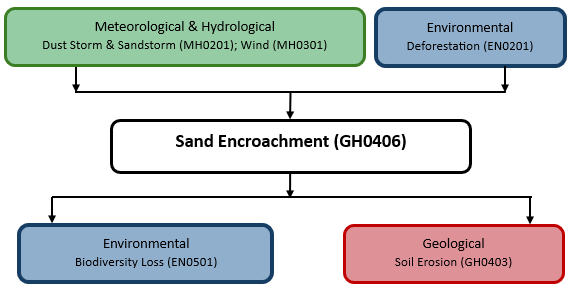
The figure below summarises common interactions between sand encroachment and other hazards. This information should be used with caution and not be solely relied upon in Disaster Risk Management, particularly as some interactions may not have been included. Note that hazardous events occurring together or locally in space or time may not necessarily cause, amplify or be otherwise related to each other. Specific examples of multi-hazard context can be found in the ‘Hazard drivers’ and ‘Impacts’ sections above.
Multi-hazard diagram
Risk Management
Risk management strategies are often localized and informal, for example removal of sand to clear roads. Larger scale management of dune systems involve using vegetation to stabilise sand dunes (UKCEH, 2021).
Monitoring
The section and the table below offer an overview of monitoring sand encroachment. This information can be used for forecasting within a national early warning system (EWS). Since EWS capacities and processes differ across countries, the most current and specific information regarding EWS should be obtained from the appropriate national or regional agency/authority responsible for disaster management.
| Which institution(s) produce(s) Disaster Risk Data/Information? | Local authorities |
| How is the Hazard Monitored/Observed/Forecast? | Remote sensing images can be used to monitor sand encroachment |
References
Al-Helal, A.B. and J.M. Al-Awadhi, 2006. Assessment of sand encroachment in Kuwait using GIS. Environmental Geology, 49:960-967.
Boulghobra, N., S. Merdas and F. Lakhdari, 2015. Sand encroachment in the Saharan Algeria; the not declared disaster - Case study: In-Salah region in the Tidikelt. Planet@Risk, 3:72-76.
FAO, 2010. Fighting sand encroachment. Lessons from Mauritania. Food and Agriculture Organization of the United Nations (FAO). Accessed 13 February 2025.
Hamdan, M.A., A.A. Refaat and M. Abdel Wahed, 2016. Morphologic characteristics and migration rate assessment of barchan dunes in the Southeastern Western Desert of Egypt. Geomorphology, 257:57-74.
Khalaf, F.I. and D. Al-ajmi, 1993. Aeolian processes and sand encroachment problems in Kuwait. Geomorphology, 6:111-134.
UKCEH, UK Sand Dune and Shingle Network and Dynamic Dunescapes partners (2021). The Sand Dune Managers Handbook. Version 1, June 2021. Produced for the Dynamic Dunescapes (DuneLIFE) project: LIFE17 NAT/UK/000570; HG-16-08643