
Compressive Soils
Compressive soils are prone to volumetric change when subject to mechanical loading (USDA, 1990:30). Collapsible soils are metastable in that they are prone to volumetric change (collapse) on wetting and loading (Rogers, 1995).
Primary reference(s)
Rogers, C.D.F., 1995. Types and distribution of collapsible soils. In: Derbyshire, E., T. Dijkstra and I.J. Smalley (eds), Genesis and Properties of Collapsible Soils. NATO ASI Series C, vol 468. Springer. Accessed 14 October 2020.
USDA, 1990. Elementary soil engineering. In: Engineering Field Manual. Engineering. United States Department of Agriculture (USDA). Accessed 26 October 2020.
Annotations
Additional scientific description
Volume change when a soil is subject to loading, due to changes in pore volume, initially as a result of the loss of air and water from the voids and then as a consequence of more ordered grain packing, or destroying of some larger soil pores by worms or dead roots. Organic matter in the soil may be more easily compressible; organic-rich and peat soils being particularly susceptible to consolidation. Consolidation is the gradual reduction in soil volume resulting from an increase in compressive stress. The resulting increase in density is compaction (USDA, 1990).
Consolidation consists of 3 types: (1) an initial phase, which is a comparatively sudden reduction in volume resulting from the expulsion and compression of gas; (2) primary consolidation, which results principally from a squeezing out of water and is accompanied by a transfer of load from the soil water to the soil solids; and (3) secondary consolidation, resulting principally from the adjustment of the internal structure of the soil mass after initial consolidation. Settlement is the displacement of a structure due to the compression and deformation of the underlying soil. Compaction is the densification of a soil by means of mechanical manipulation (USDA, 1990).
Collapsible soils differ from compressible soils in that they are low density soils with a structure that collapses upon wetting and arrangement of particles reformed. They may have considerable strength when dry or moist. They lose strength and undergo sudden compression when they are saturated. Some will collapse under their own weight when saturated; others, only when loaded (USDA, 1990).
Thermokarst is a type of terrain characterized by very irregular surfaces of marshy hollows and small hummocks formed when permafrost-affected soils thaw. Small domes that form on the surface due to frost heaving with the onset of winter collapse during the following summer thaw, leaving surface depressions.
Compressible soils can be characterised using consolidation testing in the laboratory and in the field using static cone testing, penetrometers and bulk density rungs (USDA, 1990).
Metrics and numeric limits
Comprehensive assessments of compacted / compressive soils are lacking. The Intergovernmental Technical Panel on Soils (ITPS) and Food and Agriculture Organization of the United Nations (FAO) indicated that compaction-related soil degradation is increasing in Asia, Latin America and the Near East and North Africa; it is variable in Europe and Eurasia, the SW Pacific and North America (FAO and ITPS, 2015).
The FAO and its partners in the Global Soil Partnership (GSP) are designing SoilSTAT, a system for monitoring, forecasting and reporting periodically on the status of global soil resources. The name of the system mirrors the FAOSTAT family of global status databases and monitoring. SoilSTAT is part of the Global Soil Information System. It will be built under GSP Pillar 4 as part of spatial data infrastructure for the exchange of web-based soil data services. The basic data elements of Pillar 4 include soil profiles, soil polygon maps and soil grids; SoilSTAT will be based on indicators describing the current condition of, and trends in, soil quality. According to the Status of the World's Soil Resources report, indicators will address soil threats such as erosion, compaction, salinisation and the loss of soil organic matter. SoilSTAT will therefore be an important mediator in the harmonised reporting of national soil information for the Sustainable Development Goals (FAO and ITPS, 2015).
Key relevant UN convention / multilateral treaty
United Nations Convention to Combat Desertification (UNCCD),
Intergovernmental Technical Panel on Soils (ITPS)
Drivers
The main cause of compaction is vehicle movements across the soil surface, with farm mechanization considered the primary cause on both agricultural and forestry land, especially if soil moisture levels are high (Forest Research, 2020). Extensive compaction is also caused by livestock and herds of wild animals, especially if stocking densities are high. Soil compaction on construction sites occurs either deliberately when foundations and sub-grades are prepared for construction or as an unintended result of vehicular traffic and excavation (cut and fill) works (DEFRA, 2006).
Impacts
Compaction reduces the volume of void available for water, potentially affecting water infiltration into soil, crop root moisture uptake and penetration, and consequential crop yield. Soil compaction can lead to surface ponding of water and water logging, leading to chemical deterioration in soil quality. The potential for increased surface water run-off can lead to soil erosion (USDA, 1990).
Collapsible soils commonly occur as alluvial fans in sub-humid to arid areas. Consequential threats include salinisation, nutrient imbalance and loss of biodiversity that may result from soil compaction. Compacted soil may contribute to atmospheric warming through increased emissions of carbon dioxide, methane and nitrogen dioxide from such soils (USDA, 1990). Significant shrinkage of organic soils can occur during their drainage, compression and decomposition. Drainage of peat results in on-going land subsidence and carbon loss. Subsidence is the gradual lowering of the land surface due to the drained peat shrinking, consolidating and becoming denser.
Collapsible soil foundations cause problems when they are saturated after being loaded by a structure. Examples are settlement of a dam foundation resulting in cracking of the dam when stored water saturates the foundation; settlement and cracking of an irrigation ditch, dike or lining when seepage from the ditch saturates the foundation; or settlement of a building when the foundation soil is saturated with water from a downspout or leaks in water or sewer pipes (USDA, 1990).
Multi-hazard context
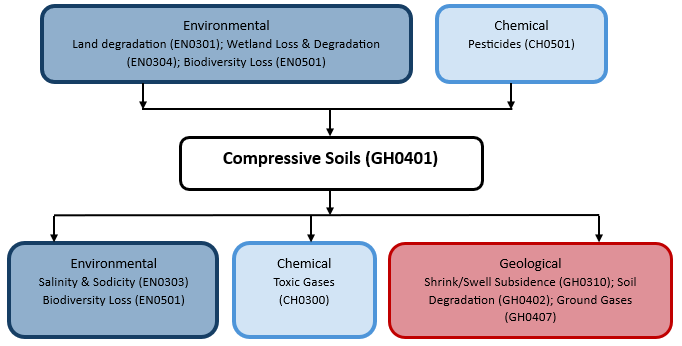
The figure below summarises common interactions between compressive soils and other hazards. This information should be used with caution and not be solely relied upon in Disaster Risk Management, particularly as some interactions may not have been included. Note that hazardous events occurring together or locally in space or time may not necessarily cause, amplify or be otherwise related to each other. Specific examples of multi-hazard context can be found in the ‘Hazard drivers’ and ‘Impacts’ sections above.
Multi-hazard diagram
Risk Management
Compressible soils commonly occur in river estuaries where they may be associated with flooding. Building in these areas may necessitate the use of building platforms to avoid flooding. However, loads with shallow foundations may be subject to large settlement over long durations. Methods such as the installation of sand drains can be used to manage the settlement. Where the compressible soils are relatively thin, foundations may be taken down to bear into more competent strata at depth. This scenario can lead to differential settlement. These soils are also sensitive to ground lowering as a consequence of dewatering (USDA, 1990).
For organic soils, drainage should be avoided and rewetting as a restoration process. Traffic on organic soils should be avoided. For mineral soils, animal loads and traffic should be reduced, especially in wet conditions.
Many loessal soils are collapsible because of their soil particle bonding structure. Low density soils above the water table in this situation should be suspected of being collapsible. They can be identified by modified consolidation testing of undisturbed samples. In testing, samples are loaded in a moist condition, then saturated collapsible soils will show sudden settlement upon wetting (USDA, 1990). For example, it is important to check the foundations of earth dams for strength, permeability, compressibility, dispersive clays (piping), water table elevation, and depth to bedrock (USDA, 1990).
Monitoring
The section and the table below offer an overview of monitoring compressive soils. This information can be used for forecasting within a national early warning system (EWS). Since EWS capacities and processes differ across countries, the most current and specific information regarding EWS should be obtained from the appropriate national or regional agency/authority responsible for disaster management.
| Which institution(s) produce(s) Disaster Risk Data/Information? | Land management agency |
| How is the Hazard Observed/Monitored/Forecast? | Soil physical property analysis |
References
Department for Environment, Food and Rural Affairs (DEFRA), 2006. The Impact of Subsoil Compaction on Soil Functionality and Landscape. Department of the Environment Food and Rural Affairs (DEFRA). https://sciencesearch.defra.gov.uk/ProjectDetails?ProjectId=14010 Accessed 13 February 2025.
Food and Agriculture Organization of the United Nations (FAO), 2020. Land and water: SoilSTAT. Food and Agriculture Organization of the United Nations (FAO). Accessed 13 February 2025.
Food and Agriculture Organization of the United Nations and Intergovernmental Technical Panel on Soils (FAO and ITPS), 2015. Status of the World’s Soil Resources: Technical Summary. Food and Agriculture Organization of the United Nations (FAO) and Intergovernmental Technical Panel on Soils (ITPS). Accessed 13 February 2025.
Forest Research, 2020. Soil Compaction - Practical Considerations. Accessed 13 February 2025.
United States Department of Agriculture (USDA), 1990. Elementary soil engineering. In: Engineering Field Manual. Engineering. United States Department of Agriculture (USDA). Accessed 13 February 2025.