
Ionospheric Disturbances
Ionospheric disturbances refer to the state of the ionosphere characterized by irregular variations of ionospheric parameters without a systematic pattern. These disturbances can be of different spatiotemporal scales and have distinct characteristics at different geographic locations. Different ionospheric disturbances pose different risks to various applications (WMO, 1992).
Primary reference(s)
WMO, 1992. International Meteorological Vocabulary. World Meteorological Organization (WMO), Report No. 182. Accessed 31 January 2025.
Annotations
Additional scientific description
Ionospheric disturbances can originate from space weather events, including solar flares, solar particle events, geomagnetic storms, and ionospheric pre-reversal enhancement, especially at night local time, due to fast vertical ionospheric drift. These disturbances can severely disrupt radio-wave propagation, particularly at high latitudes (AMS, 2012). The ionosphere, a part of Earth's upper atmosphere, plays a pivotal role in reflecting and modifying radio waves for communication, navigation, and radar tracking of space objects. The air in the ionosphere is ionized. Large amounts of free electrons are present within the range of 103 - 106 per 1 cm3. The electron concentration depends on the ionospheric region and geophysical conditions. The Sun, emitting X-ray and ultraviolet radiation, is the primary ionization source. Free electrons enable radio wave reflection in the ionosphere, facilitating long-distance radio propagation through reflections from ionospheric regions and the Earth's surface.
The electron concentration in the ionosphere undergoes variations of different spatiotemporal scale, most of which depend on variations in solar UV and X-ray fluxes. This flux variation leads to corresponding changes in ionospheric density. Particle precipitation, particularly at high latitudes, significantly influences ionospheric behaviour. The ionosphere comprises D, E, F1, and F2 regions, with local maxima of electron density. The F region, housing the main maximum of electron density in the ionosphere, is particularly notable. Solar irradiance influences ionization, resulting in the pole facing away from the Sun compared to the day-side and the pole facing the Sun (NOAA, 2019b). Solar proton bursts and particle precipitation cause effects in the ionosphere mostly at high latitudes. The impacts of solar proton bursts and auroral precipitation can be observed, particularly at high latitudes and in the polar caps.
An ionospheric storm, whether positive or negative, is a specific type of ionospheric disturbance characterized by an increase or decrease in the electron concentration within the F2 region during and/or after a geomagnetic storm compared to its quiet values. Ionospheric disturbances are a combination of ionospheric and atmospheric phenomena that are influenced by various factors, including the coordinates of the observation point, local time, season, and other conditions.
Metrics and numeric limits
Due to their high regional specifics, there is no global index/scale for ionospheric disturbances. The impact estimation for each region is based on the regional diagnostics.
The Space Weather Centres designated by the International Civil Aviation Organization (ICAO) are expected to provide airlines with advisories about anomalous conditions in HF communication and in GNSS performance based on the following parameters and thresholds (ICAO, 2019):
| Impact | Parameter | MOD | SEV |
|---|---|---|---|
| GNSS Ampl. Scint. | S4 | 0.5 | 0.8 |
| GNSS Phase Scint. | σφ | 0.4 rad | 0.7 rad |
| Ionospheric delay in GNSS signal | Total Electron Content | 125 TECU (1 TECU= 1016 el/m2) | 175 TECU |
| Polar Cap Absorption of HF waves | Cosmic Noise Absorption by ionospheric D-layer | 2 dB | 5 dB |
| Post Storm Depression of HF reflectivity | Decrease in the Maximum Usable Frequency | 30% | 50% |
Key relevant UN convention / multilateral treaty
Sendai Framework for Disaster Risk Reduction 2015-2030.
Drivers
Drivers, among others, include solar activity: Many ionospheric disturbances are driven by solar activity, including solar flares, solar particle events, and coronal mass ejections. Increased solar activity can lead to more frequent and intense ionospheric storms.
Fast solar wind streams causing stream interaction regions in the solar wind can also drive ionospheric disturbances. Irregular drivers include intensive tropospheric convection, seismic activity, artificial explosion, and solar eclipses.
Impacts
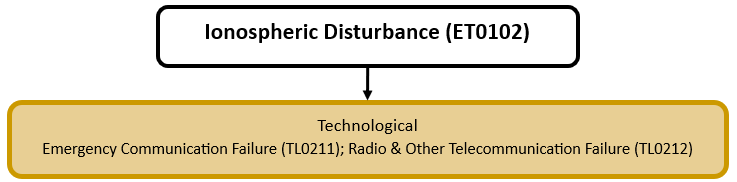
Disruption of radio communication: Ionospheric disturbances can affect sky-wave radio wave propagation, leading to quality degradation or failure of communication links in the affected regions. More specifically, it can impact HF (high-frequency) radio communications, crucial for aviation, maritime operations, and emergency services This can impact air traffic control communications, aircraft-to-aircraft communications, and other radio-based systems used in aviation.
Navigation errors: ionospheric disturbances can also introduce errors in GNSS signals, in particular, it degrades the accuracy and reliability of Global Navigation Satellite Systems (GNSS) causing errors in positioning, navigation, and timing systems.
Satellite drag:. increases atmospheric drag on satellites in low Earth orbit, altering orbital dynamics and potentially shortening satellite lifespans. Ionospheric disturbances can produce large short-term increases in upper atmosphere temperature and density, increasing drag on satellites and changing their orbits. Challenges to radio astronomical observations and other space research activities, as precise signal transmission and reception through the ionosphere are affected.
GNSS navigation disruptions affect industries relying on precise positioning, such as construction, agriculture, and logistics. Emergency response and disaster management suffer delays due to compromised communication channels, impacting coordination during natural disasters or crises.
Multi-hazard context
The figure below summarises common interactions between ionospheric disturbances and other hazards. This information should be used with caution and not be solely relied upon in Disaster Risk Management, particularly as some interactions may not have been included. Note that hazardous events occurring together or locally in space or time may not necessarily cause, amplify, or be otherwise related to each other. Specific examples of multi-hazard context can be found in the ‘Hazard drivers’ and ‘Impacts’ sections above.
Multi-hazard diagram
Risk Management
Space weather monitoring: A range of organizations monitor conditions and provide alerts and forecasts related to ionospheric storms. This allows stakeholders to be aware of potential impacts and take necessary precautions.
Flight diversion and postponement: In cases where ionospheric disturbances pose a significant risk to aviation operations, flights may be diverted to alternate routes or postponed until the storm subsides. This helps mitigate the potential impacts of disrupted radio communication and navigation errors. Airlines and aviation organizations implement mitigation strategies to minimize the impacts of ionospheric disturbances. This may include implementing alternative communication systems, using backup navigation methods, and ensuring pilots and air traffic controllers are trained to handle space weather-related disruptions.
Satellites require shielding and surge protection to safeguard sensitive electronics. Establish redundant ground stations in geographically diverse locations to maintain satellite communication even if one station is affected by ionospheric disturbances. Develop redundancy in communication links by utilizing diverse frequency bands, communication paths, and transmission modes. This ensures that alternative channels can be quickly activated if primary communication links are disrupted.
Atmospheric density: Various organizations provide services for atmospheric conditions influenced by space weather.
Monitoring
Space weather services members of the International Space Environment Services (ISES) provide warning systems for specific users in their countries. The Space Weather centres designated by the International Civil Aviation Organization (ICAO) issue advisories about ionospheric disturbances to airlines.
References
AMS, 2012. Ionospheric storm. Glossary of Meteorology, American Meteoroidal Society (AMS). Accessed 31 January 2025.
ESA, no date. Federated products from the UK Met Office (UKMO). ESA Space Weather Service Network. Accessed 31 January 2025.
ISES, 2019. Ionospheric storm scale. International Space Environment Service (ISES). Accessed 31 January 2025.
NOAA, 2019a. Ionosphere. Space Weather Prediction Center, National Oceanic and Atmospheric Administration (NOAA). Accessed 31 January 2025.
NASA, 2019a. Ionosphere. Space Weather Prediction Center, National Oceanic and Atmospheric Administration (NOAA). Accessed 25 November 2019.
NOAA, 2019b. Space Weather Glossary. Space Weather Prediction Center, National Oceanic and Atmospheric Administration (NOAA). Accessed 31 January 2025.
NOAA Space Weather Prediction Center. Satellite Drag. Accessed 31 January 2025.