Geomagnetic Disturbance
A geomagnetic disturbance refers to perturbations in Earth's magnetosphere caused by sudden and significant variations in the solar wind's speed, density, and magnetic properties. The intensity of a geomagnetic disturbance can be measured using different geomagnetic indexes. Although a geomagnetic disturbance is a global phenomenon, the intensities and characteristics vary at different geographic locations (NOAA, 2023).
Primary reference(s)
NOAA Space Weather Prediction Center (2023) Geomagnetic Storms. Available at https://www.swpc.noaa.gov/phenomena/geomagnetic-storms Accessed 31 January 2025
Annotations
Additional scientific description
A geomagnetic disturbance is a substantial perturbation of Earth's magnetosphere, which arises due to the efficient infusion of energy from the solar wind into the space environment surrounding our planet. These disruptions are triggered by fluctuations in the solar wind, leading to significant alterations in the currents, plasmas, and magnetic fields within Earth's magnetosphere. Geomagnetic disturbances typically occur during prolonged periods (lasting several to many hours) of high-speed solar wind, primarily when the solar wind's magnetic field is oriented southward, opposing Earth's magnetic field. This configuration notably facilitates the transfer of energy from the solar wind to Earth's magnetosphere, particularly on the dayside of the magnetosphere.
The intensity of a geomagnetic disturbance can be measured using different geomagnetic indexes. The K-index quantifies disturbances in the horizontal component of the Earth's magnetic field with an integer in the range 0-9, with 1 being calm and 5 or more indicating a geomagnetic storm. It is derived from the maximum fluctuations of horizontal components observed on a magnetometer during a three-hour interval. The planetary 3-hour-range index Kp is the mean standardized K-index from 13 geomagnetic observatories between 44 and 60 degrees northern or southern geomagnetic latitudes. The label 'K' comes from the German word 'Kennziffer', meaning 'characteristic digit.'
The effects of geomagnetic disturbances range from mild, such as interference with aeromagnetic surveys, to extreme cases where electric power grids may experience blackouts or collapse. The most notable recorded solar superstorm, the Carrington Event, occurred in 1859. It was associated with a large solar flare, and the coronal mass ejections took only 17.6 hours to travel from the Sun to Earth. This event caused auroras to be observed where they are not typically seen, including equatorial latitudes. One consequence of the Carrington Event was the malfunctioning of telegraph systems worldwide, with operators receiving messages despite having disconnected their power supplies (Boteler, 2006; Clauer and Siscoe, 2006, Gonzalez-Esparza and Cuevas-Cardona, 2018).
In March 1989, the third strongest recorded geomagnetic disturbance struck Earth, resulting in severe consequences. Within a minute, induced currents in transmission lines triggered overload safety systems, leading to the shutdown of sections of the Quebec power network. This cascade effect caused a complete collapse of the network, plunging the region into darkness for nine hours. Restoration efforts were further complicated because the disturbance also affected backup equipment (CAA, 2016).
Different countries utilize various scales to assess and communicate the severity of geomagnetic disturbances. The common one is the K-level index, which ranges from 0 to 9. The K-index can be utilized locally (K-index) or planetary (Kp-index). Storms with minimal effects fall within the range of K=0-3, while mid-level effects occur for K=4-7. Strong storms with significant impacts are classified as K>7 (NRC, 2019). The K-index is used in Canada, Europe, Brazil, Mexico, and other regions worldwide to measure geomagnetic disturbances.
The K-index records locally the intensity of a geomagnetic disturbance event at different regions of the planet.
Metrics and numeric limits
Geomagnetic Disturbances are classified using a five-level scale introduced by the United States National Oceanic and Atmospheric Administration (NOAA, 2023) in 1999. The scale is currently under review and presented below. It is good to recognize that the Effect column also lists impacts typical during geomagnetic disturbances but has their causes in the other space weather hazards (ET-0005, ET-0006, ET-0007). The Space Weather centers designated by the International Civil Aviation Organization (ICAO) are expected to provide airliners with advisories about anomalous conditions in HF communication when Kp exceeds the levels of 8 (for moderate activity, MOD) and 9 (for severe activity, SEV) (ICAO, 2019).
| Scale | Description | Effect | Physical measure | Average Frequency (1 cycle = 11 years) |
|---|---|---|---|---|
| G5 | Extreme | Power systems: Widespread voltage control problems and protective system problems can occur; some grid systems may experience complete collapse or blackouts. Transformers may experience damage. Spacecraft operations: May experience extensive surface charging, problems with orientation, uplink/downlink, and tracking satellites. Other systems: Pipeline currents can reach hundreds of amps, HF (high frequency) radio propagation may be impossible in many areas for one to two days, satellite navigation may be degraded for days, low-frequency radio navigation can be out for hours, and aurora has been seen at typically 40° geomagnetic lat. | Kp = 9 | 4 per cycle (4 days per cycle) |
| G4 | Severe | Power systems: Possible widespread voltage control problems and some protective systems will mistakenly trip out key assets from the grid. Spacecraft operations: May experience surface charging and tracking problems, corrections may be needed for orientation problems. Other systems: Induced pipeline currents affect preventive measures, HF radio propagation sporadic, satellite navigation degraded for hours, low-frequency radio navigation disrupted, and aurora has been seen at typically 45° geomagnetic lat. | Kp = 8, including a 9- | 100 per cycle (60 days per cycle) |
| G3 | Strong | Power systems: Voltage corrections may be required, false alarms triggered on some protection devices. Spacecraft operations: Surface charging may occur on satellite components, drag may increase on low-Earth-orbit satellites, and corrections may be needed for orientation problems. Other systems: Intermittent satellite navigation and low-frequency radio navigation problems may occur, HF radio may be intermittent, and aurora has been seen at typically 50° geomagnetic lat. | Kp = 7 | 200 per cycle (130 days per cycle) |
| G2 | Moderate | Power systems: High-latitude power systems may experience voltage alarms, long-duration disturbances may cause transformer damage. Spacecraft operations: Corrective actions to orientation may be required by ground control; possible changes in drag affect orbit predictions. Other systems: HF radio propagation can fade at higher latitudes, and aurora has been seen at typically 55° geomagnetic lat.. | Kp = 6 | 600 per cycle (360 days per cycle) |
| G1 | Minor | Power systems: Weak power grid fluctuations can occur. Spacecraft operations: Minor impact on satellite operations possible. Other systems: Migratory animals are affected at this and higher levels; aurora is commonly visible at high. | Kp = 5 | 1700 per cycle (900 days per cycle) |
Key relevant UN convention / multilateral treaty
Sendai Framework for Disaster Risk Reduction 2015-2030.
Drivers
Solar activity: Geomagnetic disturbances are driven by CMEs and high-speed solar wind streams. Increased solar activity can lead to more frequent and increased chance of intense geomagnetic disturbances.
Impacts
Electrical Grid Vulnerabilities: Geomagnetic disturbances can induce currents in long electrical conductors, particularly in power grids. This can lead to voltage instabilities and transformer damage, potentially resulting in widespread power outages, as was experienced during the Quebec event in 1989. During severe geomagnetic disturbances, the changing magnetic fields induce electric currents in power transmission lines. The geomagnetically-induced currents (GIC) can overload transformers and other equipment, leading to disruptions and damage to power grids. In extreme geomagnetic disturbances, the impacts on power grids can go beyond GIC-induced damage. The rapid fluctuations in the Earth's magnetic field can affect the operation and stability of power systems, potentially leading to blackouts or grid instability.
Communication Disruptions: The disturbances can interfere with radio frequencies used for communication, especially affecting high-frequency radio communications and GPS systems. This can disrupt aviation, marine, and terrestrial communications, including emergency services that rely on these systems.
Satellite Operations: Satellites are particularly vulnerable to geomagnetic storms due to their exposure to intensified radiation and charged particles. This can lead to temporary or permanent damage to satellite electronics, loss of satellite control, and degradation of the accuracy of satellite-based navigation and communication systems.
Pipeline Corrosion: Geomagnetically induced currents (GICs) can also accelerate corrosion in pipelines carrying oil and gas. This not only risks the structural integrity of the pipelines but also increases the risk of leaks, which can have environmental and economic impacts.
Aviation Risks: Increased radiation levels during geomagnetic storms can pose risks to flight crews and passengers at high altitudes, particularly on polar routes. Airlines may need to reroute flights, leading to increased flight times and fuel consumption.
Economic and Social Impact: The combined effects on power grids, communication systems, satellite operations, and pipelines can have cascading impacts on various sectors including healthcare, finance, and emergency services, potentially leading to significant economic losses and social disruption.
Multi-hazard context
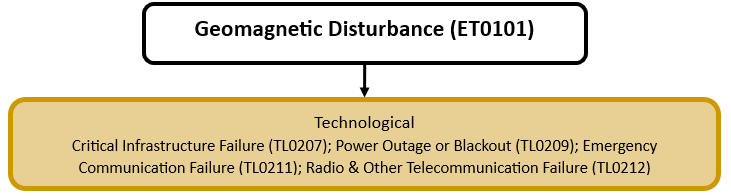
The figure below summarises common interactions between geomagnetic disturbance and other hazards. This information should be used with caution and not be solely relied upon in Disaster Risk Management, particularly as some interactions may not have been included. Note that hazardous events occurring together or locally in space or time may not necessarily cause, amplify or be otherwise related to each other. Specific examples of multi-hazard context can be found in the ‘Hazard drivers’ and ‘Impacts’ sections above.
Multi-hazard diagram
Risk Management
Space weather monitoring: A range of organizations monitor solar activity and the geomagnetic conditions around the Earth. The geomagnetic storm evolution can be monitored from space and ground-based vantage points.
Geomagnetic storm predictions: The predictions of a geomagnetic storm are provided to alert and prepare for future conditions. Space weather services can provide products for operators, e.g., power systems and pipelines, radiofrequency management.
Monitoring
Space weather services members of the International Space Environment Services (ISES) offer warning systems to specific users in their countries. The Space Weather centers designated by the International Civil Aviation Organization (ICAO) provide airliners with advisories about geomagnetic storms.
References
Boteler, D.H., 2006. The super storms of August/September 1859 and their effects on the telegraph system. Advances in Space Research, 38:159-172.
CAA, 2016. Impacts of Space Weather on Aviation. Civil Aviation Authority (CAA). Accessed 14 October 2020.
Cannon, P., M. Angling, L. Barclay, A. Thomson and C. Underwood, 2013. Extreme Space Weather: Impacts on engineered systems and infrastructure. Royal Academy of Engineering. Accessed 31 January 2025.
Clauer, C.R. and G.E. Siscoe, 2006. The Great Historical Geomagnetic Storm of 1859: A Modern Look. Advances in Space Research, 38:115-388.
ESA, no date. Geomagnetic Conditions Expert Service Centre (G-ESC). ESA Space Weather Service Network. Accessed 31 January 2025.
González‐Esparza, J.A. and MC Cuevas‐Cardona, 2018. Observations of Low-Latitude Red Aurora in Mexico During the 1859 Carrington Geomagnetic Storm. Space weather, 16. Accessed 31 January 2025.
International Civil Aviation Organization. Manual on SpaceWeather Information in Support of International Air Navigation (Doc 10100); Technical report; ICAO: Montréal, Canada, 2019.
Riley, P. and J. J. Love, 2017. Extreme geomagnetic storms: probabilistic forecast and their uncertainties. Space Weather, 1(14): 16-27.
NOAA, 2019. NOAA Space Weather Scales. Space Weather Prediction Center, National Oceanic and Atmospheric Administration (NOAA). Accessed 20 November 2019.
The classical and the most used geomagnetic storm classifications (by Dst and Bz) are given in:
Gonzalez, W.D., Joselyn, J.A., Kamide, D., Kroehl, H.W., Rostoker, G., Tsurutani, B.T., Vasyliunas, V.M.: What is a geomagnetic storm? J. Geophys. Res., 99, 6, 5771–5792 (1994).
Loewe, C.A., Prölss, G.W.: Classification and mean behavior of magnetic storms, Journal of Geophysical Research, 102, 14209-14213 (1997). Accessed 31 January 2025.