
Coral Bleaching
Corals are subject to ‘bleaching’ when the seawater temperature is too high: they lose the symbiotic algae that give coral its colour and part of its nutrients. Severe, prolonged or repeated bleaching can lead to the death of coral colonies (United Nations, 2017).
Primary reference(s)
United Nations, 2017. The First Global Integrated Marine Assessment: World Ocean Assessment I. Cambridge University Press. Accessed 25 February 2025.
Annotations
Additional scientific description
Corals are symbiotic organisms with the coral polyp hosting photosynthetic zooxanthellae algae for mutual benefit. In times of stress, the polyp expels the algae, affecting coral growth and reproduction and leading to bleaching. When bleaching persists, it can result in coral starvation and death (Saxena et al., 2023).
Coral bleaching is a relatively modern phenomenon. Prior to 1980, it was rarely observed and considered a local issue. Since then, both the frequency and severity of bleaching events have increased. The percentage of corals damaged globally due to bleaching rose from 8% per annum in the 1980s to around 31% in 2016 (Saxena et al., 2023).
An increase of only 1°C to 2°C above the seasonal maximum can induce bleaching. While most coral species are susceptible to bleaching, thermal tolerance varies. Many heat-stressed or bleached corals subsequently die from coral diseases (United Nations, 2017; 2021).
Increasingly frequent severe coral bleaching is one of the greatest threats to coral reefs from climate change. Global climate models project wide spatial variation in the timing of annual severe bleaching events-a point beyond which reef recovery becomes limited (UNEP, 2017).
In 2005, the USA lost half its coral reefs in the Caribbean due to a major bleaching event. Warm waters centred around the northern Antilles extended southward. Satellite data showed that thermal stress from this event exceeded the previous 20 years combined (NOAA, no date a).
In 2020, bleaching was reported around Hainan Island and the Beibu Gulf. The Great Barrier Reef experienced mass bleaching in 1998, 2002, 2006, 2016, 2017, and 2020. The Global Coral-Bleaching Database (GCBD) includes 34,846 bleaching records from 14,405 sites in 93 countries (Saxena et al., 2023).
Annual severe bleaching onset is defined as more than eight degree-heating weeks (DHWs) within a three-month period. At this threshold, thermal stress is likely sufficient to cause bleaching (van Hooidonk et al., 2016)
Metrics and numeric limits
The NOAA Coral Reef Watch daily global 5 km satellite coral bleaching Degree Heating Week (DHW) product measures accumulated heat stress that can lead to coral bleaching and mortality. A DHW value of 4 °C-weeks indicates a risk of bleaching. At 8 °C-weeks, reef-wide bleaching with mortality among heat-sensitive corals is likely. If the DHW reaches 12 °C-weeks, multi-species mortality becomes likely. When values reach 16 °C-weeks, severe mortality affecting more than 50% of corals is expected, and at 20 °C-weeks or above, near-total mortality (in excess of 80%) is probable (NOAA, 2018).
Key relevant UN convention / multilateral treaty
The Convention on Biological Diversity (1992) includes objectives to conserve biodiversity, sustainably use its components, and fairly share the benefits from genetic resources.
Drivers
The main drivers for coral bleaching are climate change and heat. Multiple reef stressors, such as erosion, solar radiation, rising sea surface temperatures, pollution, sedimentation due to deforestation and construction, predation, variable salinity, infections, disease outbreaks, and increased virulence, as well as overfishing and destructive fishing practices, have been associated with the loss of symbiotic algae in corals. Bleaching can be induced by subjecting corals to suboptimal conditions of any factor central to growth and survivorship. Bleaching occurs where severe (“lethal”) doses of any one environmental factor occur, and also when moderate (“sublethal”) doses operate in combination. The complexity of the drivers affecting coral bleaching is summarised in the figure below (Suggett and Smith, 2019).

Climate change is considered the major cause of coral bleaching. Evidence strongly supports the role of marine heatwaves as the primary driver of mass bleaching events. Heatwave severity is measured as Degree Heating Weeks (DHWs), reflecting the cumulative time during which sea surface temperatures (SSTs) exceed the seasonal norm. All environmental factors mentioned above influence the timing and severity of heat stress-induced bleaching. This complex interaction has led researchers to describe the system as one where "all roads can lead to [some form of] coral bleaching" (Suggett and Smith, 2019). Because coral polyps tolerate only a narrow thermal range, a rise of just 1-2°C can initiate mass bleaching. While bleaching is reduced in shaded reef systems, it is more pronounced in areas exposed to elevated light conditions (Saxena et al., 2023).
High turbidity caused by silt and contaminants reduces light availability to coral reefs, increasing their vulnerability. Additional hazards such as frequent and intense tropical cyclones, ocean acidification, and ozone depletion (which increases UV radiation) further stress corals and increase bleaching risk. Eutrophication of coastal waters is also contributing to increased coral mortality (Lesser, 2021).
Impacts
Coral reef degradation caused by bleaching significantly affects fisheries, as corals provide nutrition and habitat for numerous fish species and reef-associated marine fauna. The decline in reef fish populations has reduced the numbers of larger predatory species. These impacts severely affect coastal communities in the tropics that rely on coral reef-based fisheries for livelihood, income, and food security. There is also a cascading effect on industrialised nations that import seafood from reef ecosystems (Saxena et al., 2023).
Coral reefs act as natural wave barriers. The loss of reef integrity due to mass bleaching has made coastlines more vulnerable to damage in the past decade (Saxena et al., 2023).
Economic assessments estimate global losses in coral reef value under climate change to range from US$3.4 billion to US$23.78 billion annually (Chen et al., 2015; coast.noaa.gov/states/fast-facts/coral-reefs.html).
Multi-hazard context
The figure below summarises common interactions between coral bleaching and other hazards. This information should be used with caution and not be solely relied upon in disaster risk management, particularly as some interactions may not have been included. Note that hazardous events occurring together or in proximity in space or time may not necessarily cause, amplify, or be otherwise related to one another. Specific examples of multi-hazard context can be found in the ‘Hazard drivers’ and ‘Impacts’ sections above.
Multi-hazard diagram
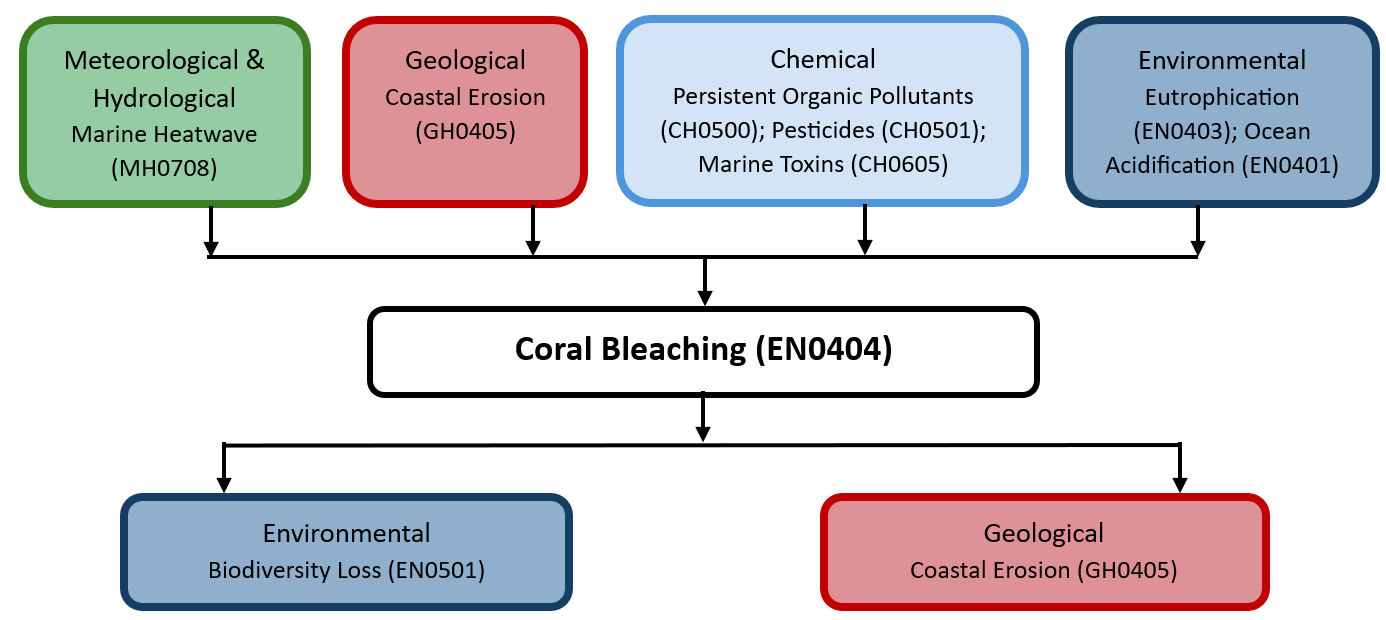
Risk Management
The recurrence of mass coral bleaching events in recent years has highlighted the need to protect coral reefs and support their adaptation to climate change. Multiple approaches are possible.
One approach focuses on protecting the environmental conditions in which corals grow to improve their health and reduce the impacts of heatwaves. Established practices include the use of marine protected areas (MPAs), which reduce fishing pressure on coral reefs, enhance opportunities for coral larvae recruitment, and provide some buffering against extreme events. Effective regulation of land-derived nutrient inflows that promote algal growth and exacerbate coral sensitivity to heat-induced bleaching is also a necessary step (Suggett and Smith, 2019).
Another approach aims to enhance the adaptive capacity of corals to withstand higher temperatures. Corals have shown the ability to develop resistance (defying bleaching), tolerance (surviving in a bleached state), and recovery (returning to a healthy state post-bleaching). These capacities vary across individuals and species. Some show visible signs of bleaching only after 1–2 weeks at 1.5°C above normal, while others in the same location may remain unbleached for more than 4–6 weeks (Saxena et al., 2023). Understanding these dynamics can help inform targeted interventions.
Coral restoration projects are under way in many countries. Some initiatives involve coral farming or propagation, in which large corals are broken into small fragments or miniature polyps (ranging from 1 to 5 in number). These fragments trigger the formation of clones that grow to 25–50 times the size of the original coral. These cloned fragments then recognise and fuse with one another to form large colonies. Once matured—after approximately 4–12 months—they are returned to the ocean or a designated restoration site (Saxena et al., 2023). Other methods involve placing underwater structures that encourage coral larvae settlement and growth. In 2020, a novel restoration project in the Gulf of Kachchh, Gujarat, India, used an electric current passed through Bio-rock (mineral accretion). This process facilitates the bonding of calcium and carbonate ions to form calcium carbonate, on which coral larvae settle and grow rapidly without expending their own energy (Saxena et al., 2023).
However, these restoration and adaptation strategies alone are currently insufficient to counteract the broader effects of climate change. For long-term effectiveness and to prevent catastrophic, large-scale coral loss, they must be combined with reductions in greenhouse gas emissions (Suggett & Smith, 2019).
Monitoring
The section above and the table below provide an overview of monitoring for coral bleaching. This information may support forecasting within a national early warning system (EWS). As EWS capacities and processes vary across countries, the most current and specific information should be obtained from the relevant national or regional agency or authority responsible for disaster management.
| Which institution(s) produce(s) disaster risk data/information? | NOAA Coastal Communities |
| How is the hazard monitored/observed/forecast? | The National Oceanic and Atmospheric Administration (NOAA) Coral Reef Watch programme uses satellite data to provide current reef environmental conditions and to rapidly identify areas at risk of coral bleaching (NOAA, no date b). Coral Reef Watch also offers a modelled outlook that predicts the likelihood of coral bleaching heat stress on a week-by-week basis, up to four months in advance (the typical duration of a bleaching season).
Continuous satellite monitoring of sea surface temperatures at global scales, along with modelled projections of approaching bleaching-level heat stress, provides resource managers, scientific researchers, and other coral reef ecosystem stakeholders with tools to understand and better manage the complex interactions that lead to coral bleaching. When bleaching conditions arise, these tools can be used to trigger bleaching response plans and to support appropriate management decisions and public communication (NOAA, no date b).
In addition, citizen science has been used to monitor the extent of a coral bleaching event in the Philippines in 2020, highlighting the role of local communities in measuring the impact of disturbances such as coral bleaching-particularly when appropriate methods, tools, and governmental support are available (Licuanan & Mordeno, 2021). |
A Global Coral-Bleaching Database (GCBD), encompassing 34,846 coral bleaching records from 14,405 sites across 93 countries between 1980 and 2020 (Global Coral Bleaching Database (NCEI Accession 0228498). The GCBD provides vital information on the presence or absence of coral bleaching, along with site exposure, distance to land, mean turbidity, cyclone frequency, and a suite of sea surface temperature metrics recorded at the time of survey (van Woesik & Kratochwill, 2022). This database has supported various models aimed at identifying contributing factors to coral bleaching (Zheng, 2024).
References
Chen, P.Y., Chen, C.C., Chu, L., McCarl, B., 2015. Evaluating the economic damage of climate change on global coral reefs. Global Environmental Change, 30, 12-20. Evaluating the economic damage of climate change on global coral reefs - ScienceDirect biab101.pdf. Accessed 25 February 2025.
Lesser, M.P., 2021. Eutrophication on Coral Reefs: What Is the Evidence for Phase Shifts, Nutrient Limitation and Coral Bleaching. BioScience 71(12), 1216-1233. biab101.pdf. Accessed 25 February 2025.
Licuanan, W.Y., Mordeno, P.Z.B., 2021. Citizen Science Reveals the Prevalence of the 2020 Mass Coral Bleaching in One Town. Philippine Journal of Science, 150 (3): 945-949. Accessed 25 February 2025.
NOAA, no date a. What is coral bleaching? National Oceanic and Atmospheric Administration (NOAA), National Ocean Service. Accessed 25 February 2025.
NOAA, no date b. Coral Reef Watch Satellite Monitoring and Modeled Outlooks. National Oceanic and Atmospheric Administration (NOAA) Satellite and Information Service. Accessed 25 February 2025.
NOAA, 2018. Daily Global 5km Satellite Coral Bleaching Heat Stress Degree Heating Week. NOAA Coral Reef Watch Daily 5km Satellite Coral Bleaching Heat Stress Degree Heating Week Product (Version 3.1). Accessed 25 February 2025.
Saxena, T., Sahgal, A., Gupta, R., Mehra, N., and Arora, R., 2023. Coral Bleaching: Causes, Mechanism, Consequences, Resilience and Preventive Strategies for Mitigation. International Journal of Ecology and Environmental Sciences 49: 327-340, 2023. Available from: doi.org/10.55863/ijees.2023.2717 Accessed 25 February 2025.
Sugget, D.J., Smith, D.J., 2019. Coral bleaching patterns are the outcome of complex biological and environmental networking: Global Change Biology. 2020;26:68–79. Coral bleaching patterns are the outcome of complex biological and environmental networking. Accessed 25 February 2025.
UNEP, 2017. Coral Bleaching Futures: Downscaled projections of bleaching conditions for the world’s coral reefs, implications of climate policy and management responses. United Nations Environment Programme (UNEP). Accessed 25 February 2025.
United Nations, 2017. The First Global Integrated Marine Assessment: World Ocean Assessment I. Cambridge University Press. Accessed 25 February 2025.
United Nations, 2021. The Second Global Integrated Marine Assessment: World Ocean Assessment II. The Second World Ocean Assessment. Accessed 25 February 2025.
van Hooidonk, R., Maynard, J., Tamelander, J., Gove, J., Ahmadia, G., Raymundo, L., Williams, G., Heron, S.F., Planes, S., 2016. Local-scale projections of coral reef futures and implications of the Paris Agreement. Scientific Reports, 6:39666. doi:10.1038/ srep39666 Local-scale projections of coral reef futures and implications of the Paris Agreement | Scientific Reports. Accessed 25 February 2025.
van Woesik, R., Kratochwil, C., 2022. A global coral-bleaching database,1980–2020. Nature Scientific Data, 9:20, DOI: 10.1038/s41597-022-01121-y. Accessed 25 February 2025.
Zheng, Q., 2024. Exploration on Environmental Causes of Coral Bleaching. Journal of Advances in Engineering and Technology. DOI: 10.62177/jaet.v1i3.84. Accessed 25 February 2025.