
Ocean Acidification
Ocean acidification refers to a reduction in the pH of the ocean over an extended period, caused primarily by the uptake of carbon dioxide from the atmosphere. It can also result from other chemical additions to or subtractions from the ocean (IPCC, 2011).
Primary reference(s)
IPCC, 2011. IPCC Workshop on Impacts of Ocean Acidification on Marine Biology and Ecosystems. Intergovernmental Panel on Climate Change (IPCC). Accessed 12 February 2025.
Annotations
Additional scientific description
The ocean absorbs approximately 30% of the carbon dioxide (CO2) released into the atmosphere from human activities. As CO2 dissolves in seawater, it alters the carbonate chemistry, causing a reduction in pH, a decrease in dissolved carbonate ion concentration, an increase in the partial pressure of CO2 (pCO2), and a rise in the concentration of dissolved bicarbonate ions (IPCC, 2019; UNESCO, 2023).
When CO₂ is absorbed by seawater, a series of chemical reactions increase the concentration of hydrogen ions. This increase causes seawater to become more acidic and reduces the availability of carbonate ions.
Carbonate ions are essential building blocks for structures such as seashells and coral skeletons. A reduction in carbonate ions makes it more difficult for calcifying organisms-such as oysters, clams, sea urchins, shallow-water corals, deep-sea corals and calcareous plankton-to build and maintain shells and calcium carbonate structures.
These chemical changes can also affect the behaviour of non-calcifying organisms. For example, some fish may experience reduced ability to detect predators in more acidic waters. As these organisms become at risk, entire marine food webs may also be affected.
Ocean acidification is impacting all of the world's oceans, including coastal estuaries and waterways. Many economies depend on fisheries and shellfish, and a significant portion of the global population relies on the ocean as a primary source of protein (NOAA, 2024).
Metrics and numeric limits
The seawater carbon system has four measurable variables, and at least two of these are needed in order to constrain the carbon system relative to ocean acidification: pH, partial pressure of carbon dioxide (pCO2), total alkalinity (TA), and total dissolved inorganic carbon (DIC).
Temperature and salinity data are also required.
The units of these parameters are pH (on the total scale); pCO2 [μatm]; DIC [μmol/kg]; and TA [μmol/kg] (IOC, 2018; IPCC, 2019).
Key relevant UN convention / multilateral treaty
United Nations 2030 Agenda for Sustainable Development (UNGA, 2015).
United Nations Framework Convention on Climate Change (UNFCCC, 1994).
UNFCCC Paris Agreement (UNFCCC, 2015).
Drivers
Ocean acidification occurs when carbon dioxide (CO2) absorbed by the ocean reacts with seawater, resulting in a shift in dissolved carbonate chemistry, including increased acidity levels in the marine environment (i.e. decreased seawater pH). Climate change is, thus a key driver of ocean acidification.
Impacts
The observed changes have been shown to cause a range of responses at the organism level that can affect biodiversity and ecosystem structure. Direct consequences for marine life can propagate through the food web and affect ocean-related services and uses, including food security (in terms of fisheries and aquaculture), livelihoods, coastal protection, tourism and cultural heritage.
For example, decreases in dissolved carbonate ion concentrations have been shown to impact the growth and larval survival of key marine calcifying organisms, including oysters, mussels and corals. The impact on corals is likely to result in weaker reefs, making them more prone to storm damage and altering the structural complexity that supports biologically diverse reef ecosystems. Effects on growth, reproduction and predator avoidance have also been observed in many other marine organisms due to changes in pH and/or partial pressure of carbon dioxide (pCO₂). Food production from marine calcifiers in both wild and aquaculture fisheries is expected to be adversely affected by ocean acidification, with some aquaculture facilities already implementing monitoring and adaptation strategies.
Multi-hazard context
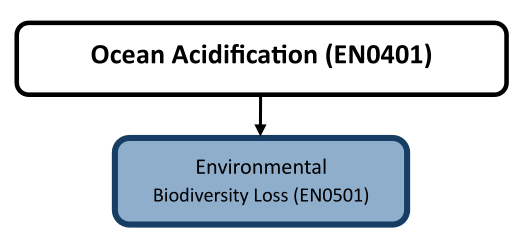
The figure below summarises common interactions between ocean acidification and other hazards. This information should be used with caution and should not be solely relied upon in disaster risk management, particularly as some interactions may not have been included. Note that hazardous events occurring simultaneously or locally in space or time may not necessarily cause, amplify, or be otherwise related to one another. Specific examples of the multi-hazard context can be found in the ‘Hazard drivers’ and ‘Impacts’ sections above.
Multi-hazard diagram
Risk Management
It may be possible to lessen the impacts of ocean acidification on ocean services through mitigation and adaptation strategies for carbon dioxide emissions. This would be informed by appropriate monitoring and improved understanding of natural and human-induced variability, as well as the rate of change, combined with studies of biological impacts. Further investigation is also required, as ocean acidification may act as a stress multiplier when combined with other changes in the marine environment, including changes in temperature and oxygen concentrations.
Monitoring
The section and the table below provide an overview of monitoring for ocean acidification. This information can be used for forecasting within a national early warning system (EWS). Since EWS capacities and processes differ across countries, the most current and specific information regarding EWS should be obtained from the appropriate national or regional agency or authority responsible for disaster management.
| Which institution(s) produce(s) disaster risk data/information? | Global Ocean Acidification Observing Network (GOA-ON - https://goa-on.org/) |
| How is the hazard observed/monitored/forecast? | Remote sensing and satellite monitoring. The Ships of Opportunity Programme also monitors pH, CO₂ and temperature. |
References
IOC, 2018. Update on IOC custodianship role in relation to SDG 14 indicators. Intergovernmental Oceanographic Commission (IOC) of the United Nations Educational, Scientific and Cultural Organization. Accessed 12 February 2025.
IPCC, 2019. UIPCC Special Report on the Ocean and Cryosphere in a Changing Climate. Accessed 12 February 2025.
NOAA, 2024. What is Ocean Acidification? Ocean Facts. Accessed 12 February 2025.
UNESCO, 2023. Ocean Acidification. United Nations Educational, Scientific and Cultural Organization (UNESCO). Ocean Acidification | Intergovernmental Oceanographic Commission. Accessed 12 February 2025.
UNFCCC, 2015. The Paris Agreement. Accessed 12 February 2025.
UNGA, 2015. Transforming Our World: The 2030 Agenda for Sustainable Development. United Nations General Assembly (UNGA). Accessed 12 February 2025.