
Land Degradation
Land degradation is the reduction or loss, in arid, semi-arid and dry sub-humid areas, of the biological or economic productivity and complexity of rainfed cropland, irrigated cropland or range, pasture, forest and woodlands resulting from land uses or from a process or combination of processes, including processes arising from human activities and habitation patterns such as soil erosion caused by wind and/or water; deterioration of the physical, chemical and biological or economic properties of soil; and long-term loss of natural vegetation (UNCCD, 1993).
Primary reference(s)
UNCCD, 1993. Land degradation. United Nations Convention to Combat Desertification (UNCCD). Accessed 19 October 2020.
Annotations
Additional scientific description
Land degradation is the reduction in the capability of the land to produce benefits from a particular land use under a specified form of land management (FAO, 1999).
More than 60% of human-induced land degradation is happening in agricultural lands (cropland and pastureland). Food production is reduced and the entire agrifood system is under pressure. The restoration of agricultural land is a priority to ensure the achievement of several SDGs, such as food security and land degradation neutrality.
In the soil conservation arena, the terms soil degradation and land degradation are sometimes incorrectly used interchangeably, with soil erosion regarded as synonymous with both. However, there is more to soil degradation than just soil erosion, and land represents a broader concept than simply soil. As with its use in the context of land evaluation (FAO, 1976), the term land refers to all natural resources which contribute to agricultural production, including livestock production and forestry. Land thus covers climate, landforms, water resources, soils and vegetation (including both grassland and forests) (FAO, 1999).
There are a number of interrelated land degradation components, all of which may contribute to a decline in agricultural production. The most important according to Douglas (1994) cited by FAO (1999):
- Soil degradation: decline in the productive capacity of the soil as a result of soil erosion and changes in the hydrological, biological, chemical and physical properties of the soil.
- Vegetation degradation: decline in the quantity and/or quality of the natural biomass and decrease in the vegetative ground cover.
- Water degradation: decline in the quantity and/or quality of both surface and groundwater resources.
- Climate deterioration: changes in the micro- and macro-climatic conditions that increase the risk of crop failure.
- Losses to urban/industrial development: decline in the total area of land used, or with potential, for agricultural production as a result of arable land being converted to urban, industrial and infrastructure uses (FAO, 1999).
Examples of causes of different types of land degradation include water erosion, wind erosion, soil fertility decline, waterlogging, salinisation, lowering of the water table, deforestation, forest degradation and rangeland degradation (FAO, 1994).
Soil loss from conventionally tilled land exceeds the rate of soil formation by more than two orders of magnitude (medium confidence). An estimated 3.2 billion people, or a quarter of the world's population, depend directly on land that is being degraded (FAO, 2021).
Metrics and numeric limits
Nachtergaele et al. (2011) reported that there is a plethora of methods, indicators and recent studies concerning specific aspects of land degradation at local and national levels. An inventory carried out by the United Nations Convention to Combat Desertification (UNCCD) revealed more than 900 different land degradation indicators used in a sample of UNCCD countries. Efforts for harmonisation are ongoing. Eleven indicators have been provisionally defined by the UNCCD, and 22 metrics have been selected to be tested for their measurement. Practical monitoring may use any of the following:
- The Land Degradation Assessment in Drylands (LADA) / World Overview of Conservation Approaches and Technologies (WOCAT) participatory assessment methodology can be used at the subnational level. The main parameters describe the state, cause and impact of degradation. At the same time, the type and extent of sustainable land management interventions are inventoried.
- The coupled human-environment promotes the integrated consideration of biophysical and socio-economic parameters linking institutional and policy considerations with land degradation. These consider threshold tipping points beyond which systems can no longer be restored.
- Remote sensing approaches have the significant advantage that data are continuously collected objectively and as such are ideally suited for monitoring purposes. Reliability issues and capacity needs remain as weakness points.
- Local sampling techniques and surveys are objective and the most detailed of all but are more costly and time-consuming (Nachtergaele et al., 2011).
Key relevant UN convention / multilateral treaty
United Nations Convention to Combat Desertification (UNCCD) (UNCCD, 1994).
The UNCCD 2018-2030 Strategic Framework (UNCCD, 2017).
Drivers
Land-use changes and unsustainable land management are direct human causes of land degradation (very high confidence), with agriculture being a dominant sector driving degradation (very high confidence) (Nachtergaele et al., 2011).
The expected increase in the frequency and severity of hazards, such as forest fires, floods, landslides and droughts, may aggravate land degradation (Nachtergaele et al., 2011).
Impacts
Land degradation has both on-site and off-site effects. On-site effects are the lowering of the productive capacity of the land, causing either reduced outputs (crop yields, livestock yields) or the need for increased inputs. Off-site effects of water erosion occur through changes in the water regime, including decline in river water quality, and sedimentation of river beds and reservoirs. The main off-site effect of wind erosion is overblowing, or sand deposition (FAO, 1994).
In their 2019 review on land degradation for the Intergovernmental Panel on Climate Change (IPCC), Olsson et al. (2019) reported that land degradation adversely affects people’s livelihoods (very high confidence) and occurs over a quarter of the Earth’s ice-free land area (medium confidence). The majority of the 1.3 to 3.2 billion affected people (low confidence) are living in poverty in developing countries (medium confidence).
Land degradation affects humans in multiple ways, interacting with social, political, cultural and economic aspects, including markets, technology, inequality and demographic change (very high confidence). Land degradation impacts extend beyond the land surface itself, affecting marine and freshwater systems, as well as people and ecosystems far from the local sites of degradation (very high confidence) (Olsson et al., 2019).
Multi-hazard context
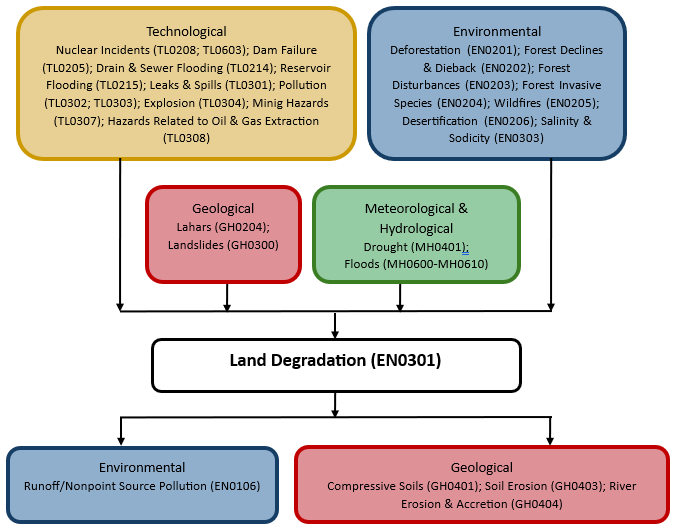
The figure below summarises common interactions between land degradation and other hazards. This information should be used with caution and not be solely relied upon in Disaster Risk Management, particularly as some interactions may not have been included. Note that hazardous events occurring together or locally in space or time may not necessarily cause, amplify, or be otherwise related to each other. Specific examples of multi-hazard context can be found in the ‘Hazard drivers’ and ‘Impacts’ sections above.
Multi-hazard diagram
Risk Management
The Food and Agriculture Organization of the United Nations (FAO) assists member countries in assessing the physical, socio-economic, institutional and legal potential and constraints on land use, with the aim of achieving the optimal and sustainable use of land resources and empowering people to make informed decisions on the allocation of those resources.
In this regard, FAO’s work to reduce land degradation focuses on e.g. promoting sustainable land management practices, enhancing resource-use efficiency, optimising the use of inputs, sustaining the full range of ecosystem functions (e.g. the provisioning of food, fibre and energy; soil health; water quality; cultural values; and biodiversity conservation) and integrated land use planning (FAO, 2020).
Monitoring
No information available
References
Douglas, M.G., 1994. Sustainable Use of Agricultural Soils. A Review of the Prerequisites for Success or Failure. Development and Environment Reports No. 11, Group for Development and Environment, Institute for Geography, University of Berne, Switzerland. DOI:10.1051/agro:2007025. Accessed 21 January 2025.
FAO, 1976. A Framework for Land Evaluation. Food and Agricultural Organization of the United Nations (FAO) Soils Bulletin No. 32. Accessed 21 January 2025.
FAO, 1994. Land degradation in south Asia: Its severity, causes and effects upon the people. In: Types of Land Degradation, Chapter 2. Food and Agricultural Organization of the United Nations (FAO). Accessed 21 January 2025.
FAO, 1999. Poverty alleviation and food security in Asia. In: Land Degradation, Chapter 3. Food and Agricultural Organization of the United Nations (FAO). Accessed 21 January 2025.
FAO, 2020. Land assessment and impacts. Food and Agricultural Organization of the United Nations (FAO). Accessed 21 January 2025.
FAO, 2021. The state of the world land and water resources for food and agriculture (SOLAW). Rome. Accessed 21 January 2025.
Nachtergaele, F., R. Biancalani and M. Petri, 2011. Land degradation: SOLAW Background Thematic Report 3. Accessed 21 January 2025.
Olsson, L., Barbosa, H., S. Bhadwal et al., 2019. Land degradation. In: Shukla, P.R., J. Skea, E. Calvo Buendia and 19 others (eds.), Climate Change and Land: an IPCC special report on climate change, desertification, land degradation, sustainable land management, food security, and greenhouse gas fluxes in terrestrial ecosystems. Accessed 21 January 2025.
UNCDD, 1994. About the Convention, United Nations Convention to Combat Desertification (UNCDD). Accessed 21 January 2025.
UNCDD, 2017. The UNCCD 2018-2030 Strategic Framework. United Nations Convention to Combat Desertification (UNCDD). Accessed 21 January 2025.