
Forest Invasive Species
Forest invasive species are any species that are non-native to a particular forest ecosystem and whose introduction and spread cause, or are likely to cause, socio-cultural, economic or environmental harm, or harm to human health (adapted from FAO, 2015).
Primary reference(s)
FAO, 2015. Invasive species: impacts on forests and forestry. Food and Agriculture Organization of the United Nations (FAO). Accessed March 2024.
Annotations
Additional scientific description
Forest invasive species occur in all major taxonomic groups, from micro-organisms to mammals. These include bacteria, fungi, flatworms, nematodes, insects and arachnids, molluscs, amphibians, reptiles, birds, mammals, grasses, plants, trees and shrubs (FAO, 2009a).
The Food and Agriculture Organization of the United Nations (FAO) reported that (FAO, 2009b):
- Insect pests: The most commonly reported species belong to the orders Coleoptera and Lepidoptera, which together make up over 70% of all insect pest species reported. Hemipteran species were the third most important insect order at 16%. In Africa, Asia and the Pacific, both Coleoptera and Lepidoptera made up the majority of reported pest species. Europe reported more Lepidoptera, while Latin America and the Caribbean reported more Coleoptera.
- Diseases: The majority of species were members of the phylum Ascomycota, which represented almost 60% of all pathogens reported. Basidiomycota species were the next major group at 33%. Four of the regions reported more Ascomycota species, while the Near East reported more Basidiomycota species.
- Other pests: Acarina species were the most common, followed by Artiodactyla species (even-toed ungulates) and Santalales (mistletoes and parasitic plants). Nematodes, rodents and primates were also classified as important pests. Africa reported more primate species, Europe more Artiodactyla, Latin America and the Caribbean more mistletoes and parasitic plants, and the Near East more Acarina species. In the Asia and Pacific region, nematodes and rodents were equally reported.
Plants: Many invasive plants are woody species, including shrubs and trees, and they are among the most widespread and damaging (Richardson & Rejmánek, 2011 as cited in IPBES, 2023). While the exact number of established invasive woody species is unknown, Richardson and Rejmánek (2011; 2013 as cited in IPBES, 2023) compiled a global database listing 751 species-434 trees and 317 shrubs-spanning 90 plant families and 286 genera. These species have spread beyond their native ranges through various pathways, including horticulture (62%: 196 trees and 187 shrubs), forestry (13%), food production (10%) and agroforestry (7%). The regions with the highest numbers of invasive woody species are North America (212 species), the Pacific Islands (208), Australia (203), Southern Africa (178), Europe (134), and the Indian Ocean Islands (126) (IPBES, 2023).
Vertebrates: Invasive vertebrate herbivores have spread to forests in many regions, significantly affecting both aboveground and belowground ecosystems by altering forest community composition. Damage by invasive vertebrates can lead to significant changes in vegetation structure and disrupt nutrient cycling. In addition to direct consumption, these species can introduce novel disturbances not present in native ecosystems, such as trampling vegetation and modifying habitats. These disturbances can result in ecological impacts that often exceed those caused by herbivory alone, leading to profound changes in forest structure, biodiversity and overall ecosystem health (Wardle & Peltzer, 2017).
Metrics and numeric limits
No globally delivered solution is available for this complex issue, but work continues by several organisations.
- In 2023, IPBES published a report on invasive alien species and their control. This report describes key forest invasive species (IPBES, 2023).
- FAO is collecting data presented in the global review of the status of invasiveness of forest tree species outside their native habitat, available in a database format (FAO, 2009c)
- The Global Invasive Species Programme (GISP), established in 1997, supports the implementation of Article 8(h) of the Convention on Biological Diversity. GISP has prepared a global strategy on invasive alien species, which outlines ten strategic responses (Global Invasive Species Database, no date).
Key relevant UN convention / multilateral treaty
Convention on Biological Diversity
Kunming–Montreal Global Biodiversity Framework (2022)
Global Action Plan on Biodiversity and Health, particularly Target 6 and associated actions Decision adopted by the Conference of the Parties to the Convention on Biological Diversity on 1 November 2024.
Intergovernmental Science-Policy Platform on Biodiversity and Ecosystem Services (IPBES)
International Plant Protection Convention (IPPC)
Drivers
Globally, many forests are continually subject to severe outbreaks of invasive species, which can have major environmental and socio-cultural impacts. The threat of forest invasive species is rising due to increasing global trade and travel and is exacerbated by the impacts of climate change.
Impacts
Forest invasive species significantly impact forest ecosystems, threatening their health, productivity and biodiversity. Effective management and protection are crucial to maintaining these essential services and ensuring forests continue to support both the environment and communities worldwide.
Multi-hazard context
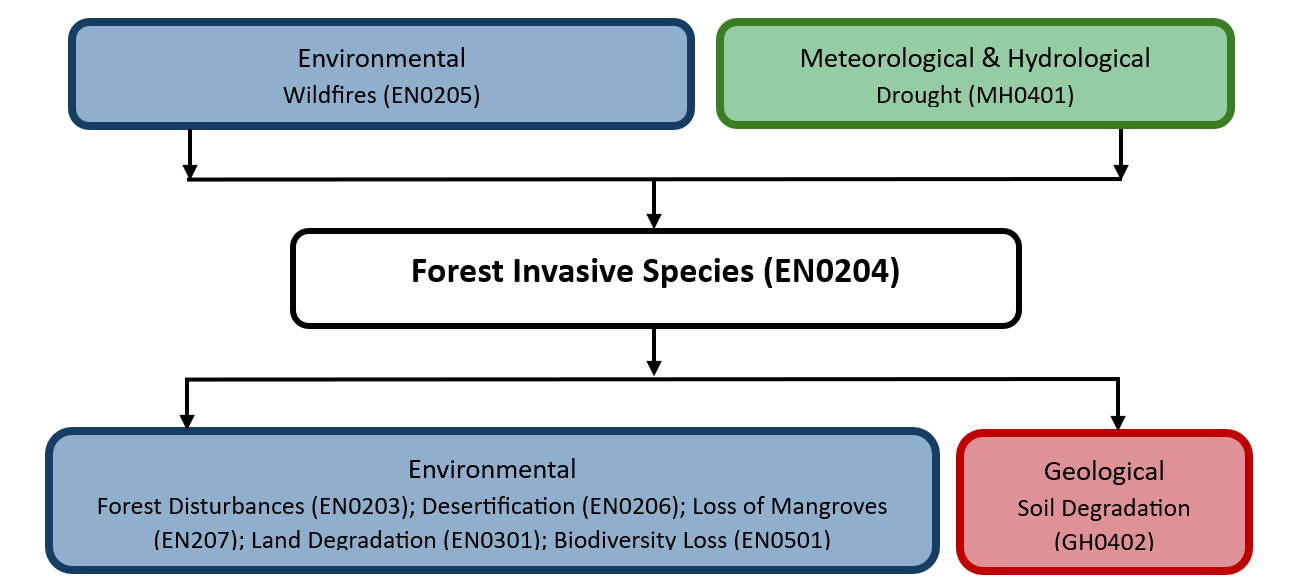
The figure below summarises common interactions between forest invasive species and other hazards. This information should be used with caution and not be solely relied upon in disaster risk management, particularly as some interactions may not have been included. Note that hazardous events occurring together or locally in space or time may not necessarily cause, amplify or be otherwise related to each other. Specific examples of multi-hazard context can be found in the ‘Hazard drivers’ and ‘Impacts’ sections above.
Multi-hazard diagram
Risk Management
It is essential to protect the world’s forests from harm. The global forest area is just over 4 billion ha, representing 31% of the total land area (FAO, 2024a). Managing invasive species and avoiding the introduction of species with known invasive potential require coordinated efforts nationally, regionally and globally (FAO & UNEP, 2020).
Forests provide environmental, economic and social benefits. They yield timber, fuelwood, fibre and other wood and non-wood products, and contribute to rural livelihoods. They offer ecosystem services such as combating desertification, protecting watersheds, regulating climate, maintaining biodiversity, and preserving social and cultural values (FAO, 2024b).
FAO is addressing forest invasive species by:
- Establishing Regional Forest Invasive Species Networks in five regions (Africa, Asia-Pacific, Europe and Central Asia, Latin America and the Caribbean, Near East and North Africa) to facilitate information exchange, awareness, and stakeholder collaboration.
- Developing multiple editions of the Guide to Implementation of Phytosanitary Standards in Forestry, which explains how good forest management and phytosanitary standards can reduce pest spread and support safe trade (FAO, 2011; 2024b).
- Assisting countries in responding to pest outbreaks and establishing long-term forest protection strategies (FAO, 2024c).
- Providing a neutral forum for technical and policy dialogue on invasive species in the forest sector.
- Conducting a review of forest insect pests and diseases in 25 countries across Africa, Asia and the Pacific, Europe, Latin America and the Caribbean, and the Near East (FAO, 2020).
- Publishing reports on global forest health, including insect pests, diseases and invasive species (FAO, 2009b).
- Undertaking fact-finding studies on the invasiveness of forest tree species (FAO, 2018).
- Documenting benefits and drawbacks of Prosopis spp., introduced in dry and semi-arid zones for their survival capacity and land restoration potential (FAO, 2009c).
- Participating in the Inter-agency Liaison Group on Invasive Alien Species (IALG-IAS) under the Convention on Biological Diversity, to coordinate efforts to prevent and mitigate impacts of invasive species (FAO, 2015).
FAO is a member of the Inter-agency Liaison Group on Invasive Alien Species (IALG-IAS) of the Convention on Biological Diversity (CBD) which facilitates cooperation among relevant organisations to support measures to prevent the introduction and mitigate the impacts of invasive alien species (FAO, 2015).
Monitoring
The section and the table below offer an overview of monitoring for forest invasive species. This information can be used for forecasting within a national early warning system (EWS). Since EWS capacities and processes differ across countries, the most current and specific information regarding EWS should be obtained from the appropriate national or regional agency/authority responsible for disaster management.
References
FAO, 2009a. Forest invasive species. Food and Agriculture Organization of the United Nations (FAO). Accessed 19 March 2025.
FAO, 2009b. Global review of forest pests and diseases. Food and Agriculture Organization of the United Nations (FAO), Forestry Paper 156. Accessed 24 October 2020.
FAO, 2009c. Survey of the effects of Prosopis introduction in Sahelian Africa. Food and Agricultural Organisation of the United Nations (FAO). Accessed 19 March 2025.
FAO, 2011. Guide to implementation of phytosanitary standards in forestry. Rome. Accessed 19 March 2025.
FAO, 2015. Invasive species: impacts on forests and forestry. Food and Agriculture Organization of the United Nations (FAO). Accessed 19 March 2025.
FAO, 2018. FAO Forest Health and Biosecurity Working Papers. Food and Agricultural Organisation of the United Nations (FAO). Accessed 19 March 2025.
FAO, 2020. Country Pest Overviews. Food and Agricultural Organisation of the United Nations (FAO). Accessed 19 March 2025.
FAO, 2024a. The State of World's Forests – Forest-sector innovations towards a more sustainable future. Rome. DOI: 10.4060/cd1211en. Accessed 19 March 2025.
FAO, 2024b. Guide to implementation of phytosanitary standards in forestry. Second edition. FAO Forestry Paper No. 164. Rome. DOI: 10.4060/cd3046en. Accessed 19 March 2025.
FAO, 2024c. Forest health and protection. Retrieved March 2024, from Food and Agriculture Organization of the United Nations. Accessed 19 March 2025.
FAO and UNEP, 2020. The State of the World’s Forests: Forests, biodiversity and people. Food and Agriculture Organization of the United Nations (FAO) and United Nations Environmental Programme (UNEP). Accessed 19 March 2025.
Global Invasive Species Database, no date. Accessed 19 March 2025.
IPBES, 2023. Thematic Assessment of Invasive Alien Species and their Control of the Intergovernmental Science-Policy Platform on Biodiversity and Ecosystem Services. Bonn, Germany: IPBES secretariat. DOI: 10.5281/zenodo.7430682. Accessed 19 March 2025.
Soto-Navarro, C.A., Harfoot, M., Hill, S.L.L., Campbell, J., Campos Santos, H.-C., Mora, F., Pretorius, C., Kapos, V., Allison, H. and Burgess, N.D., 2020. Building a Multidimensional Biodiversity Index – A scorecard for biodiversity health. Project report. UN Environment Programme World Conservation Monitoring Centre (UNEP-WCMC), Cambridge, UK and Luc Hoffmann Institute (LHI), Gland, Switzerland. Accessed 19 March 2025.
Wardle, D.A., Peltzer, D.A., 2017. Impacts of invasive biota in forest ecosystems in an aboveground–belowground context. Biological Invasions, 3301–3316. DOI: 10.1007/s10530-017-1372-x Accessed 19 March 2025.