Forest Disturbances
Forest disturbance is the damage caused by any factor (biotic or abiotic) that adversely affects the vigour and productivity of the forest, and which is not a direct result of human activities. It includes disturbance by insect pests, diseases, severe weather events and fires (FAO, 2018; 2020).
Primary reference(s)
FAO, 2018. Global Forest Resources Assessment 2020. Terms and Definitions FRA 2020. Food and Agricultural Organisation of the United Nations (FAO), Forest Resources Assessment Working Paper No. 188. Accessed 12 February 2025.
FAO, 2020. Global Forest Resources Assessment 2020: Main report. Food and Agricultural Organisation of the United Nations (FAO). DOI: 10.4060/ca9825en. Accessed 12 February 2025.
Annotations
Additional scientific description
Forest area is defined by the Food and Agriculture Organization of the United Nations (FAO) as: land spanning more than 0.5 ha with trees higher than 5 m and a canopy cover of more than 10%, or trees able to reach these thresholds in situ. It does not include land that is predominantly under agricultural or urban land use (FAO, 2018).
The world's total forest area is approximately 4.06 billion ha, which is 31% of the total land area. This area is equivalent to 0.52 ha per person. Forests are not distributed equally among the world's people or geographically. The tropical domain has 45% of the world's forests. It should also be noted that more than half (54%) of the world's forests are in only five countries: the Russian Federation, Brazil, Canada, the United States of America and China (FAO, 2020).
Forest disturbances include areas of forest affected by:
(i) Insects - disturbance caused by insect pests;
(ii) Diseases - disturbance caused by pathogens, such as bacteria, fungi, phytoplasma or viruses;
(iii) Severe weather events - disturbance caused by abiotic factors, such as snow, storms, droughts, etc.;
(iv) Fire - forest area affected by fire (FAO, 2018).
Forest degradation does not have a single commonly agreed definition but is considered to occur when forest ecosystems lose their capacity to provide important goods and services to people and nature (IUCN, 2017).
Measuring forest degradation and disturbance is challenging. There is no commonly agreed definition or monitoring method. Degradation and disturbances can entail long-term negative changes in the structure, composition and other characteristics of the forest which can be difficult to detect.
Metrics and numeric limits
The Global Forest Resources Assessment 2020 noted that relatively few data were available for forest disturbance and that it was not possible to estimate accurately the total forest area affected by disturbances globally (FAO, 2020). Only 36 countries and territories, accounting for just 25% of the world’s forest area, reported complete time-series data for the forest area disturbed annually by insects (2000–2017). Therefore, further discussion is warranted on how best to obtain and analyse data and whether more information is needed to properly assess forest disturbance (FAO, 2020).
Key relevant UN convention / multilateral treaty
Convention on Biological Diversity (CBD): Established in 1992 and entered into force on 29 December 1993. The convention has three main objectives: the conservation of biological diversity; the sustainable use of the components of biological diversity; and the fair and equitable sharing of the benefits arising out of the utilisation of genetic resources (CBD, no date).
United Nations Convention to Combat Desertification (UNCCD): Established in 1994 to protect and restore land and ensure a safer, just and more sustainable future. The UNCCD is the only legally binding framework set up to address desertification and the effects of drought. The Convention – based on the principles of participation, partnership and decentralisation – is a multilateral commitment to mitigate the impact of land degradation and protect our land so we can provide food, water, shelter and economic opportunity to all people (CCD, no date).
United Nations Framework Convention on Climate Change (UNFCCC): Negotiated from February 1991 to May 1992 and entered into force on 21 March 1994. It seeks to reduce atmospheric concentrations of greenhouse gases, with the aim of preventing dangerous anthropogenic interference with the Earth’s climate system. At the Conference of the Parties (COP21) in Paris, on 12 December 2015, Parties to the UNFCCC reached a landmark agreement to combat climate change and to accelerate and intensify the actions and investments needed for a sustainable low-carbon future (UNFCCC, 2015).
Drivers
Forests face many disturbances that can adversely affect their health and vitality and reduce their ability to provide a full range of goods and ecosystem services.
Forests face many disturbances that can adversely affect their health and vitality and reduce their ability to provide a full range of goods and ecosystem services.
About 98 million ha of forest were affected by fire in 2015 (the latest available global dataset). This was mainly in the tropical domain, where fire burned about 4% of the total forest area in that year. More than two-thirds of the total forest area affected was in Africa and South America (FAO, 2020). In Canada, since 1900, wildfires have consumed an average of 2.5 million ha per year (NRC, no date). In Europe, in 2018, 58,016 fires consumed 350,180 ha, compared to an average of 64,261 fires consuming 406,281 ha per year between 2008 and 2017 (JRC, 2018).
The Global Forest Resources Assessment 2020 noted the extent of different types of disturbance in the forests of the world in 2015 (FAO, 2020).
- 51 countries, representing 42% of the world's forest area, reported that 6.6 million ha (0.4% of the forest area of the reporting countries) were affected by disease.
- 62 countries, representing 52% of the world's forest area, reported that 30.2 million ha (1.4% of the forest area of the reporting countries) were affected by insects.
- 48 countries, representing 37% of the world's forest area, reported that 3.8 million ha (0.3% of the forest area of the reporting countries) were affected by severe weather events (FAO, 2020).
Air, water and soil pollution can also contribute to forest degradation. For example, acid rain, resulting from the interaction of sulphur dioxide and nitrogen oxides (mostly produced by the burning of fossil fuels, but also from volcanic eruptions) with water in the atmosphere, damages trees and forests (Zhang, 2023). Acid rain leaches aluminium from the soil, and that aluminium can be toxic to plants, including trees. In addition, other nutrients are also removed from the soil by acid rain, limiting tree growth. At high elevations, acidic fog and clouds might strip nutrients from foliage, leaving trees with brown or dead leaves and needles. The trees are then less able to absorb sunlight, making them weak and less able to withstand freezing temperatures (US EPA, no date).
Impacts
Over 80% of the world’s terrestrial biodiversity can be found in forests. Forest disturbance can threaten the survival of many species and reduce the ability of forests to provide essential services such as clean air and water, healthy soils for agriculture, and climate regulation. Additionally, forests support the livelihoods of 1.6 billion people globally, one billion of whom are among the world’s poorest (IUCN, 2017).
Multi-hazard context
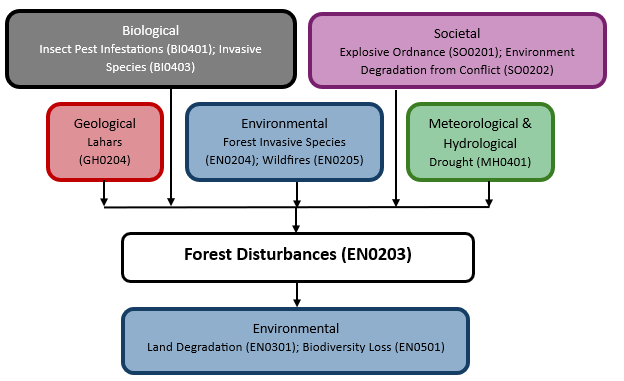
The figure below summarises common interactions between forest disturbances and other hazards. This information should be used with caution and not be solely relied upon in disaster risk management, particularly as some interactions may not have been included. Note that hazardous events occurring together or locally in space or time may not necessarily cause, amplify or be otherwise related to each other. Specific examples of multi-hazard context can be found in the ‘Hazard drivers’ and ‘Impacts’ sections above.
Multi-hazard diagram
Risk Management
Many countries have developed policies and laws designed to promote the sustainable and multipurpose use of forests and trees. Such policies and laws serve as a foundation for sustainable forest management by, for example, promoting legal timber trade, involving stakeholders in forest management, addressing forest tenure, and providing incentives (FAO, 2020).
Monitoring
The section and the table below offer an overview of monitoring for forest disturbances. This information can be used for forecasting within a national early warning system (EWS). Since EWS capacities and processes differ across countries, the most current and specific information regarding EWS should be obtained from the appropriate national or regional agency/authority responsible for disaster management.
| Which institution(s) produce(s) disaster risk data/information? | National forest agencies |
| How is the hazard observed/monitored/forecast? | Ground surveys and remote sensing. Global Forest Watch is an online platform that provides data and tools for monitoring forests. |
References
CBD, no date. Convention on Biological Diversity. The Convention on Biological Diversity. Accessed 12 February 2025.
CCD, no date. Convention to Combat Diversification. Convention | UNCCD. Accessed 12 February 2025.
FAO, 2018. Global Forest Resources Assessment 2020. Terms and Definitions FRA 2020. Food and Agricultural Organisation of the United Nations (FAO). Forest Resources Assessment Working Paper No. 188. Accessed 12 February 2025.
FAO, 2020. Global Forest Resources Assessment 2020: Main report. Food and Agricultural Organization of the United Nations (FAO). Accessed 12 February 2025.
IUCN, 2017. Issues Brief: Deforestation and Degradation. International Union for Conservation of Nature (IUCN). Accessed 12 February 2025.
JRC, 2018. Annual Report: Forest Fires in Europe, Middle East and North Africa 2018. European Commission Joint Research Centre (JRC). Technical Report. Accessed 12 February 2025.
NRC, no date. Forest Fires. Natural Resources Canada (NRC). Accessed 12 February 2025.
UNFCCC, 2008. Informal meeting of experts on methodological issues related to forest degradation. Chair’s summary of key messages. United Nations Framework Convention on Climate Change (UNFCCC). Accessed 12 February 2025.
UNFCCC, 2015. Paris Agreement. United Nations Framework Convention on Climate Change (UNGCC). Accessed 12 February 2025.
US EPA, no date. Acid Rain: Acid Rain Basics. United States Environmental Protection Agency (US EPA). Accessed 12 February 2025.
Zhang, L., 2023. Effects of acid ran on forest organisms and countermeasures. Highlights in Science, Engineering, and technology 69. (PDF) Effects of Acid Rain on Forest Organisms and Countermeasures. Accessed 12 February 2025.