
Forest Declines and Diebacks
Forest declines and diebacks are episodic events characterised by premature, progressive loss of tree and stand vigour and health over a given period without obvious evidence of a single clearly identifiable causal factor such as physical disturbance or attack by primary disease or insect (Ciesla & Donaubauer, 1994).
Tree declines can be described as the gradual deterioration of plant tissues over time, triggered by a series of adverse events such as abiotic stress, climate deregulation, the emergence of new pathogens, biological invasions and agricultural strategies. Declines may also be seen as a long-term reduction of wood or fruit productivity, leading (or not) to sudden tree mortality, occasionally referred to as dieback (Bettenfeld et al., 2020).
Primary reference(s)
Ciesla, W.M. and Donaubauer, M.E. 1994. Decline and dieback of trees and forests: a global overview. FAO Forestry Paper No. 120. Accessed 13 February 2025.
Bettenfeld, P., Fontaine, F., Trouvelot, S., Fernandez, O., & Courty, P.-E., 2020. Woody Plant Declines. What’s Wrong with the Microbiome? Trends in Plant Science, 25(4), 381-394. DOI: 10.1016/j.tplants.2019.12.024. Accessed 13 February 2025.
Annotations
Additional scientific description
Forest decline is characterised by the presence of symptoms such as reduced growth, shortened internodes, root necrosis, premature fall colouring in temperate forests, yellowing and loss of foliage, dieback of twigs and branches generally beginning in the upper crown, sprouting from adventitious buds, and/or increased prevalence and pathogenicity of root decay fungi (Manion & Lachance, 1992).
The decline has been considered a symptom of disease, a distinct class of disease, and as part of forest dynamics. Another widely accepted concept describes decline as a result of the interaction of predisposing, inciting and contributing factors (Manion & Lachance, 1992). Predisposing factors are often of long-term duration with slowly changing factors such as soil, site and climate. These factors alter the ability of trees to withstand or respond to injury-inducing agents.
Compared with less complex or non-multifactorial diseases, it is difficult to define a state of decline just by looking at its symptoms, since these can vary widely depending on the species or individual tree. Because they result from multiple factors working together, it is difficult to link specific symptoms to a single cause. In most cases, the entire tree is affected over time, with damage spreading from one part to another, eventually impacting its overall health. This can lead to visible signs such as major biomass loss, as seen in poplar and ash, or a reduction in fruit quality and quantity, as in grapevines and olive trees (Bettenfeld et al., 2020).
Metrics and numeric limits
The Food and Agriculture Organization of the United Nations (FAO) has been monitoring the world's forests at 5- to 10-year intervals since 1946. FAO's Global Forest Resources Assessments (FRA) have been produced every five years in an attempt to provide a consistent approach to describing the world's forests and how they are changing.
The guidelines and specifications for FAO's FRAs have been adapted both in scope and reporting regularity to better respond to recent developments in the international forest policy arena, such as the United Nations' 2030 Agenda for Sustainable Development, the United Nations Strategic Plan for Forests 2017-2030, and the 2015 Paris Agreement. Furthermore, the reporting content has been streamlined, and a new online reporting platform has been developed to make reporting more efficient and to decrease countries' reporting burden (FAO & UNEP, 2020).
Key relevant UN convention / multilateral treaty
UN Climate Change Convention: At the Conference of the Parties (COP21) in Paris, on 12 December 2015, Parties to the United Nations Framework Convention on Climate Change (UNFCCC) reached a landmark agreement to combat climate change and to accelerate and intensify the actions and investments needed for a sustainable low-carbon future.
Drivers
Multiple factors such as insect pest and disease outbreaks (Morand & Lajaunie, 2021), and extreme weather events such as drought, are considered the main causes of forest decline and diebacks. However, human activities such as pollution, urbanisation and encroachments on sensitive habitats can exacerbate what would ordinarily be cyclical occurrences of these factors. Forest decline can be hastened and worsened as the forest ecosystem becomes less resilient and more sensitive to changes, whether natural or anthropogenic (Martínez-Vilalta et al., 2012; DeSantis et al., 2016; Morand & Lajaunie, 2021).
Forest declines and diebacks result from complex interactions between multiple hazards, both biotic and abiotic, which can be further intensified by anthropogenic stressors. Abiotic stressors include drought, water deficiency, soil degradation, pollution, storms, fires, heatwaves, frost and late snow events. Biotic stressors include invasive insect pests, plants, pathogens and mammals.
Impacts
The complexity of declines and diebacks makes it challenging to quantify their impact, and as a result, available data remain limited and require further development.
Forest dieback has far-reaching impacts beyond the loss of trees. It disrupts the intricate web of ecological relationships within forests, affecting wildlife populations, soil fertility, water cycles and the livelihoods of communities that depend on forest resources (UNU-EHS, 2023).
Multi-hazard context
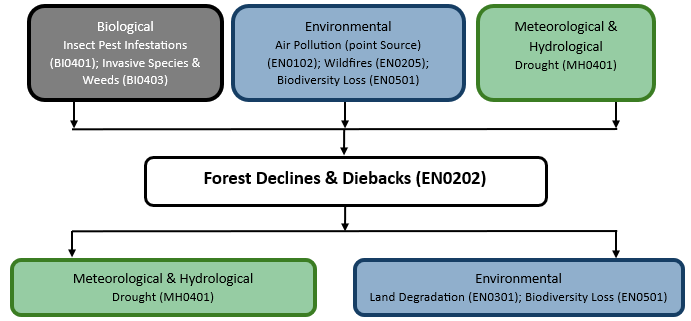
The figure below summarises common interactions between forest declines and diebacks and other hazards. This information should be used with caution and not be solely relied upon in disaster risk management, particularly as some interactions may not have been included. Note that hazardous events occurring together or locally in space or time may not necessarily cause, amplify or be otherwise related to each other. Specific examples of multi-hazard context can be found in the ‘Hazard drivers’ and ‘Impacts’ sections above.
Multi-hazard diagram
Risk Management
Risk management includes sustainable forest management to establish resilient forest ecosystems, establish early warning and early action systems for pests and diseases, and increase community participation in forest management.
Early warning systems (EWS) for forest decline and dieback rely on detecting subtle signs of ecosystem stress before significant damage occurs. Forests are exposed to various pressures, including climate change, pests, pollution and human disturbances, which can trigger forest declines (Dong & Fang, 2024).
Physiological changes, such as shorter growing periods, reduced carbon and water-use efficiency, and hydraulic failure, often precede visible decline. Researchers use statistical methods such as lag-1 autocorrelation and spatial analysis to identify critical slowing down, which signals reduced ecosystem recovery capacity and potential tipping points. Remote sensing, particularly NDVI monitoring, helps track vegetation health over time, offering a robust tool for early detection (Alibakhshi, 2023; Dong & Fang, 2024).
However, challenges remain in refining these methodologies to reduce false alarms and improve real-world applications. Advances in remote sensing and spatial-temporal analysis are enhancing the accuracy of EWS, making them essential for proactive forest management.
Monitoring
The section and the table below offer an overview of monitoring for forest declines and diebacks. This information can be used for forecasting within a national early warning system (EWS). Since EWS capacities and processes differ across countries, the most current and specific information regarding EWS should be obtained from the appropriate national or regional agency/authority responsible for disaster management.
| Which institution(s) produce(s) disaster risk data/information? | National forest agencies |
| How is the hazard observed/monitored/forecast? | Ground surveys and remote sensing. The Global Forest Watch is an online platform that provides data and tools for monitoring forests. |
References
Alibakhshi, S., 2023. A robust approach and analytical tool for identifying early warning signals of forest mortality. Ecological Indicators, 155. DOI: 10.1016/j.ecolind.2023.110983. Accessed 13 February 2025.
Bettenfeld, P., Fontaine, F., Trouvelot, S., Fernandez, O., and Courty, P.-E. (2020, April). Woody Plant Declines. What’s Wrong with the Microbiome? Trends in Plant Science, 25(4), 381-394. DOI: 10.1016/j.tplants.2019.12.024. Accessed 13 February 2025.
Ciesla, W.M. and M.E. Donaubauer, 1994. Decline and dieback of trees and forests: a global overview. FAO Forestry Paper No. 120. Accessed 13 February 2025.
DeSantis, R.D., W. Moser and W. Keith, 2016. Maintenance of forest ecosystem health and vitality. In: Shifley, S.R., P.D. Manion and D. Lachance, 1992, Forest Decline Concepts. No. 634.96 F716. American Phytopathological Society.
Dong, Y., and Fang, O., 2024. Decreasing resistance as an early warning signal of forest declines in the Qilian Mountains. Biological Conservation, 299. DOI: 10.1016/j.biocon.2024.110809. Accessed 13 February 2025.
FAO and UNEP, 2020. The State of the World’s Forests: Forests, biodiversity and people. Food and Agricultural Organization of the United Nations (FAO) and United Nations Environment Programme (UNEP).
Manion, P.D. and D. Lachance (eds.), 1992. Forest Decline Concepts, APS Press.
Martínez-Vilalta, J., F. Lloret and D.D. Breshears, 2012. Drought-induced forest decline: causes, scope and implications. Biology Letters, 8:689-691.
Morand, S., and Lajaunie, C., 2021. Outbreaks of Vector-Borne and Zoonotic Diseases Are Associated With Changes in Forest Cover and Oil Palm Expansion at Global Scale. Front. Vet. Sci. 8:661063. doi: 10.3389/fvets.2021.661063. Outbreaks of Vector-Borne and Zoonotic Disease. Accessed 13 February 2025.
Steinkamp, J. and T. Hickler, 2015. Is drought-induced forest dieback globally increasing? Journal of Ecology, 103:31-43.
United Nations University’s Institute for Environment and Human Security (UNU-EHS). 2023, June 14. 5 Things You Need to Know About Forest Die-back. Accessed 13 February 2025.